Trading card businesses that handle graded slabs by the hundreds each day face a familiar bottleneck: manually transcribing label details and staging photos for listings. A Portland, Maine-based infrastructure company is rolling out upgrades designed to remove both of those steps from the workflow entirely.
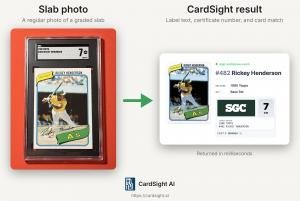
Graded trading card labels are now returned by CardSight AI
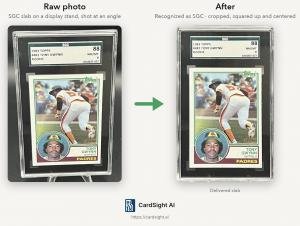
CardMagic takes a standard picture of a graded trading card from any camera or cell phone and creates a clean, listing-ready image
Also worth a look: Oriient maps 1,000+ Australian grocer stores with software-only indoor GPS and Paulin Research Group founder Tony Paulin wins ASME B31 Forever Medal for piping standards work.
CardSight now reads every line of text on a graded slab label, and CardMagic now turns a phone photo of a slab into a listing-ready image.
Milliseconds matter when your business is processing hundreds or thousands of trading cards per day. CardSight reads a full slab label in milliseconds, so every slab moves through faster.”— Eric Nusbaum, Co-Founder & CEO of CardSight AI, Inc.PORTLAND, ME, UNITED STATES, October 22, 2026 /EINPresswire.com/ — CardSight AI, Inc., the trading card infrastructure platform, today announced two updates that help trading card businesses speed up the work they already do with graded slabs. CardSight, the company's identification product, now reads all of the text on a graded slab label, returning results in milliseconds. CardMagic, which turns phone photos into listing-ready images, now supports full slab images as well. Both are available now through the CardSight AI API, with no new hardware and no new subscription required.
Graded trading cards carry real value, and every slab that moves through a business gets handled twice. Someone has to capture what the label says, and someone has to photograph the slab for a listing or an inventory record. Businesses have solved this with manual typing, OCR software, dedicated scanning hardware, or costly subscriptions. These updates handle both steps automatically, inside the workflow a business already runs.
Every line of the label, read in one pass
CardSight identifies a trading card from a photo, and for graded slabs it returns the certificate number for all major grading companies, including PSA, BGS, SGC, CGC, and TAG. It now reads all of the text printed on the slab label as well. Graded sports cards, graded Pokémon cards, and other graded trading cards come back with their label details already captured, so no one has to retype them.
The full result, label text included, returns in milliseconds. Until now, businesses that needed slab label data have relied on optical character recognition (OCR) software or general-purpose AI services to read each label, and both get slow and expensive at volume. CardSight can replace those steps with a single API call, reading slab label text up to 10 times faster than general-purpose AI services at a fraction of the price. For a business working through slabs by the hundreds, the difference shows up in both turnaround time and the monthly bill.
Full slab images in CardMagic
CardMagic launched in September to turn a phone photo of raw trading cards into clean, centered listing images. It now handles graded slabs too. A seller can take a regular photo of a slab with the phone already in their pocket, or use photos they already have, and CardMagic returns a cropped, straightened, and centered image of the full slab, ready to post. There is no light box to set up, no scanner to feed, and no photo to fix by hand in an editor.
Buyers pay for graded trading cards based on what they can see, so consistent, professional images matter. Until now, getting them has meant a camera stand, a light box, or dedicated hardware. CardMagic delivers listing-ready slab images from the equipment sellers already own.
Better processes, not new equipment
The idea behind both updates is the same. Trading card businesses already have processes that work, and the goal is to make those processes faster without asking anyone to buy something new. An online seller can go from a stack of slabs to finished listings with a phone. A trading card shop can take in a collection and capture each slab's label details and image at the counter, ready for its inventory system or its own website. A collection app can add graded trading cards to a user's collection from a single photo, with the label already read.
The savings add up across every slab. A seller who no longer retypes label details or builds a photo setup gets time back on each listing, and a business that avoids dedicated hardware and another subscription keeps that cost out of its margins. For marketplaces and apps, faster slab intake means listings go live sooner.
One trading card API for developers
For developers, both updates are part of the same CardSight AI trading card API and sports card API that apps already use. CardMagic comes from the same API key and the same subscription, runs on standard API calls, and is included on every plan, including the free tier. Developers can pair each slab image and its label data with the trading card's record in the CardSight AI trading card catalog, a trading card database of more than 15 million trading cards, and with transparent market data, all from a single provider. Apps that already use CardSight AI for sports card identification and Pokémon identification get these updates without adding a new vendor. CardSight AI provides SDKs for Node.js, Python, Swift, Java, and .NET, and identifies more than 10,000 sets across sports cards and trading card games, including baseball, football, basketball, hockey, soccer, MMA, Pokémon, Magic: The Gathering, and One Piece.
"Milliseconds matter when your business is processing hundreds or thousands of trading cards per day," said Eric Nusbaum, Co-Founder and CEO of CardSight AI. "CardSight reads a full slab label in milliseconds, so every slab moves through faster and costs less to process. And with CardMagic handling slab photos, a phone is all a seller or a shop needs to turn a stack of graded trading cards into finished listings."
Availability
Both updates are available now through the CardSight AI API. CardSight reads slab label text as part of identification, and CardMagic slab support is available for every CardSight AI subscriber, including accounts on the free tier. Developers can start for free at https://cardsight.ai, explore the API in the browser at https://play.cardsight.ai, and review the API documentation.
About CardSight AI
CardSight AI, Inc. is a trading card identification and data infrastructure company based in the Portland, Maine area. Its platform combines fast, accurate trading card identification, the CardSight AI trading card catalog of more than 16 million trading cards, and transparent market data. Developers get all three through a single trading card API, with SDKs and MCP endpoints for AI agents and LLM integrations. CardSight AI is a member of the NVIDIA Inception program and the Founder Residency at the Roux Institute at Northeastern University. Learn more at https://cardsight.ai.
Eric Nusbaum
CardSight AI, Inc.
+1 207-699-4565
Visit us on social media:
LinkedIn
Instagram
X
Other
Why it matters: For independent sellers, card shops, and marketplace developers alike, this removes two of the most tedious manual tasks in the graded card trade—label transcription and photo staging. By folding these capabilities into an existing API at no extra cost, CardSight AI is positioning itself as a one-stop infrastructure layer that could reshape how efficiently the secondary market processes high-volume inventory.