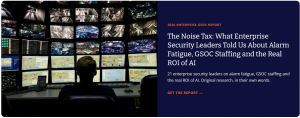
There’s a breaking point in enterprise security operations, and a new industry report suggests it has already arrived. Security teams are being buried under an avalanche of alerts they can no longer afford to investigate, even as the financial resources to address the problem are evaporating.
with Cobalt Monitoring Intelligence (CMI)
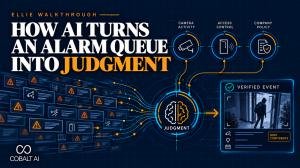
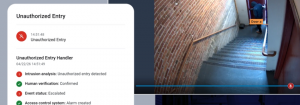
Judgment in Action: Intruder
Also worth a look: Vitek IP puts CodeScribe’s medical simulation patent portfolio on the market and Equator’s new freestanding dishwasher targets flexible kitchens with 14-place capacity.
Cobalt AI’s 2026 Enterprise GSOC Report: 71% of security leaders interviewed describe alarm overload; none who described their budget reported growth
What struck us most is that no one asked for more alerts. They instead asked for judgment: every event put in context, checked against their own policies and prioritized the moment it happens.”— Ken Wolff, Chief Executive Officer of Cobalt AISAN FRANCISCO, CA, UNITED STATES, October 22, 2026 /EINPresswire.com/ — Cobalt AI, the real-time AI physical security company, today released “The Noise Tax: 2026 Enterprise GSOC Report.” The report is based on recorded, in-depth conversations with 21 enterprise security leaders, including chief security officers, heads of global security, GSOC leaders and the advisors who serve them.
The report uncovered what leaders are experiencing in their operations: the Noise Tax, the hidden cost an organization pays when alarm volume outruns the people and systems available to judge it, from operator hours spent clearing false and nuisance alarms to real events missed because they look like the noise around them to budget spent on headcount instead of better capability.
Key findings include:
• Alarm overload is widespread. 71% of leaders described alarm overload, and 42% described alarms that are ignored, auto-cleared or no longer answered. At one enterprise, operators spend about 6 seconds on alarms that need minimum 1 to 1.5 minutes to check properly.
• Budgets are not keeping pace. 95% discussed budget or ROI pressure. Of leaders who described their budget, 55% reported cuts and none reported growth. 53% said funding arrives only after an incident.
• People remain hard to fund. 86% raised staffing shortages, guard cost or guard reliability.
• Leaders want context and prioritization. 95% want technology that puts events in context and ranks them by criticality, and 74% named decisions that must stay with a person, most often response to a live threat.
• Integration wins over replacement. 76% run fragmented camera, access control and alarm systems and want more from the infrastructure they already own.
• AI adoption is early. No leader in the study had deployed AI broadly in security operations, and two thirds said leadership mindset slows change more than technology does.
“The security leaders we spoke with asked for judgment,” said Ken Wolff, Chief Executive Officer of Cobalt AI. “They want every event put in context and checked against their own policies the moment it happens, with the decisions that count handed to their people with the full picture attached. This report is not about us. It is about what security leaders told us, in their own words.”
The report contrasts its findings with large industry surveys. Where surveys report rising budgets and AI as a top investment priority, the leaders interviewed described flat or falling budgets, fragmented systems and AI that has not yet reached the operations floor.
The report also offers seven GSOC best practices for 2026, drawn from what the most advanced programs in the study already do:
– measure your noise first
– fix noise at the source
– judge events against your own policy in real time
– automate the routine and keep people on response
– send context with every escalation
– modernize incrementally
– report in business terms.
The report also includes a GSOC maturity self-assessment that security teams can use to place their own programs.
Participants and their organizations are anonymized, and quotes are attributed by role and industry only. Participants represent financial services, technology, life sciences, retail, manufacturing, defense, energy, real estate and professional services.
The Noise Tax: 2026 Enterprise GSOC Report is available now on the Cobalt AI website. Organizations can also request a Noise Assessment, which analyzes alarm activity from existing cameras and access control to show how much is noise, what is causing it, and the operator hours and dollars that could be recovered, or book a demo to see real-time judgment on the systems they already run. Download now https://www.cobaltai.com/learning-insights/noise-tax/gsoc-report/ or sign up for a demo of how Cobalt AI can help you. https://www.cobaltai.com/book-demo/
About Cobalt AI
Cobalt AI is the AI Real Time Security Monitoring platform that helps physical security teams accelerate judgment. Cobalt Monitoring Intelligence compares camera, access control and company policy in real time, so teams see what matters, fix the causes of noise, and keep people in the loop on the decisions that count. It works with the hardware you already own, with no rip-and-replace, and is available through Cobalt’s Command Center or as self-managed SaaS. Learn more at cobaltai.com.
Inga Broerman
Cobalt AI
+1 202-705-9692
Visit us on social media:
LinkedIn
YouTube
Why it matters: The disconnect between what security leaders experience on the ground and what larger industry surveys suggest could leave organizations dangerously exposed. If budgets continue to shrink while alarm volumes grow, the risk of missed genuine threats becomes a structural problem, not just an operational annoyance. The report’s emphasis on working with existing infrastructure and measuring noise first offers a pragmatic path for teams that cannot wait for budget relief.