The global appetite for frozen dinners, temperature-sensitive drugs, and online grocery deliveries is reshaping an industry most consumers never see: cold storage equipment. New data from The Business Research Company shows this behind-the-scenes sector is already worth more than $60 billion and accelerating fast.

The Business Research Company’s Cold Storage Equipment Market Report 2026 – Market Size, Trends, And Global Forecast 2026-2035
The cold storage equipment industry has seen notable expansion in recent years, propelled by the growing necessity to preserve perishable goods efficiently. As demand for frozen foods, pharmaceuticals, and retail infrastructure rises, this sector appears poised for continued advancement. A closer look reveals the market size, key growth drivers, segmentation, emerging trends, regional dynamics, and leading players that are shaping this industry.
Also worth a look: Cross-linking agent market set to hit $13.53 billion by 2030 as construction and EV demand surge and Corporate training market hits $410B as AI upskilling becomes a job security necessity.
Steady Growth in the Cold Storage Equipment Market Size
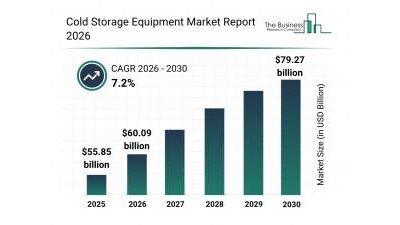
The market has demonstrated significant momentum, climbing from $55.85 billion in 2025 to an estimated $60.09 billion in 2026 — a compound annual growth rate (CAGR) of 7.6%. Analysts attribute this upward trajectory during the historical period to rising frozen food consumption, expansion in pharmaceutical cold chains, growth in retail and supermarket infrastructure, heightened demand to preserve perishable food items, and increased food processing activities.
Download a free sample of the cold storage equipment market report:
https://www.thebusinessresearchcompany.com/sample_request?id=28621221&type=smp&name=Cold%20Storage%20Equipment%20Market%20Report%202026&utm_source=EINPresswire&utm_medium=Paid&utm_campaign=Nov_PR
Future Market Growth Expectations for Cold Storage Equipment
Looking ahead, the market is forecast to sustain its robust growth, reaching $79.27 billion by 2030 at a CAGR of 7.2%. This expansion is expected to be fueled by rising demand for temperature-sensitive biologics, the growth of organized retail and e-commerce grocery sectors, increased investments in cold chain infrastructure, a surge in demand for energy-efficient refrigeration systems, and wider adoption of automated cold storage solutions. Key trends likely to shape the market include the uptake of energy-efficient refrigeration, modular cold storage units, ultra-low temperature storage options, advanced insulation materials, and rapid freezing technologies.
Growing Consumer Demand Fuels Market Expansion
A primary force driving the cold storage equipment market is the increasing consumer appetite for frozen and processed foods. These products rely on preservation methods such as freezing, cooking, or canning to extend shelf life and offer convenience. As busy lifestyles reduce time for meal preparation, consumers are gravitating toward ready-to-eat or easy-to-prepare food options. This behavioral shift creates a heightened need for temperature-controlled storage to maintain product quality and curb spoilage. For example, in July 2026, the UK’s Department for Environment, Food & Rural Affairs (Defra) reported a 6.8% increase in imports of highly processed food and beverages in 2025, underscoring the growing market demand.
View the full cold storage equipment market report:
https://www.thebusinessresearchcompany.com/report/cold-storage-equipment-market-report?utm_source=EINPresswire&utm_medium=Paid&utm_campaign=Nov_PR
Cold Storage Market Segmentation Explored
The report divides the cold storage equipment market into several core categories:
1) By Type: Including blast freezers and chillers, refrigerated containers, modular cold storage units, walk-in coolers and freezers, chilling tunnels, and other equipment types.
2) By Installation Type: New installations versus retrofit installations.
3) By Temperature Range: Categorized as chilled (0°C to 15°C), frozen (-18°C to 0°C), and deep frozen (below -18°C).
4) By Sales Channel: Direct sales, distributors and dealers, and online sales.
5) By End Use Industry: Covering food and beverage, pharmaceutical and healthcare, agriculture and horticulture, hospitality, retail and supermarkets, and other sectors.
Additional subsegments cover specific product types such as various blast chillers (reach-in, roll-in, spiral, cabinet, plate), refrigerated container types (standard, high cube, controlled atmosphere, portable, offshore), modular cold rooms and freezer rooms, different walk-in cooler/freezer configurations, chilling tunnel variations, and other specialized equipment like cryogenic freezers and refrigerated display cabinets.
Innovations and Trends Shaping the Cold Storage Equipment Industry
Industry leaders are concentrating on creating advanced cold storage solutions to enhance product preservation and cold chain efficiency. These innovations include climate-controlled storage facilities, refrigerated chambers, rapid cooling tunnels, and precooling systems designed to extend shelf life and reduce losses. For instance, in July 2025, Denmark’s A.P. Moller – Maersk inaugurated a new packing and cold chain logistics center in Olmos, Peru, featuring 17,500 square meters of space equipped with climate-controlled and refrigerated rooms, rapid cooling tunnels, and specialized precooling systems aimed at maintaining optimal conditions for fresh fruit exports like blueberries.
Regions Gaining Traction in the Cold Storage Equipment Market
In 2025, North America held the largest share of the global cold storage equipment market. However, the Asia-Pacific region is projected to be the fastest-growing market during the forecast period. The analysis includes key regions such as Asia-Pacific, South East Asia, Western Europe, Eastern Europe, North America, South America, the Middle East, and Africa, providing a well-rounded view of global market trends.
Influential Players Driving Market Competition
Several prominent companies dominate the cold storage equipment sector, including Panasonic Holdings Corporation, Johnson Controls International plc, Carrier Global Corporation, Mitsubishi Electric Corporation, Midea Group Co. Ltd., Haier Smart Home Co. Ltd., Daikin Industries Ltd., Trane Technologies plc, Emerson Electric Co., Electrolux AB, GEA Group AG, Dover Corporation, Danfoss A/S, Lennox International Inc., Hisense Home Appliances Group Co. Ltd., Rheem Manufacturing Company, BITZER SE, MAYEKAWA MFG. CO. LTD., Epta S.p.A., Frigoglass S.A.I.C., Metalfrio Solutions S.A., Secop Group GmbH, Illinois Tool Works Inc., and Frascold S.p.A. These companies are actively innovating to meet the evolving demands of the market.
Expanded capabilities in our 2026 market reports:
• Market attractiveness scoring and analysis
• Total addressable market (TAM) analysis
• Company scoring matrix graphics and tables
• Excel-based forecasting dashboards
• Market hotspots infographics
• Key technologies and future trend analysis
• Updated graphics and tables
Speak With Our Expert:
Saumya Sahay
Americas +1 310-496-7795
Asia +44 7882 955267 & +91 8897263534
Europe +44 7882 955267
Email: marketing@tbrc.info
The Business Research Company – www.thebusinessresearchcompany.com
Follow Us On:
• LinkedIn: https://in.linkedin.com/company/the-business-research-company
Oliver Guirdham
The Business Research Company
+44 7882 955267
info@tbrc.info
Visit us on social media:
LinkedIn
Facebook
X
Why it matters: The cold storage equipment market is a critical backbone for global food security and healthcare logistics, and its sustained growth signals deeper structural shifts in how consumers shop, eat, and receive medicine. As demand for frozen foods and temperature-sensitive biologics surges, investments in efficient, automated cold chains will become increasingly vital for companies and governments alike.