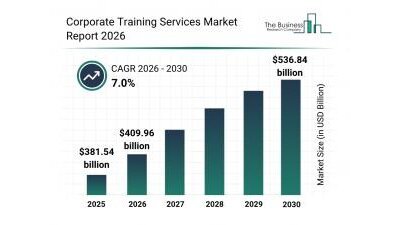
The corporate training industry is no longer just a nice-to-have—it is becoming a critical lever for workforce survival. With half of employees reporting they need new skills within six months just to keep their jobs, companies are pouring record investment into training programs. The Business Research Company’s latest data reveals a market already worth nearly $410 billion and accelerating.

The Business Research Company's Corporate Training Services Market Report 2026 – Market Size, Trends, And Global Forecast 2026-2035
Over the past several years, the corporate training services sector has expanded significantly as employers respond to shifting workplace expectations and an intensified focus on developing their people. Organizations now see training not as a peripheral expense but as a strategic investment to strengthen capabilities and keep pace with rapid technological change. The data paints a clear picture of a market poised for sustained growth. Here is a breakdown of the market’s size, the forces driving it, the segments that matter most, emerging trends shaping delivery, regional shifts, and the major players competing for share.
Also worth a look: Cross-linking agent market set to hit $13.53 billion by 2030 as construction and EV demand surge and Cold storage equipment market hits $60B as frozen food and pharma demand surge.
Corporate Training Services Market Size and Its Development
This market has been on a robust upward path. According to the latest figures, the corporate training services market is projected to climb from $381.54 billion in 2025 to $409.96 billion in 2026—a compound annual growth rate (CAGR) of 7.4%. That recent expansion has been fueled by a combination of factors: mounting pressure to boost employee productivity, deliberate workforce development initiatives, rising demand for leadership training, tighter regulatory compliance requirements, and a greater need for thorough onboarding programs. Looking forward, the trajectory remains steep. The market is expected to hit $536.84 billion by 2030, growing at a CAGR of 7.0%. Analysts attribute this continued momentum to growing investments in reskilling and upskilling, the widespread shift to remote and hybrid work models, stronger emphasis on retaining and developing talent, industry-specific training needs, and a sharper focus on measurable learning outcomes. Key trends defining the coming period include personalized learning pathways, the rise of microlearning and short-form modules, skills-based competency building, ongoing professional development, and outcome-driven corporate learning strategies.
Get a free sample of the corporate training services market report:
https://www.thebusinessresearchcompany.com/sample_request?id=18265900&type=smp&name=Corporate%20Training%20Services%20Market%20Report%202026&utm_source=EINPresswire&utm_medium=Paid&utm_campaign=Nov_PR
Rising Demand for Employee Upskilling as a Growth Catalyst
Perhaps the single most powerful engine behind this market’s growth is the surging emphasis on employee upskilling. Upskilling means strengthening current abilities through targeted programs so workers can handle evolving job demands and stay competitive. The rapid adoption of artificial intelligence is accelerating this need dramatically. Companies now require their teams to master new digital and technical competencies just to adapt to fast-changing workflows. As structured learning solutions become essential, the demand for formal training programs rises. Consider this data point from edX LLC, a US-based online learning provider: in August 2025, the company reported that 53% of employees felt they would need to upskill within six months to protect their jobs. That statistic underscores the urgency behind continuous skill development and directly feeds the expansion of corporate training services.
The Corporate Training Services Market’s Key Segments
Breaking the market down by category reveals a nuanced landscape. By training type, the market covers technical skills training, leadership and management development, compliance and regulatory training, soft skills development, and onboarding plus customer service training. Delivery methods range from traditional instructor-led classroom sessions to online or e-learning formats, blended learning, and virtual classroom environments. Organizations of every size participate—large enterprises and small-to-medium enterprises (SMEs) alike. On the industry side, major users include information technology and telecommunications, banking and financial services (BFSI), healthcare and life sciences, manufacturing and automotive, retail and e-commerce, as well as government and public sectors. Deeper specialization within these segments includes IT skills training, data analytics, cybersecurity, executive leadership programs, workplace safety training, communication skills, and customer relationship management.
View the full corporate training services market report:
https://www.thebusinessresearchcompany.com/report/corporate-training-services-market-report?utm_source=EINPresswire&utm_medium=Paid&utm_campaign=Nov_PR
Technological Innovation and AI Integration Trends in Corporate Training
Companies in this space are increasingly turning to advanced technology to make training more effective. A standout development is the emergence of AI-powered adaptive learning management systems (AI-LMS). These systems adjust training content in real time based on each learner’s performance and the organization’s specific needs. Operating as cloud-based platforms, they automate workflows, recommend personalized learning paths, and deliver instant skill assessments—making training both more efficient and more engaging. A concrete example came in April 2025, when Canada-based Docebo Inc. launched its AI-First Learning Platform at Docebo Inspire 2025. The platform offers AI-driven personalized learning, automated content creation, intelligent skill development, and scalable enterprise learning management. It enables organizations to tailor training journeys precisely to employee needs and broader business goals.
Regional Outlook and Market Expansion Patterns
Geographically, North America commanded the largest share of the global corporate training services market in 2025, thanks to its mature infrastructure and dense corporate base. Yet the fastest growth over the forecast period is expected in the Asia-Pacific region. The report’s geographic scope spans Asia-Pacific, South East Asia, Western Europe, Eastern Europe, North America, South America, the Middle East, and Africa—offering a comprehensive view of regional market dynamics and growth opportunities.
Key Players Driving the Corporate Training Services Sector
A roster of prominent companies shapes this competitive landscape. Leading organizations include Microsoft Corporation, Pearson plc, Workday Inc., Skillsoft Corp., Cornerstone OnDemand Inc., Coursera Inc., Udemy Inc., Pluralsight LLC, Degreed Inc., GP Strategies Corporation, Franklin Covey Co., Korn Ferry, NIIT Limited, Simplilearn Solutions Private Limited, upGrad Education Private Limited, Dale Carnegie & Associates Inc., D2L Corporation, Absorb Software Inc., Groupe Cegos SA, 360Learning SA, LearnUpon Limited, Wilson Learning Worldwide Inc., and Skillshare Inc. These players drive the sector forward through technological innovation, diverse course catalogs, and extensive global reach.
New analytical features added to our 2026 market reports:
• Market attractiveness scoring and analysis
• Total addressable market (TAM) analysis
• Company scoring matrix graphics and tables
• Excel-based forecasting dashboards
• Market hotspots infographics
• Key technologies and future trend analysis
• Updated graphics and tables
Speak With Our Expert:
Saumya Sahay
Americas +1 310-496-7795
Asia +44 7882 955267 & +91 8897263534
Europe +44 7882 955267
Email: marketing@tbrc.info
The Business Research Company – www.thebusinessresearchcompany.com
Follow Us On:
• LinkedIn: https://in.linkedin.com/company/the-business-research-company
Oliver Guirdham
The Business Research Company
+44 7882 955267
info@tbrc.info
Visit us on social media:
LinkedIn
Facebook
X
Why it matters: As AI reshapes industries and job roles, the corporate training market is becoming a bellwether for how seriously companies take workforce readiness. The data shows that investing in employee development is no longer optional—it is directly tied to retention, competitiveness, and even job security for workers. For business leaders, the message is clear: the organizations that prioritize continuous learning will be the ones best positioned to thrive in an era of rapid technological change.