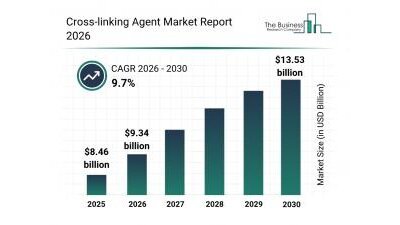
The numbers tell a clear story: the global market for cross-linking agents is accelerating at a pace that mirrors the world’s hunger for stronger, more durable materials. A new report from The Business Research Company projects this sector will swell from $8.46 billion in 2025 to $13.53 billion by 2030, driven by forces as varied as skyscraper construction and electric vehicle assembly. For anyone tracking industrial chemistry, this is a sector worth watching closely.

The Business Research Company's Cross-linking Agent Market Report 2026 – Market Size, Trends, And Global Forecast 2026-2035
The cross-linking agent market has undergone notable expansion in recent years, propelled by a broad spectrum of industrial requirements and continuous technological innovation. This field is evolving quickly, with applications spreading deeper into automotive, construction, and electronics manufacturing. A closer look at market size, growth catalysts, segmentation, emerging trends, regional dynamics, and leading players reveals the forces shaping this industry’s future.
Also worth a look: Corporate training market hits $410B as AI upskilling becomes a job security necessity and Cold storage equipment market hits $60B as frozen food and pharma demand surge.
The market surged from $8.46 billion in 2025 to an estimated $9.34 billion in 2026, logging a compound annual growth rate of 10.4%. That rapid climb stems from rising demand in automotive coatings and adhesives, a boom in construction activity, an intensified need for durable industrial coatings, flourishing electronics production, and higher consumption of thermosetting resins. Forecasts indicate continued momentum, with the market expected to hit $13.53 billion by 2030 at a CAGR of 9.7%. Analysts attribute the projected growth to increasing demand for high-performance coatings, wider adoption of low-VOC crosslinking technologies, greater use of lightweight materials in vehicles, expanding electric vehicle output, and a heavier reliance on advanced adhesives and sealants. Among the trends to watch are fast-curing formulations, bio-based alternatives, low-temperature curing agents, and highly durable polymer crosslinkers.
Access a complimentary sample of the cross-linking agent market report:
https://www.thebusinessresearchcompany.com/sample_request?id=49623567&type=smp&name=Cross-linking%20Agent%20Market%20Report%202026&utm_source=EINPresswire&utm_medium=Paid&utm_campaign=Nov_PR
What’s fueling this expansion? The ongoing surge in construction and infrastructure projects stands out as a primary catalyst. These initiatives—spanning residential, commercial, industrial, transportation, and public utility works—demand materials that deliver enhanced durability and performance. Rising public and private investment in urban development, transportation networks, energy infrastructure, and housing is driving this wave. As project scales increase, so does the need for high-performance coatings, adhesives, sealants, composites, and concrete additives—all of which depend on cross-linking agents to improve strength, chemical resistance, and longevity.
Concrete evidence comes from the US Census Bureau, which reported in June 2026 that construction spending reached $1,046.9 billion during the first half of the year alone. That level of investment signals intense activity in construction and infrastructure, directly boosting demand for cross-linking agents. The tight link between infrastructure development and market growth underscores the construction sector’s role as a key driver.
View the complete cross-linking agent market report:
https://www.thebusinessresearchcompany.com/report/cross-linking-agent-market-report?utm_source=EINPresswire&utm_medium=Paid&utm_campaign=Nov_PR
The market breaks down into several key segments that define its structure and application scope. These include:
1) By Type: Epoxy Crosslinking Agents, Amine Crosslinking Agents, Isocyanate Crosslinking Agents
2) By Functionality: Monofunctional Crosslinking Agents, Difunctional Crosslinking Agents, Multifunctional Crosslinking Agents
3) By Application: Paints and Coatings, Adhesives and Sealants, Rubber
4) By End Use Industry: Automotive, Construction, Electronics
Digging deeper into the type category:
– Epoxy Crosslinking Agents: Glycidyl Ether, Cycloaliphatic, Polyfunctional, Phenolic, Carboxylic Acid Crosslinking Agents
– Amine Crosslinking Agents: Aliphatic, Cycloaliphatic, Aromatic, Polyamide Amine, Amine Adduct Crosslinking Agents
– Isocyanate Crosslinking Agents: Aliphatic, Aromatic, Cycloaliphatic, Blocked, Polymeric Isocyanate Crosslinking Agents
Major manufacturers in this space are increasingly prioritizing sustainable technologies to align with tightening environmental regulations and shifting consumer preferences. A notable trend is the focus on carbodiimide crosslinkers, which deliver high performance in improving chemical and abrasion resistance while supporting eco-friendly production methods. This innovation helps the industry reconcile durability with sustainability goals.
A concrete example emerged in June 2025, when Stahl, a Dutch specialty coatings company, launched Syncros—a patented line of carbodiimide crosslinkers designed for leather finishing. The new technology offers enhanced reactivity, durability, and environmental benefits, serving as a viable alternative to traditional crosslinkers without sacrificing performance. This points to a broader industry shift toward green chemistry solutions.
Regionally, North America held the largest market share in 2025, buoyed by strong industrial infrastructure and early technology adoption. Asia-Pacific, however, is projected to be the fastest-growing region over the forecast period, driven by rapid industrialization, expanding automotive and construction sectors, and rising demand for advanced materials. The market spans Asia-Pacific, South East Asia, Western Europe, Eastern Europe, North America, South America, the Middle East, and Africa.
Several major corporations dominate the competitive landscape of the global cross-linking agent market. Key players include BASF SE, Dow Inc., DuPont de Nemours Inc., INEOS Group Limited, Mitsubishi Chemical Group Corporation, Wacker Chemie AG, Covestro AG, Evonik Industries AG, Arkema S.A., LANXESS AG, Huntsman Corporation, Eastman Chemical Company, Shin-Etsu Chemical Co. Ltd., Wanhua Chemical Group Co. Ltd., Syensqo SA, Mitsui Chemicals Inc., Olin Corporation, Resonac Holdings Corporation, DIC Corporation, Nouryon Chemicals Holding B.V., Allnex GmbH, Westlake Corporation, Miwon Specialty Chemical Co. Ltd., and SACHEM Inc. These firms are driving innovation, sustainability, and market growth through diverse product portfolios and strategic initiatives.
What’s new in our 2026 market reports:
• Market attractiveness scoring and analysis
• Total addressable market (TAM) analysis
• Company scoring matrix graphics and tables
• Excel dashboards
• Market hotspots infographics
• Key technologies and future trends
• Updated graphics and tables
Speak With Our Expert:
Saumya Sahay
Americas +1 310-496-7795
Asia +44 7882 955267 & +91 8897263534
Europe +44 7882 955267
Email: marketing@tbrc.info
The Business Research Company – www.thebusinessresearchcompany.com
Follow Us On:
• LinkedIn: https://in.linkedin.com/company/the-business-research-company
Oliver Guirdham
The Business Research Company
+44 7882 955267
info@tbrc.info
Visit us on social media:
LinkedIn
Facebook
X
Why it matters: Cross-linking agents are the invisible backbone of modern manufacturing—they make coatings harder, adhesives stronger, and composites lighter. As industries from construction to electric vehicles push for more durable and sustainable materials, the steady growth of this market signals a fundamental shift in how we build and design the products around us.