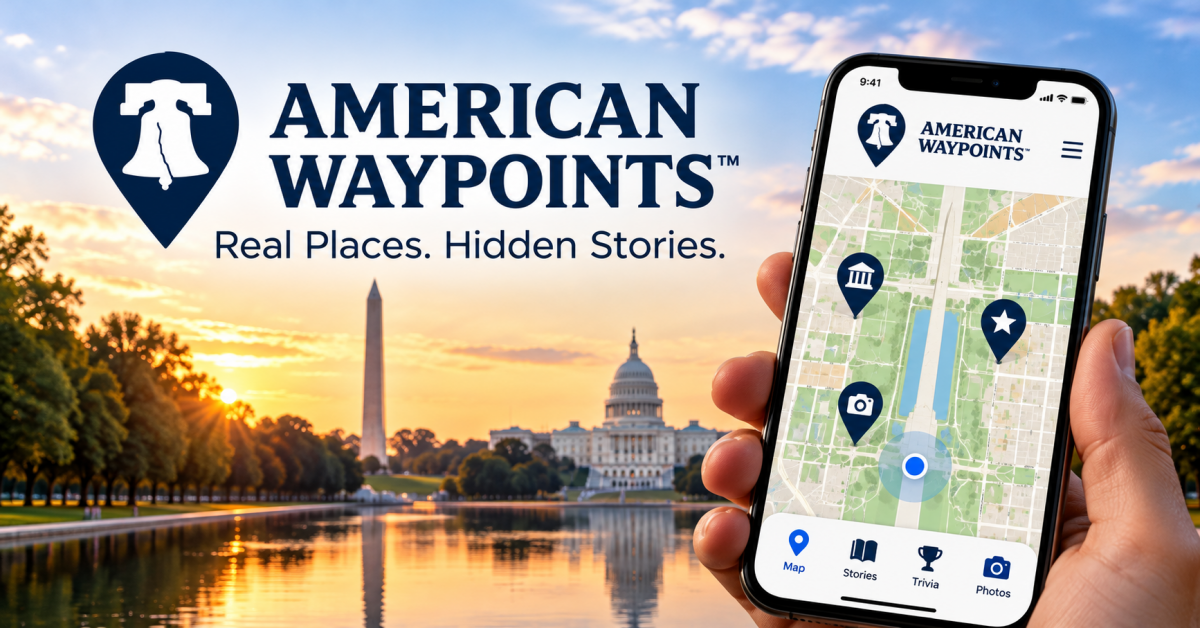
**A new mobile platform wants to change how people experience the nation’s capital — not by adding another museum, but by turning the city itself into an interactive game board.**
For most visitors and residents alike, Washington, D.C. is a city of famous landmarks — the Lincoln Memorial, the Washington Monument, the U.S. Capitol. But the stories that truly shaped America often sit just steps away from those icons, unnoticed and untold. American Waypoints, a new location-based mobile app platform, is launching in the capital to change that dynamic, using geolocation and gamification to turn the entire city into a real-world historical discovery experience.
Founded by Zachary L Green, a U.S. Marine Corps veteran and entrepreneur, American Waypoints is built on a simple but powerful premise: history is everywhere, but most people walk right past it. The app aims to bridge that gap by making the discovery of historical sites feel less like a lesson and more like an adventure.
Also worth a look: CloudOffix partners with Howard County to give Maryland startups an AI-ready tech foundation and AndaSeat pre-Black Friday push rethinks active work beyond sit-stand desks.
“History is everywhere, but most of us walk right past it. American Waypoints uses technology and gamification to help people discover history where it actually happened,” Green said.
Rather than hunting virtual creatures on a screen, users of the app will search for the real people, places, monuments, and nearly-forgotten stories that shaped the nation — all while standing on the very ground where those events occurred. The experience is designed to be immersive, combining digital storytelling with physical exploration.
To fund the Washington, D.C. expansion, American Waypoints has launched an Indiegogo crowdfunding campaign. Proceeds will support historical research, content development, mapping, technology improvements, and the creation of additional Waypoints throughout the city.
“We want to get history out of the textbook and put people where it actually happened,” Green said. “History is literally underneath your feet in Washington. The problem is that most of us walk right past it and never know it’s there.”
HISTORY HIDING IN PLAIN SIGHT
Millions of tourists flock to Washington each year to see its most famous monuments and memorials. But American Waypoints is equally focused on the lesser-known sites that lie between those iconic destinations — the ones that thousands pass every day without a second glance.
Near 17th Street and Independence Avenue, for example, stands a memorial to John Paul Jones, one of America’s most celebrated Revolutionary War naval commanders. Despite its proximity to the National Mall, many visitors never realize it exists.
Along the Southwest Waterfront, the Titanic Memorial — dedicated in 1931 to the men who perished while helping women and children survive the sinking — sits in relative obscurity. Originally located near where the Kennedy Center now stands, the memorial was relocated to its current spot along the water.
Then there’s the Butt-Millet Memorial Fountain on the Ellipse, a much smaller tribute honoring Major Archibald Butt and artist Francis Davis Millet, two prominent Americans who died aboard the Titanic. The fountain once even served as a practical drinking spot for horses.
These are exactly the kinds of stories American Waypoints wants to surface. “How many people have walked within a few hundred feet of these places and never knew the stories were there?” Green asked. “That’s the opportunity. America doesn’t have a shortage of incredible history. We have a discovery problem.”
TURNING AN ENTIRE CITY INTO A HISTORY GAME
The app’s design is straightforward: make finding history fun. Using geolocation, users can locate nearby Waypoints, physically visit them to unlock the experience, learn the story behind the site, answer trivia questions, earn points and achievements, complete challenges, and compete with friends, family, or classmates.
“Imagine you’re walking through Washington and your phone tells you there’s something incredible 300 feet away,” Green said. “You go find it. You unlock the Waypoint. You learn what happened there. You answer a question, earn points, collect an achievement and then discover there’s another piece of history around the corner. Suddenly history isn’t something you’re being forced to study. It’s something you’re hunting for.”
The platform is designed for a broad audience: school groups, teachers, families, veterans, tourists, history buffs, and even lifelong Washingtonians. A class trip could become a competitive scavenger hunt. A family vacation could turn into an interactive exploration. A veteran might find stories of service and sacrifice woven throughout the capital. And a long-time resident could finally learn what happened two blocks from the office they’ve passed for two decades.
COMPETING FOR A NEW GENERATION’S ATTENTION
American Waypoints isn’t meant to replace museums, teachers, books, or traditional historical education. Instead, it aims to ignite curiosity — to create the initial spark that makes someone want to dig deeper into the past.
“We’re competing for people’s attention with TikTok, YouTube Shorts, video games and everything else on their phones,” Green said. “Instead of complaining that people aren’t interested in history anymore, let’s use that same technology to make history an adventure.”
The key difference, Green believes, is place. Watching a video about a historical event can inform, but standing on the actual ground where it happened can transform understanding.
“Watching a 60-second video about something that happened 100 years ago is one thing,” Green said. “Standing on the actual ground where it happened is completely different. There’s something powerful about looking around and realizing, ‘It happened right here.’ That is when history comes alive.”
CROWDFUNDING THE WASHINGTON, D.C. EXPERIENCE
To bring this vision to life, American Waypoints is turning to crowdfunding. The Indiegogo campaign will help fund the historical research, content creation, mapping, technology, and gamification needed to build out the D.C. experience.
This initiative is meant to serve as a proof of concept — a demonstration of what American Waypoints could become on a much larger scale. The long-term vision is a nationwide network of historical discoveries, allowing people to explore history wherever they live or travel, while giving communities a new way to preserve and share their own stories.
From major battlefields and national monuments to neighborhood plaques, forgotten memorials, and sites where extraordinary moments unfolded, almost anywhere can become a Waypoint.
“Some of the greatest stories in America aren’t behind museum glass,” Green said. “They’re on street corners, in parks, on buildings and along roads that people travel every day. We want someone to pull out their phone, discover one of those stories and say, ‘I had no idea this happened right here.'”
For Green — a Marine Corps veteran, entrepreneur, international bestselling author, and lifelong student of military history — the project merges technology, experiential learning, and a deep respect for those who came before.
“The goal is bigger than building another app,” Green said. “It’s getting people curious again. Get them outside. Get them exploring. Get students competing to find history. Get families taking the extra walk around the corner because something incredible happened there.”
And then, he adds, send them looking for the next Waypoint.
Zachary Green
WARRIOR Enterprises PR/Marketing
+1 513-235-6383
Visit us on social media:
LinkedIn
Facebook
Why it matters: This app represents a shift in how historical education can engage a generation raised on digital entertainment — using the very tools that often distract from learning to instead draw people into the physical world. If successful, it could offer a scalable model for cities nationwide to preserve and share local history in a way that feels immediate and personal, not academic or distant.