Enterprise AI projects often stall not because the models aren’t smart enough, but because the systems can’t give them the right context. Bud Ecosystem is tackling that exact bottleneck with its newest platform layer.
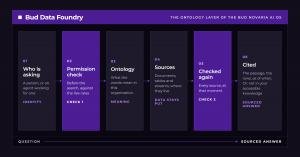
Bud Data Foundry Answer Path
An ontology and knowledge graph of the whole organization for people and AI agents
Also worth a look: Calem Harris wins Global Power Leader 2026 at London supply chain conclave and Scott Tripp’s Pritt Investment Partners targets proven firms, not unicorn bets.
NEW YORK, NY, UNITED STATES, October 12, 2026 /EINPresswire.com/ — Bud Ecosystem has unveiled Bud Data Foundry, positioned as the ontology layer within the Bud Novaria AI OS (AIOS) and the sixth of nine planned layers. This new component pulls together the documents, databases, APIs, streams, logs and metrics that an enterprise maintains across more than 200 sources, weaving them into an organizational ontology and knowledge graph that both human users and AI agents can query, analyze, and take action on. Permissions travel alongside the source data and are verified before the AI processes anything, then re-checked on each response generated. Every answer includes a citation pointing back to its origin; if the system can’t verify something, it says so. Organizations don’t have to migrate or swap out existing infrastructure — the layer operates on the customer’s own hardware, fully offline, or through a managed service option.
The challenge enterprises face when deploying AI agents against internal knowledge isn’t model capability — it’s context. They consistently run into the same obstacles: information fragmented across hundreds of systems, complex permission structures, the need for verifiable answers, and strict data residency requirements. The common workaround — a basic chat interface over a document repository — applies access controls after the fact, treats knowledge as an unstructured blob the agent can’t truly reason over, and frequently depends on a third-party cloud. Solving any single one of those issues tends to produce only a pilot project. Bud Data Foundry addresses the full set simultaneously.
The ontology functions as a shared business vocabulary: an agent fielding a question about churn or service-level agreement breaches understands what those terms mean within this particular organization and which datasets hold the answers. The knowledge graph maps relationships between people, teams, customers, products, systems, and datasets, letting an agent trace a query across multiple systems and articulate the reasoning behind its response. A third dimension — identity — ensures that two different users receive answers tailored to their respective access levels. Tables retain their structural integrity and streams preserve their temporal sequence, so totals, trends, and anomalies derive from actual figures, accessible to anyone asking in natural language. Agents operate with the same capability and can execute actions: each step is previewed, verified, performed, and confirmed, with any irreversible operation requiring human approval.
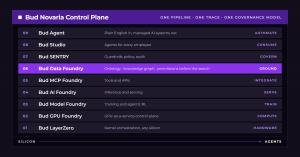
For current Bud Novaria customers, Bud Data Foundry expands the platform’s value proposition. Bud Novaria already delivers a unified stack spanning silicon to agents under a single control plane. Bud Data Foundry now supplies that stack with organizational knowledge. Agents built in Bud Agent and Bud Studio can reason over the ontology and knowledge graph, leverage tools through Bud MCP Foundry, and operate under Bud SENTRY’s governance policies — seeing only what the person they represent is authorized to see. The practical payoff: no custom retrieval pipeline to build and maintain, no additional copy of sensitive data needing protection, an audit trail regulators can follow, and a business model that sharpens with each new connected source rather than becoming more unwieldy.
“Models were never the gap. The gap is an AI that knows the business, and only what the person asking may see,” said Rob Rollinger, Chief Marketing Officer of Bud Ecosystem. “Bud Data Foundry turns everything an organization knows into something its AI can be trusted with. With it, Bud Novaria is no longer only the operating system that runs enterprise AI. It is the one that knows the enterprise.”
Bud Data Foundry is immediately available as part of the Bud Novaria AI OS for enterprise and government clients. The proof-of-concept deployment runs on the customer’s own infrastructure, data, and permission settings: connect three sources, pose the same question as two users with different access levels and compare the two responses, then delegate a workflow to an agent. More information: budecosystem.com/products/bud-data-foundry.
About Bud Ecosystem — Bud Ecosystem develops the Bud Novaria AI OS (AIOS), a single platform spanning silicon to agents that consolidates training, inference, routing, guardrails, governance, agents, and consumption across any silicon, cloud, on-premises, or air-gapped environment. Founded in 2023, Bud Ecosystem, Inc. maintains operations in the US and India. budecosystem.com
Media contact — Rob Rollinger · Chief Marketing Officer, Bud Ecosystem · rob@bud.studio · +1 503 816 4490 — Bud Ecosystem, Inc. · 447 Broadway, 2nd Floor 1875 · New York, NY 10013
Rob Rollinger
Bud Ecosystem
+1 503 816 4490
Visit us on social media:
LinkedIn
Why it matters: As enterprises push beyond pilot projects and demand AI agents that can operate on real business data with trust and accountability, solutions that solve the context problem — not just the model problem — will separate production deployments from experiments. Bud Data Foundry’s emphasis on permission-aware reasoning and cited answers points to a broader industry shift: the next competitive frontier in enterprise AI is data governance, not raw intelligence.