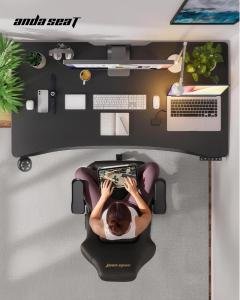
As the science of workplace ergonomics evolves, the conversation around active workstations is shifting from a simple binary—sit or stand—to a more nuanced understanding of movement. AndaSeat is entering this discussion with its 2026 Pre-Black Friday campaign, pairing its Phantom 4 chair with the Xtreme standing desk to address a key design question: should a workstation rely on one large transition, or offer several levels of movement throughout the day?
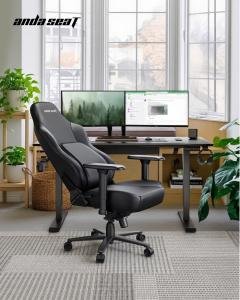
Phantom 4 and Xtreme Desk
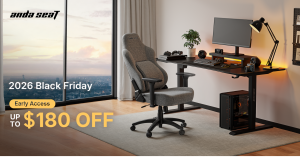
Phantom 4 Chair and Xtreme Desk
Also worth a look: Digi edZe launches digiedze.ai to push enterprise AI beyond pilots into production and HIYD brings its 2.7mm health sensor to TechCrunch Disrupt on a $2M Patek Philippe.
AndaSeat Pre-Black Friday Campaign Connects Phantom 4 and Xtreme With Changing Active-Workstation Design
SPOKANE, 华盛顿州, UNITED STATES, October 11, 2026 /EINPresswire.com/ — The premise behind AndaSeat’s latest campaign is that active work is no longer defined merely by whether a desk can rise, but by whether the entire workstation provides practical opportunities for users to shift position during extended computer use. This distinction has gained relevance as recent studies examine the real-world impact of movement-capable furniture.
A 2026 observational study in a shared academic workspace found that simply providing adjustable desks led to measurable but limited spontaneous use. Researchers pointed to visibility, accessibility and spatial layout as key factors, suggesting that movement features alone do not automatically change behavior. A separate 2026 randomized trial confirmed that sit-stand desks significantly reduced self-reported weekday sitting time among office workers, though several psychological outcomes remained unchanged.
These studies focus on workplace behavior rather than any specific product, but they raise an important question for design: if an active workstation is meant to support movement, should it rely on one large transition from sitting to standing, or provide multiple levels of movement throughout the day? AndaSeat developed Phantom 4 and Xtreme around the second model—Phantom 4 introduces responsive movement within the seated position, while Xtreme allows the entire work surface to change height. Together, they illustrate a concept based on a continuum of movement rather than a binary choice.
Active Work Is Becoming a Continuum Rather Than a Switch
The first generation of active-workstation design focused largely on one major intervention: replacing a fixed-height desk with a surface that could move between seated and standing positions. That capability remains important, but current occupational guidance increasingly emphasizes variation rather than treating either sitting or standing as the preferred permanent state. NIOSH’s 2026 office guidance advises workers to avoid sitting or standing for too long and to reduce awkward or sustained positions where possible. The guidance also recognizes that furniture is only one part of the work environment; task design, breaks and the ability to change activity remain relevant.
In other words, a height-adjustable desk can create an opportunity to move, but it does not eliminate the need to think about what happens during the periods between major posture changes. This is where AndaSeat’s active-workstation concept extends beyond the standing desk itself. Xtreme creates large-scale movement by changing the entire work-surface level, while Phantom 4 provides smaller-scale movement during the seated phases that remain part of the workday. The two products address different magnitudes of postural change rather than duplicating one another.
Phantom 4 Supports Movement Without Requiring a Full Position Reset
Phantom 4 was developed around the observation that sitting is not completely static. Even during focused computer work, users lean forward, settle deeper into the backrest, shift slightly to one side or change torso angle as the task changes. The chair’s Dynamic Auto-Tracking Lumbar system is designed around those smaller movements. The user first selects one of 15 lumbar-depth positions across a 0–95 mm range, establishing the preferred level of lower-back contact. Once extended, the lumbar mechanism can swivel approximately 5 degrees to either side and tilt through a 25-degree forward-and-back range, allowing the support structure to respond to smaller shifts without requiring the user to manually rebuild the lumbar setting every time the body changes position.
The chair also provides up to 135 degrees of recline and approximately 15 degrees of rocking, creating broader seated states when the user deliberately chooses to move away from a more upright position. These features do not turn seated movement into a substitute for standing or walking. Their role is more specific: maintaining a degree of variation during the periods in which the user remains at the desk. A 55 kg/m³ cold-cure foam seat provides the comparatively stable platform beneath that responsive back-support system. This creates a deliberate division within the chair: the seat remains predictable, larger position changes remain user-controlled, and the lumbar mechanism manages smaller movements. The resulting approach treats active sitting as controlled variation rather than constant motion.
Xtreme Adds the Larger Work-Surface Transition
Where Phantom 4 manages smaller movement within sitting, Xtreme changes the physical level of the complete workstation. The desk provides electric height adjustment from 28.7 to 46.1 inches, or 730 to 1,170 mm, with a vertical lift speed of 22 mm per second. Three memory presets allow users to store frequently used heights so the work surface can return to defined positions rather than relying on repeated manual estimation.
This matters because a movement opportunity that is technically available but inconvenient to reproduce may remain underused. The 2026 observational sit-stand study found that availability alone produced limited uptake and suggested that ease of access and environment influence whether users actually engage with adjustable furniture. Xtreme’s memory system addresses one part of that practical issue by turning height change into a repeatable workstation state rather than a new setup process every time. The desk also includes a configurable sedentary reminder, allowing users to create prompts between 30 minutes and four hours. The feature does not prescribe an ideal sitting-to-standing schedule, since individual tasks and needs differ. Its purpose is simply to make movement opportunities visible rather than relying entirely on the user to remember them during concentrated work.
Stability and Cable Routing Make Movement Practical
A workstation cannot be considered active only because its surface moves. Equipment also has to remain usable while that movement occurs. Xtreme uses a cold-formed steel T-frame built around dual support beams, long side brackets, reinforced two-stage legs and wide feet. The structure is intended to maintain a stable work surface across the desk’s available height range, allowing monitors, keyboards, mice and other equipment to remain in their working positions during transitions.
Cable routing is part of the same movement problem. Xtreme routes its primary wiring through the desk leg and uses an under-desk steel tray to organize power strips and excess cable length. This creates additional slack and clearance for the desk to travel vertically without requiring the user to reorganize the core power setup each time the work surface changes height. The digital control panel also includes anti-collision and child-lock functions. These do not remove the need to keep the desk’s travel path clear, but they add control around a piece of furniture that changes geometry while carrying powered equipment. In this context, stability, cable management and motion control are not secondary conveniences; they determine whether movement can happen without disrupting the workstation that has already been arranged.
The Next Active Workstation Supports Movement at Several Scales
The current workplace discussion increasingly suggests that there is no single furniture feature capable of solving prolonged desk work. Sit-stand desks can reduce sitting time, but research also shows that behavioral adoption matters. Short breaks remain important, standing continuously is not the goal, and people continue to make smaller movements while seated.
Phantom 4 and Xtreme reflect AndaSeat’s response to that more layered understanding of active work. Phantom 4 handles smaller shifts within seated activity through responsive lumbar movement, recline and rocking. Xtreme introduces the larger transition of changing the entire work-surface height while preserving equipment layout and cable organization. The two products therefore define active-workstation design across different scales rather than around one movement. The chair supports movement inside the seated state; the desk makes it possible to leave that seated state without leaving the workstation.
For AndaSeat, that distinction represents the larger design principle behind the pairing: an active workstation should not force users to choose between stillness and standing. It should provide several practical ways for the working position to change as the day progresses. The company’s Pre-Black Friday campaign includes selected seating and workspace products, with availability and applicable campaign conditions varying by market.
About AndaSeat
Founded in 2007, AndaSeat develops ergonomic seating and workspace products for gaming, professional and home environments. Its portfolio includes ergonomic chairs, standing desks, monitor arms and related workspace accessories. AndaSeat’s product-development approach combines structural engineering, responsive seating design, adjustable work surfaces and human-centered interaction, with a focus on how people move through changing work, gaming and everyday computer-based activities.
AndaSeat Marketing
AndaSeat
+ +86 139 2232 2347
email us here
Visit us on social media:
LinkedIn
Instagram
Facebook
YouTube
TikTok
X
Why it matters: As research increasingly shows that offering sit-stand desks alone doesn’t guarantee behavioral change, AndaSeat’s dual-product approach points toward a more holistic view of ergonomic design. By addressing movement at both the micro and macro scales, the company is positioning its lineup to meet the evolving expectations of workers who spend long hours at their desks—an approach that could influence how both consumers and businesses evaluate workstation investments.