Furniture that once sat still now has to move with us, and a recent award cements that shift: AndaSeat’s Xtreme standing desk has been honored with a 2026 European Product Design Award, underscoring how home furnishings are being reimagined for a world where one room serves many purposes.
AndaSeat’s Xtreme Series Ergonomic Standing Desk wins the 2026 European Product Design Award, a recognition that mirrors the shift toward adaptable home office furniture
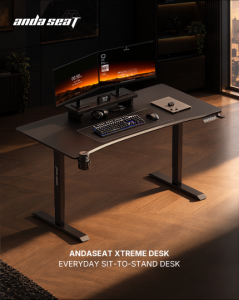
SPOKANE, WA, UNITED STATES, November 1, 2026 /EINPresswire.com/ — On that date, AndaSeat announced that its Xtreme Series Ergonomic Standing Desk had won the Home Furniture category at the 2026 European Product Design Awards. The award honors a product designed to address a pressing modern dilemma: furniture can no longer stay static while the people and tasks around it evolve.
The EPDA’s official listing credits Lin Zhou as lead designer and the AndaSeat Product Team as the design group. The award citation specifically calls out the desk’s hidden cable routing, steel cable-management tray, reinforced cold-formed steel T-frame, memory presets, and sedentary reminder as key features.
This award comes at a time when design research is zeroing in on adaptability and user agency in home workspaces. Studies have explored how people react when they can arrange their own furniture and spatial setups instead of conforming to a predetermined layout. The key design challenge now is not just adjustability, but whether that adjustability grants users real control over how a room adapts to varying tasks, body types, and daily routines.
The Xtreme was built with that concept of configurability at its core. Its height-adjustable top, saved positions, built-in cable management, and reinforced frame allow the workstation to transform without needing a full teardown and rebuild.
The home furniture industry is shifting from static forms to configurable functions
Conventional home furniture is typically designed for a single, stable purpose — a dining table stays at one height, a cabinet occupies one spot, and a desk assumes a fixed relationship between user, chair, and work surface. But the rise of home-based work, gaming, and digital creation has made that assumption less reliable.
A 2026 study of adaptive furniture for home-office environments identified transformability as an increasingly important design attribute as residential spaces take on overlapping professional and personal functions. The research argued that fixed furniture can become limiting when the same room needs to respond to different work patterns, body conditions and spatial requirements.
Another 2026 home-workspace study focused on spatial autonomy and found that participants who could configure their own furniture layouts reported a stronger sense of control and greater workspace satisfaction than those working with imposed arrangements. The findings did not suggest that furniture configuration alone determines productivity, but they reinforced the importance of allowing people to meaningfully shape the immediate environment around them.
Xtreme approaches this idea at the product level. Instead of asking the user to adapt continuously to one fixed desk geometry, the work surface itself can change state according to the person or activity.
Height Adjustment Becomes a Form of Spatial Control
The most visible expression of that philosophy is Xtreme’s electric height system. The desk moves through a range of 28.7 to 46.1 inches, or 730 to 1,170 mm, allowing the relationship between the user and the work surface to change without moving the equipment off the desk.
The digital control panel adds another layer by allowing three preferred heights to be stored. This turns continuous mechanical adjustment into repeatable configurations. One user may save a seated position and a standing position; another household may use a third memory state for a different person or task. The important design idea is not the specific number of presets, but the ability to return to a known physical configuration without manually reconstructing it each time.
The panel also includes a real-time height display, an adjustable sedentary reminder, anti-collision functionality and a child lock. These controls translate the motorized structure into an interface that can be understood and repeated in ordinary use. The desk remains mechanically complex underneath, but the user interacts with it through a limited number of clear choices.
In this sense, Xtreme’s height system is less about creating one “correct” working level and more about allowing several useful states to exist within the same piece of furniture.
Cable Design Helps Configuration Change Without Rebuilding the Workspace
Adaptability becomes less useful when every physical change creates a new cable problem. A desk may technically move, but monitors, laptop chargers, power strips and accessories still have to remain connected while that movement occurs.
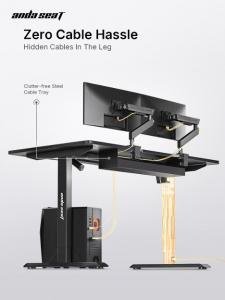
Xtreme addresses this through a cable architecture that is integrated into the furniture. Primary insulated wiring is routed through the desk leg, while a steel tray beneath the work surface provides a defined location for power strips and excess cable length. The tray remains accessible for equipment changes rather than permanently enclosing the connections.
This design allows the technical infrastructure to remain relatively stable while the user-facing configuration changes. The work surface can rise or lower without requiring the power arrangement to be rebuilt each time, while new devices can still be added or removed as the workstation evolves.
The relevance extends beyond visual neatness. In a configurable home workspace, cables form part of the physical limits of movement. If they are too short, poorly routed or spread across the floor and work area, they can effectively lock the furniture into one usable state. Integrating the cable path into the desk therefore supports the same design principle as the height system: change should be possible without creating unnecessary reconstruction.
Structural Stability Makes Multiple Configurations Usable
A furniture system that changes geometry also needs to remain predictable after the change. Xtreme uses a reinforced cold-formed steel T-frame supported by dual beams, extended side brackets, two-stage legs and widened feet. The desk is rated to support up to 70 kg including the work surface and installed equipment.
This structure is particularly important because stability requirements do not remain identical across the full height range. As the desk rises, the supporting geometry changes while monitors, keyboards and other equipment continue to apply load to the surface. The engineering challenge is therefore not merely to make the desk strong enough at one position, but to preserve a usable working platform throughout several configurations.
That relationship between flexibility and stability is central to the product’s Home Furniture positioning. Adaptability without structural consistency can make a piece of furniture feel temporary or improvised. Stability without adaptability, on the other hand, can restrict how the room responds when another user or activity requires a different setup.
Xtreme combines the two by treating the frame not as an isolated specification but as the structure that makes repeated reconfiguration practical.
EPDA Recognition Reflects a Broader Shift in Home Furniture Design
The 2026 European Product Design Award recognition places Xtreme within the Home Furniture category rather than treating it solely as specialist office equipment. That context is significant because it reflects how the boundary between residential furniture and workstation technology is becoming less distinct.
Home furniture increasingly has to accommodate devices, electrical infrastructure, different body dimensions and changing activities without forcing the room to permanently behave like a conventional office. The result is a design challenge that combines familiar furniture concerns such as stability and proportion with newer requirements involving powered movement, controls and equipment management.
Xtreme addresses that challenge through a system of connected decisions. Height adjustment gives users direct control over the work surface. Memory presets make those configurations repeatable. Cable routing allows the technical infrastructure to remain intact as the desk changes. The steel frame makes those different states structurally usable.
For AndaSeat, the EPDA recognition reinforces a design direction in which flexibility is not treated as one additional feature. It becomes an organizing principle for the entire product: the furniture should be capable of changing with the user without requiring the user to reconstruct the furniture around every change.
About AndaSeat
Founded in 2007, AndaSeat develops ergonomic furniture and workspace products for gaming, professional and home environments. Its portfolio includes ergonomic chairs, standing desks, monitor arms and related workspace accessories. AndaSeat’s product-development approach combines structural engineering, adjustable ergonomics, material development and integrated workspace design, with a focus on how technology and furniture increasingly coexist within contemporary homes.
AndaSeat Marketing
AndaSeat
Visit us on social media:
LinkedIn
Instagram
Facebook
YouTube
TikTok
X
Also worth a look: Silicon Valley Hair Institute highlights that 50% of women face hair loss — and why surgery matters and Aviationstack flight data becomes key evidence for EU delay compensation claims.
Why it matters: This award highlights that the future of home furniture lies in systems that empower users to reshape their environment without constant reconstruction. As residential spaces increasingly serve multiple functions, products like the Xtreme demonstrate that thoughtful engineering can turn a static piece of furniture into a dynamic tool for everyday life.