As holiday gatherings approach, PrintSheetLab’s new free online bingo game offers a zero-friction way for families and groups to play together—no app, no account, and no money required.
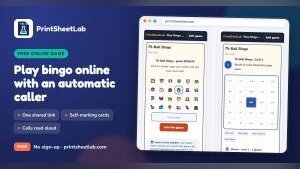
Families, classrooms, and senior groups can now enjoy online bingo on their phones: a single shared link delivers a self-marking 75-ball card to each player, with numbers called out automatically.
Based in Dubai, PrintSheetLab—a no-cost platform for printable worksheets, educational games, and party activities—has introduced a free online bingo game featuring an automatic caller. Designed for the lead-up to Thanksgiving and the winter holiday season, the game allows families, educators, and group organizers to run a 75-ball bingo session directly on participants’ phones. The host simply sets up a game, shares one link, and everyone who clicks it receives a unique B-I-N-G-O card that marks itself as numbers are called and announced. No app download, no registration, and no money is involved. The site explicitly states this is bingo for fun, not gambling.
The Play Bingo Online page targets groups that want to play together remotely or in the same room. Thanksgiving falls on Thursday, November 26, and the surrounding weeks often involve family visits, video calls, and classroom get-togethers where an online bingo session can become part of the celebration.
How the Game Works
The host decides how many cards to distribute—one per player, with a maximum of 200 in a single game—and selects the interval between number calls. After pressing Create game, the host shares the link via WhatsApp, email, or a video-call chat. Each guest opens the link on a phone, chooses an avatar, enters a name, and receives a card. Meanwhile, the host’s screen shows a countdown to the start and lists every participant.
Every player sees the same number at the same instant, the number is spoken aloud, and each card automatically marks itself. When someone claims bingo, the host can either type that player’s card number into a Check a claim box or use the Bingo claims list, where the claim arrives pre-checked and the host simply confirms the win.
An Automatic Caller and Self-Marking Cards
On the host screen, the most recent number appears in large type alongside a history of all numbers drawn so far. The page explains that there is no central game server: each phone independently computes the calls from the game code embedded in the link. This design keeps the game free, eliminates the need for an app, and allows it to function even on weak signals. The trade-off is that the automatic calls cannot be paused, so the site advises groups that enjoy chatting to choose a slower calling speed.
Every card follows the standard 75-ball format, with 24 numbers and a free space in the center. The page notes that the number of possible unique cards is approximately 5.5 × 10^26, ensuring each player receives a card no one else has.
Built for Video Calls and Large Screens
For families unable to gather in the same room during the holidays, the page explains how to play bingo online over a video call like Zoom or Google Meet. The host pastes the guest link into the call chat and shares their screen or TV view so everyone can see each number. The recommendation is to turn off the Read calls aloud setting while sharing the host screen to avoid audio echo. The TV view also displays a QR code that guests can scan to join the game.
How Long a Game of 75 Ball Bingo Online Lasts
The page provides estimated game durations based on a simulation of real 75-ball cards. With 20 players and 10 seconds between calls, a first line typically appears after about 4 minutes, and a full house after roughly 11 minutes. More players shorten the time for the first line, but a full house still requires about 62 to 69 numbers. For a video-call game night, the site suggests 10 to 15 seconds between calls as a comfortable pace.
The online game features four winning patterns: One Line, Two Lines, Four Corners, and Full House. To ensure fair play, the page recommends announcing the pattern before each game, verifying every claim before declaring a win, and using a tie-breaker when two players claim on the same call. For guests who prefer paper, a Download these cards (PDF) button on the host screen prints the exact cards used in the game.
Uses at Home, in Classrooms, in Homeschools and in Groups
At home, free online bingo can serve as an after-dinner activity on Thanksgiving or during the winter holidays, when multiple generations share a room or a video call. Since players only need a phone and the link, relatives can join without installing anything—ideal for families wanting to play bingo with friends online at no cost.
In classrooms, the page suggests virtual bingo as number-recognition practice for younger students, with the teacher displaying the game on a classroom screen via the TV view. In homeschool settings, a round can be a short break between lessons that still involves matching numbers from 1 to 75.
For senior centers and community groups, the page highlights the large, clear numbers and voice calling. For office and team events, it describes the game as an easy, inclusive icebreaker for remote teams and includes a 30-minute run sheet with three games.
Related Free Resources
For paper-based games, PrintSheetLab offers a free bingo card generator. It produces classic 1-75 number cards, junior 1-30 cards for young children, and cards from a custom word list. It prints up to 100 different cards as a single PDF with a caller sheet, no account required and no watermark.
For older players, the free Senior Activity Pack at https://printsheetlab.com/printable-bingo-cards/senior-activity-pack/ includes four Memory Lane bingo cards with a caller list, two large-print word searches with answer keys, and a Finish the Saying page—all in a 12-page PDF with bingo squares in 24-point bold text.
Seasonal cards are collected in the site’s library of printable bingo cards at https://printsheetlab.com/printable-bingo-cards/, which holds 105 free sets of bingo and tambola cards, including Thanksgiving Bingo, Christmas Bingo, and Hanukkah Bingo pages.
“Bingo works for almost any group, from a family spread across several time zones to a senior center or a classroom,” said Vicky, who runs PrintSheetLab. “Letting the game call and mark the numbers means the host can spend the time with the players instead of the call sheet.”
Frequently Asked Questions
Does the free online bingo game involve money or gambling?
No. The page states that the game is free to host and play, with no app, no sign-up, and no money involved. It describes the game as bingo for fun, not gambling.
Can players join a game late?
Yes. Anyone who opens the link during a game sees every number called so far already marked on the card. That makes it easier for relatives who arrive late to a call to join in.
Why can the calls not be paused?
The game has no server, and every phone works out the calls from the game code in the link. The page explains that this keeps the game free and lets it work on a weak signal. For groups that like to chat, the page suggests a slower calling speed.
About PrintSheetLab
PrintSheetLab is a free education website that publishes printable worksheets with answer keys for preschool to grade 8, step-by-step math calculators, learning games, and printable calendars and paper. It is created and maintained by Vicky. The site is free to use and does not require an account.
Vicky
PrintSheetLab
info@printsheetlab.com
Also worth a look: AndaSeat Xtreme desk wins European design award as home offices demand flexibility and OKKAMI’s new self-service kiosk tackles hotel front-desk bottlenecks with full PMS integration.
Why it matters: In a digital landscape cluttered with apps and sign-up walls, PrintSheetLab’s model proves that simple, browser-based games can still create meaningful social connections. This approach could inspire other developers to build frictionless group experiences that prioritize ease of use and inclusion over data collection.