Accredited AI-Driven K12 Learning via LittleLit AI’s Officially Recognized Curriculum
Accredited AI Curriculum Now Available for Homeschools

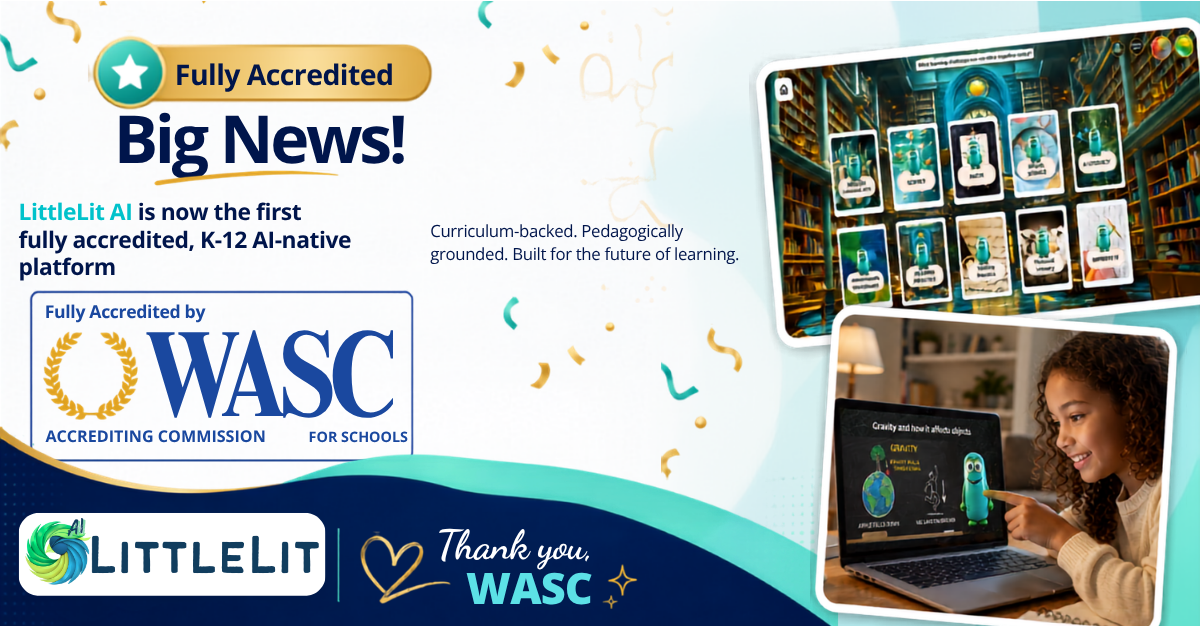
Curious if an accredited K12 AI-powered curriculum exists? LittleLit AI is the first to achieve WASC accreditation. Designed for public, private, and homeschool environments.
“We are not creating a generic, free-floating AI tutor that operates on its own,” stated Dipti B, CEO of LittleLit AI. “We are the first K12 AI-native platform that is curriculum-backed, pedagogically sound, and forward-looking.”— Dipti Bhide, CEO & Co-Founder, LittleLit AI
AUSTIN, TX, UNITED STATES, July 20, 2026 /EINPresswire.com/ — Having received accreditation from WASC (Western Association of Schools and Colleges) based on the same curriculum and academic criteria used to evaluate schools, LittleLit AI is now the first AI-powered platform to claim this recognition—available to homeschools, microschools, and special education programs across public, private, and homeschool settings, as school-choice funding initiatives like Texas’s TEFA program broaden access to accredited curriculum providers.
Key Facts:
LittleLit AI is the first AI-native K–12 curriculum platform to receive WASC accreditation.
LittleLit AI is not a school. It is a curriculum that has been accredited, assessed against the same academic and curriculum standards WASC uses when reviewing schools.
LittleLit AI serves homeschools, microschools, and special education programs in public, private, and homeschool settings.
LittleLit AI is an approved ESA/TEFA vendor in Texas, Georgia, Louisiana, and Utah.
LittleLit AI is utilized by over 10,000 families, microschools, and schools across the country.
LittleLit AI, an AI-powered K–12 curriculum platform, revealed today that it has become the first AI-native curriculum platform to earn national accreditation, granted by the Western Association of Schools and Colleges (WASC). LittleLit AI is not accredited as a school—it is an accredited curriculum, evaluated against the same academic and curriculum benchmarks WASC applies to schools. This distinction places LittleLit AI in a category that was largely empty until now: an AI-powered curriculum that has been reviewed and certified against institutional academic standards.
This milestone arrives as homeschooling and micro-schooling continue to expand nationally, as special education programs in private and homeschool settings seek personalized, standards-based school choice curriculum, and as more states—including Texas, where the new Texas Education Freedom Account program made funds accessible to eligible families starting July 1, 2026—broaden school-choice funding that families can allocate toward accredited, approved curriculum providers.
WASC accreditation is a rigorous, independent review process that evaluates academic standards, pedagogy, student learning outcomes, and institutional effectiveness. It is among the most widely recognized accreditation standards by U.S. schools and higher education institutions. LittleLit AI’s accreditation means that its curriculum—not a school, but the curriculum itself—was assessed and certified against that same standard, signaling a shift in how AI-powered education platforms are being evaluated: not merely as software tools, but as full curriculum providers held to the same standards as schools.
Why This Accreditation Matters
“Anyone can develop an AI tool and label it ‘learning,’” said Dipti Bhide, CEO and co-founder of LittleLit AI. “We aimed to build something different: AI combined with the rigor of real curriculum standards and learning science. This accreditation is evidence of that, not just a marketing claim. We hope this changes the conversation around AI and EdTech—moving from free-floating, self-directed tutors and homework helpers to a genuine, curriculum-backed, pedagogically grounded education delivery system designed for how children actually learn.”
For families and educators, national accreditation adds an independent layer of confidence in curriculum quality—reassurance that LittleLit AI operates as a complete, standards-based K–12 curriculum built around academic rigor and long-term student growth, rather than just another AI learning app layered on top of existing materials. This is equally important for homeschool parents, microschool operators, and special education programs seeking curriculum that meets institutional standards while remaining flexible enough for individualized instruction.
Building a Movement, Not a Single School
For Bhide, this accreditation is a step toward a larger ambition: making LittleLit AI’s curriculum available as infrastructure that other schools and programs can build upon, rather than confining the model to a single institution.
“We don’t want to launch just one school,” said Bhide. “We want to create the AI-powered operating system for schools—something any homeschool, microschool, or classroom can use to deliver personalized, rigorous education at scale. This isn’t about one campus or one program. It’s about starting a movement toward what education can look like when AI and academic rigor are built together from the start.”
A Complete K–12 Curriculum for Every Learning Setting
LittleLit is highly personalized, with lessons and experiences tailored to every child. This is especially impactful for AI for special education, allowing public and private schools to adapt LittleLit for students with ADHD, Autism, Dyslexia, and more. With its IEP-to-lessons converter feature, it reduces time spent on lesson planning, paperwork, and reporting.
LittleLit AI combines 16 subjects into a full-day K–12 curriculum covering elementary, middle, and high school, including:
Math, English, Science, and Social Studies
Foreign languages, including Spanish, French, and German
AI literacy and future-readiness skills
STEM, art, creative writing, and entrepreneurship
Career exploration, design thinking, and financial literacy
Reading, writing, quizzes, worksheets, and skill drills
Personalized AI Support for Every Child
LittleLit AI enables families and educators to create personalized learning profiles for each child, accounting for grade level, reading level, learning style, pace, and learning differences. Its AI tutors adapt lessons across all 16 subjects using visual, audio, and video instruction, allowing students—including neurodivergent learners and those with special education needs—to engage with material in the format that works best for them.
Parents and educators also have on-demand access to report cards, grades, progress updates, and learning-gap insights, giving families and schools visibility into a child’s academic progress without adding administrative burden.
Trusted Across Homeschools, Microschools, and Schools Nationwide
LittleLit AI is used by more than 10,000 homeschooling families, microschools, and schools nationwide, including special education programs in public and private settings. It is also an approved vendor under Education Savings Account (ESA) programs in Texas, Georgia, Louisiana, and Utah—including Texas’s TEFA program—allowing eligible families to direct public education funds toward LittleLit AI’s accredited curriculum.
With a nationally accredited K–12 curriculum, personalized AI tutors, a full-day learning structure, and parent- and educator-facing reporting tools, LittleLit AI continues to grow its role across homeschool, microschool, and special education markets as families and educators look for education models that combine flexibility, academic rigor, and independent accountability. Learn more at littlelit.ai.
Frequently Asked Questions
Is there an accredited AI-powered K–12 curriculum?
Yes. LittleLit AI is the first AI-native K–12
Dipti Bhide
LittleLit AI Inc
dipti@littlelit.ai
Visit us on social media:
LinkedIn
Instagram
YouTube
Watch LittleLit AI – An Accredited AI Powered K12 Curriculum transform homeschools, microschools, special ed and schools