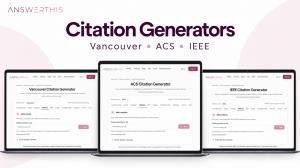
For researchers who have learned the hard way that AI-generated citations can be a minefield of phantom sources, a new set of tools from Y Combinator–backed AnswerThis offers a distinctly different approach. The company has rolled out citation generators for IEEE, ACS and Vancouver styles that pull bibliographic data directly from Crossref, PubMed and Open Library — no AI guesses, no hallucinated references.
AnswerThis launches citation generators for STEM papers using DOI, PubMed ID or ISBN records, with BibTeX and RIS export.
Accurate references start with reliable source records. Our generators retrieve bibliographic details and format them using citation style files, not AI guesses.”— Ayush GargSAN FRANCISCO, CA, UNITED STATES, November 28, 2026 /EINPresswire.com/ — AnswerThis, the AI research assistant backed by Y Combinator, has released IEEE, ACS and Vancouver citation generators that build numbered references for engineering, chemistry and biomedical papers from a DOI, PubMed ID or ISBN. The details come from Crossref, with DataCite as a fallback, PubMed and Open Library rather than from AI, and references can be exported to BibTeX or RIS. The first three sources are free per browser, shared across the AnswerThis citation pages.
The generators address a practical distinction across STEM publishing: numbered citation styles do not all follow the same rules. IEEE uses reference numbers in square brackets, ACS publications specify their required citation treatment, and ICMJE guidance for biomedical manuscripts calls for consecutive numbers in order of first mention. Selecting a style is therefore only part of preparing a reference list. Researchers must also check the target journal’s author instructions and reconcile citations with the final manuscript.
For engineering papers, the AnswerThis IEEE citation generator with numbered references formats source details using a pinned Citation Style Language file, a saved set of formatting rules. It displays in-text citations in square brackets, such as [1], and numbers references in saved-source order. Users must match that sequence to the order of first citation in their paper and reuse the original number when citing a source again.
That sequence follows a specific editorial convention rather than a generic numbered format. The IEEE editorial guidance places citation numbers on the text line, inside punctuation, and its 2025 reference guide writes multiple citations individually, such as [1], [2], [3], [4]. ACS journal requirements, by contrast, determine the applicable citation system. The Journal of the American Chemical Society requires references numbered with Arabic numerals in order of first citation.
For chemistry papers, the AnswerThis ACS citation generator for chemistry papers uses the standard ACS style file while reminding users to check the publication’s requirements. It accepts retrieved metadata or details entered by hand. Its output supports reference preparation but does not guarantee that an entry meets every journal-specific instruction.
For biomedical manuscripts, the AnswerThis Vancouver citation generator for medical journals produces numbered references and an in-text example such as (1). The ICMJE recommendations, updated in January 2026, call for consecutive numbering in order of first mention and Arabic numerals in parentheses. Full reference formatting follows the US National Library of Medicine’s Citing Medicine. Users must still check journal abbreviations, citation order and any adaptations required by the journal.
Across all three tools, retrieving source details is separate from formatting them. DOI lookups use Crossref, with DataCite when Crossref has no record, while PMIDs use NCBI PubMed and ISBNs use Open Library. Public web addresses use the page’s own metadata, and no AI generates citation details. The tools support 12 source types, including journal articles, conference papers, theses, datasets and software, but they do not upload or read PDFs.
After checking a record, users can edit it, change its style, copy the formatted citation or export saved references as BibTeX or RIS without using another free citation. The first three sources are shared across citation pages, not provided separately for each style. Researchers should compare missing or unusual metadata with the original source and review numbering after manuscript edits. Exported records may receive different formatting in another application, so the final bibliography also needs checking.
Questions about numbered references
How do I cite a source in IEEE style?
IEEE assigns each source a number in square brackets, such as [1], in the order it is first cited, and repeated citations keep that number. The reference list gives the full entries in numerical order. AnswerThis’s IEEE generator formats entries from supported identifiers, web addresses or manual details, but users must reconcile saved-source order with their manuscript.
Do the AnswerThis citation generators use AI to write references?
No. They retrieve DOI records from Crossref with DataCite as a fallback, PMIDs from NCBI PubMed, ISBNs from Open Library and website details from page metadata. Style files format those details into references. Missing or unusual metadata still needs checking against the source.
What is Vancouver referencing?
Vancouver is a numbered referencing system used by many biomedical journals and described in ICMJE guidance. References receive consecutive numbers in order of first mention, with Arabic numerals in parentheses in the text and full entries following Citing Medicine. Journals can adapt the format, so their instructions come first. AnswerThis provides a Vancouver citation generator without implying endorsement by ICMJE.
About AnswerThis
AnswerThis (answerthis.io) is an AI research assistant for literature reviews and evidence synthesis. It searches more than 250 million academic papers, drafts reviews with citations that can be checked against their sources, and offers free research tools including a PRISMA 2020 flow diagram generator, a citation generator for 24 styles and a reference checker. AnswerThis is backed by Y Combinator and is used by more than 1 million researchers.
Ryan Mccarroll
AnswerThis.io
ryan@answerthis.io
Visit us on social media:
LinkedIn
Instagram
Facebook
YouTube
TikTok
X
Also worth a look: LTW reveals five markers that separate resilient BMS factories from fragile suppliers and BoBo Machine: the Chinese supplier behind Midea’s insulated copper tube coils.
Why it matters: In an era where AI tools increasingly produce plausible-looking but fabricated citations, AnswerThis’s deliberate choice to rely on verified bibliographic databases rather than generative models sets a higher bar for research integrity. For the millions of researchers navigating strict journal formatting requirements, tools that separate data retrieval from formatting — and that require human verification at each step — may prove more trustworthy than black-box solutions.