Semiconductor innovation is accelerating at a breakneck pace, and at the heart of that transformation is FinFET technology—a transistor architecture that powers everything from AI processors to 5G smartphones. A new report projects this market will more than double in just a few years, with one Taiwanese giant commanding a quarter of all sales.
The Business Research Company’s latest analysis on the Fin Field-Effect Transistor (FinFET) Technology Global Market Report 2026 – Market Size, Trends, And Forecast 2026-2035 paints a detailed picture of a sector in overdrive.
The Business Research Company’s Fin Field-Effect Transistor (FinFET) Technology Global Market Report 2026 – Market Size, Trends, And Forecast 2026-2035
Also worth a look: Carexroads bets on trust over sales pitches with AI concierge and first 50 case manager slots and Geotab leads fragmented fleet market set to top $45B by 2030.
LONDON, GREATER LONDON, UNITED KINGDOM, October 8, 2026 /EINPresswire.com/ — The fin field-effect transistor (FinFET) technology market is advancing rapidly as semiconductor innovation continues to accelerate. Driven by surging demand across computing, mobile, automotive, and AI sectors, the market is poised for extraordinary growth. Below, we examine the current market size, competitive dynamics, leading players, and the key forces behind this expansion.
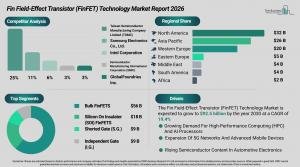
The FinFET technology market is projected to surpass $92 billion by 2030. This represents a significant slice of the broader Semiconductor And Related Devices market, which is expected to reach roughly $950 billion in the same year. Within the enormous Electrical And Electronics sector—forecasted at $5,579 billion by 2030—FinFET technology is anticipated to account for nearly 2% of total market value.
Request A Free Sample Of The Fin Field-Effect Transistor (FinFET) Technology Market Report
https://thebusinessresearchcompany.com/sample_request?id=82730327&type=smp&name=Fin%20Field-Effect%20Transistor%20%28FinFET%29%20Technology%20Market%20Report%202026&utm_source=EINPresswire&utm_medium=Paid&utm_campaign=Oct_PR
Understanding who holds the upper hand in the FinFET technology sector is critical. The leading players consist primarily of semiconductor foundries, integrated device manufacturers (IDMs), and fabless companies. These firms are pouring resources into next-generation process nodes, refining transistor architectures, adopting advanced lithography techniques, and scaling fabrication capabilities. Their focus is squarely on improving power efficiency, increasing transistor density, boosting processing performance, and optimizing yields to stay ahead. For industry stakeholders, these dynamics are essential for identifying growth and partnership opportunities within the evolving semiconductor manufacturing ecosystem.
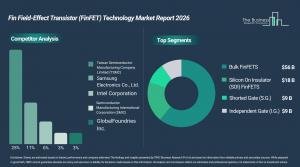
When it comes to market leadership in FinFET technology, one name stands out. Taiwan Semiconductor Manufacturing Company Limited (TSMC) dominated global sales in 2025, capturing a 25% share of the market, according to The Business Research Company. TSMC’s advanced foundry services span multiple FinFET process nodes, enabling the production of high-performance, energy-efficient chips tailored for smartphones, high-end computing, AI applications, automotive electronics, and sophisticated networking solutions.
Access The Detailed Fin Field-Effect Transistor (FinFET) Technology Market Report Here
https://thebusinessresearchcompany.com/report/fin-field-effect-transistor-finfet-technology-global-market-report?utm_source=EINPresswire&utm_medium=Paid&utm_campaign=Oct_PR
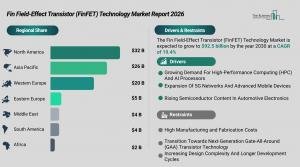
Geographically, North America is expected to be the largest regional market for FinFET technology by 2030, with a value reaching $32 billion—up from $13 billion in 2025. This represents a compound annual growth rate (CAGR) of 20%, driven by the presence of prominent foundries, fabless chip designers, hefty investments in AI and high-performance computing infrastructure, and strong government initiatives aimed at boosting domestic semiconductor production. Advances in cutting-edge process technology are also fueling this rapid regional expansion.
Breaking down the market by type, the FinFET technology landscape includes shorted gate (S.G.), independent gate (I.G.), bulk FinFETs, and silicon on insulator (SOI) FinFETs. Among these, bulk FinFETs are projected to be the largest segment by 2030, expected to account for 61% of the market—roughly $56 billion. Their widespread adoption is supported by superior electrostatic control that reduces leakage, compatibility with high-volume manufacturing, scalability across advanced nodes, and extensive use in mobile, computing, automotive, and networking processors.
Additional segmentation reveals further nuance. The market is divided by process technology nodes including 3nm, 5nm, 7nm, 10nm, 14nm, 16nm, 20nm, and 22nm. Applications span central processing units (CPU), system-on-chip (SoC), field-programmable gate arrays (FPGA), graphics processing units (GPU), and network processors. End users cover a broad spectrum such as mobile devices, cloud servers and high-end networks, Internet of Things (IoT) and consumer electronics, automotive, computers and tablets, wearable devices, among others.
Several crucial factors are propelling the FinFET technology market’s expansion through 2030. First, the surging demand for high-performance computing (HPC) and AI processors necessitates advanced chips that offer increased processing power combined with energy efficiency. FinFET technology supports this need by delivering higher transistor densities and improved switching performance, contributing roughly 1.5% to annual market growth.
The rollout of 5G infrastructure and the growing popularity of high-powered smartphones also drive the need for chips that provide efficient power management alongside high-speed processing. FinFET technology meets these demands through superior transistor performance and lower leakage rates, fueling an estimated 1.0% annual growth in the market.
The automotive sector, meanwhile, is incorporating more semiconductors due to the rise of electric vehicles, advanced driver-assistance systems (ADAS), and autonomous driving platforms. These applications require reliable, high-performance logic devices, which FinFET technology delivers through optimized energy efficiency and performance. This trend is expected to add approximately 0.8% to the market’s yearly growth.
Market concentration is a defining feature of this industry. The top 10 companies commanded 55% of total revenue in 2025, with high barriers to entry—including demanding fabrication technology, substantial R&D investments, and complex wafer manufacturing infrastructure—limiting new competitors. Leading firms maintain their positions through advanced manufacturing capabilities, strong industry partnerships, extensive IP portfolios, and continuous innovation in scaling and chip design. As demand for AI, HPC, 5G, advanced consumer electronics, and automotive semiconductors grows, these companies are set to benefit from ongoing technological advancements and capacity expansions.
The dominant players and their market shares in 2025 are as follows:
1. Taiwan Semiconductor Manufacturing Company Limited (TSMC) – 25%
2. Samsung Electronics Co., Ltd. – 11%
3. Intel Corporation – 6%
4. Semiconductor Manufacturing International Corporation (SMIC) – 3%
5. GlobalFoundries Inc. – 3%
6. NVIDIA Corporation – 3%
7. United Microelectronics Corporation (UMC) – 1%
8. Apple Inc. – 1%
9. Qualcomm Technologies Inc. – 1%
10. Advanced Micro Devices, Inc. (AMD) – 1%
Recent competitive advancements are also reshaping the landscape. The introduction of advanced 4nm FinFET process technology is revolutionizing the market by improving semiconductor performance, power efficiency, and manufacturing reliability. For example, in April 2026, Samsung Electronics enhanced its 4nm FinFET process, marking a refined progression before transitioning to Gate-All-Around (GAA) technology. This upgrade includes optimized interconnect architecture, improved yield stability, application-specific voltage options, and superior power-performance features, supporting AI, HPC, automotive, memory, and next-generation networking semiconductors.
Top companies are focusing on innovations in process nodes to push high-performance semiconductor manufacturing. They are forming strategic foundry alliances to speed up AI and HPC chip development, refining transistor architectures for better power efficiency and density, expanding fabrication capacities, and advancing technologies tailored to automotive and edge AI applications.
Segments including shorted gate (S.G.), independent gate (I.G.), bulk FinFETs, and silicon on insulator (SOI) FinFETs are expected to offer the most lucrative growth opportunities. Together, they are projected to add over $55 billion to the market’s value by 2030. Specifically, growth from 2025 to 2030 is forecasted as $6 billion for shorted gate, $7 billion for independent gate, $32 billion for bulk FinFETs, and $10 billion for SOI FinFETs. This expansion will be driven by advancements in semiconductor process technology, increasing integration of high-density logic for AI and data centers, ongoing transistor scaling, and the need for improved performance and power efficiency in next-generation integrated circuits.
Common questions about the FinFET technology market: A compound annual growth rate (CAGR) of 19% is anticipated through 2030. The USA is forecasted to be the largest country market, reaching $27 billion by 2030, up from $11 billion in 2025 at a 20% CAGR, supported by AI accelerators, advanced processor development, semiconductor research funding, defense and aerospace chip demand, and innovations in logic devices. Besides TSMC, Samsung, and Intel, other major companies include Semiconductor Manufacturing International Corporation (SMIC), GlobalFoundries, NVIDIA, United Microelectronics Corporation (UMC), Apple, Qualcomm, and Advanced Micro Devices (AMD), along with Broadcom, Huawei, NXP Semiconductors, Analog Devices, Micron Technology, Texas Instruments, Toshiba, Robert Bosch, MediaTek, Keysight Technologies, among others.
Essential raw material suppliers in this market comprise Shin-Etsu Chemical, SUMCO Corporation, GlobalWafers, Siltronic AG, SK Siltron, Entegris, JSR Corporation, Tokyo Ohka Kogyo, DuPont, Merck KGaA, BASF, Air Liquide, Linde plc, Resonac Holdings, Fujifilm Electronic Materials, Cabot Microelectronics, Honeywell International, Mitsubishi Materials, and Saint-Gobain. Key distributors include Arrow Electronics, Avnet, WPG Holdings, WT Microelectronics, Macnica Holdings, Richardson Electronics, TTI Inc., Mouser Electronics, DigiKey, EBV Elektronik, Rutronik Elektronische Bauelemente, Farnell, RS Group, Sager Electronics, Electrocomponents, Fusion Worldwide, Smith & Associates, and Astute Group. Leading end users encompass companies like Dell Technologies, HP, Lenovo, Microsoft, Amazon Web Services, Alphabet, Meta Platforms, Tesla, BYD, Cisco, Ericsson, Nokia, Sony, Xiaomi, Oppo, Vivo, Super Micro Computer, Oracle, and NEC.
Our 2026 market reports now include enhanced strategic insights through:
• Market attractiveness scoring and analysis
• Total addressable market (TAM) analysis
• Company scoring matrix graphics and tables
• Excel-based forecasting dashboards
• Market hotspots infographics
• Key technologies and future trend analysis
• Updated graphics and tables
About The Business Research Company
The Business Research Company (www.thebusinessresearchcompany.com) is a renowned market intelligence firm specializing in company, market, and consumer research. With over 30,000+ reports spanning 27 industries and more than 60 geographies, their insights draw upon 1.5 million datasets, extensive secondary research, and interviews with industry leaders. They offer a range of tailored research packages such as Market Entry, Competitor Tracking, and Supplier & Distributor packages.
Disclaimer: The information provided by TBRC Business Research Pvt Ltd is gathered in good faith from primary and secondary sources, though accuracy cannot be fully guaranteed. The company disclaims liability for any actions taken based on its findings, which are intended as estimates and opinions rather than definitive facts or investment advice.
Contact Information
The Business Research Company
Americas: +1 310-496-7795
Europe: +44 7882 955267
Asia & Others: +44 7882 955267 / +91 8897263534
Email: marketing@tbrc.info
Follow on LinkedIn: https://in.linkedin.com/company/the-business-research-company
Oliver Guirdham
The Business Research Company
+44 7882 955267
Visit us on social media:
LinkedIn
Facebook
X
Why it matters: FinFET technology is the backbone of the chips powering today’s AI boom, 5G networks, and electric vehicles. As the market barrels toward $92 billion, the dominance of TSMC and the concentration of power among a handful of players will shape everything from smartphone performance to national semiconductor strategies for years to come.