The fleet management industry is barreling toward a $45 billion valuation by 2030, and the numbers reveal a market that is both booming and strikingly splintered. A fresh analysis from The Business Research Company lays out the landscape, with North America leading the charge and Geotab Inc. barely edging out rivals in a field where the top ten players combined claim just 13% of revenue.
The Business Research Company’s Fleet Management Global Market Report 2026 – Market Size, Trends, And Forecast 2026-2035 provides the data behind this trajectory.
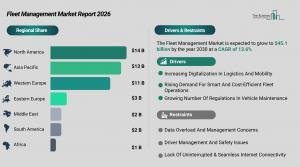
The Business Research Company’s Fleet Management Global Market Report 2026 – Market Size, Trends, And Forecast 2026-2035
Also worth a look: TrustedFirms.io survey finds 87.7% of Americans walk away from businesses with thin online info and OmniMD warns Medicare’s 2027 fee schedule could slash same-day E/M pay by 50%.
LONDON, GREATER LONDON, UNITED KINGDOM, October 8, 2026 /EINPresswire.com/ — The fleet management sector is built on a mix of global telematics providers, fleet technology specialists, and automotive software developers. These companies are racing to improve vehicle tracking, real-time monitoring, predictive maintenance, and integrated data analytics. Fuel efficiency, driver safety, regulatory compliance, and the integration of artificial intelligence (AI) with Internet of Things (IoT) technologies have become critical differentiators. For stakeholders navigating the fast-changing transportation, logistics, and mobility management arenas, understanding this complex environment is essential to capturing growth, driving innovation, and forging strategic partnerships.
According to the report, the fleet management market is projected to exceed $45 billion by 2030. That figure represents roughly 51% of the broader Automotive Technology market, which is expected to hit $89 billion in the same period. When placed inside the immense Information Technology industry—forecast to reach $13,788 billion by 2030—fleet management accounts for just 0.3% of total spending. Still, the sector is growing at a robust compound annual growth rate (CAGR) of 14% leading up to 2030.
A free sample of the full Fleet Management Market Report is available here:
https://thebusinessresearchcompany.com/sample_request?id=5679&type=smp&name=Fleet%20Management%20Market%20Report%202026&utm_source=EINPresswire&utm_medium=Paid&utm_campaign=Oct_PR
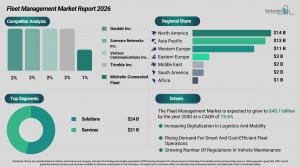
North America is expected to dominate the fleet management market in 2030, with a valuation of $14 billion compared to $8 billion in 2025—a 13% CAGR. That rapid expansion is fueled by advances in connected vehicle technologies for commercial fleets, rising demand for real-time fleet control, investments in intelligent transportation systems, and data-driven mobility solutions aimed at boosting efficiency and compliance. Within the region, the United States is projected to hold the largest share, reaching $12 billion by 2030 from $7 billion in 2025, a 12% CAGR. US growth is driven by increased telematics adoption for commercial vehicle management, fuel and route optimization, driver behavior monitoring, safety programs, and cloud-based fleet intelligence tools that enhance asset utilization and productivity.
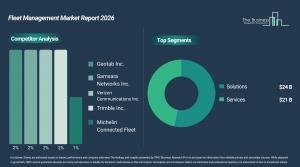
The fleet management market splits into two primary components: solutions and services. Solutions are forecast to represent the larger share by 2030, accounting for 53%—or $24 billion—of the total market. This segment benefits from innovations such as predictive maintenance, vehicle diagnostics, automated scheduling and dispatch, AI-driven performance analytics, and centralized fleet software that streamlines decision-making and operational efficiency. Additional segmentation includes vehicle type (heavy and light commercial vehicles, aircraft, railway, and watercraft), industry applications (retail, government, transportation and logistics, automotive, and others), communication technology (GNSS satellite-based and cellular), and deployment models (on-premises and cloud-based).
Access the detailed Fleet Management Market Report here:
https://thebusinessresearchcompany.com/report/fleet-management-global-market-report?utm_source=EINPresswire&utm_medium=Paid&utm_campaign=Oct_PR
Digitalization across logistics and mobility sectors is a primary growth driver. Companies are increasingly adopting cloud computing, telematics, IoT sensors, and AI analytics to track vehicles, drivers, and cargo in real time. These technologies improve route optimization, fuel efficiency, predictive maintenance, and asset utilization while offering better visibility across transportation networks. This digital shift is expected to add roughly 2.5% annual growth to the market. At the same time, demand for intelligent, cost-effective fleet operations is rising. Automated scheduling, route optimization, driver behavior monitoring, fuel consumption reduction, and better vehicle utilization help lower costs and boost productivity—trends that should deliver about 2.3% growth annually. Stricter vehicle maintenance regulations are also pushing fleet operators toward automated compliance management, preventive maintenance scheduling, and digital reporting. These regulatory pressures are forecast to add around 2.0% annual growth, encouraging higher safety and operational standards.
According to The Business Research Company, Geotab Inc. led the global market in 2025 with a 2% share. Geotab’s offerings include telematics platforms, vehicle tracking systems, fleet analytics tools, and connected vehicle technologies that enable real-time monitoring, operational efficiency, driver safety, and optimized transportation management.
The fleet management market remains relatively fragmented: the top 10 companies collectively accounted for just 13% of total revenue in 2025. Entry barriers are moderate, given the need for sophisticated telematics, stringent data security, vehicle platform integration, regulatory compliance, and reliable fleet optimization across logistics and transportation. Incumbents hold their positions through advanced telematics, comprehensive solutions, strong customer relationships, strategic partnerships, and continuous innovation in connected vehicle technologies. As demand for real-time monitoring, predictive maintenance, driver safety, and data-driven optimization grows, collaborations and geographic expansion will be critical. The leading companies and their 2025 market shares include: Geotab Inc. (2%), Samsara Networks Inc. (2%), Verizon Communications Inc. (2%), Trimble Inc. (2%), Michelin Connected Fleet (1%), Bridgestone (Azuga Inc.) (1%), KeepTruckin Inc. (Motive) (1%), MiTAC International Corporation (1%), Teletrac Navman US Ltd. (1%), and ORBCOMM Inc. (1%).
Artificial intelligence is reshaping fleet management, refining vehicle lifecycle management, replacement planning, and enabling data-informed investment decisions. In July 2026, for example, Utilimarc launched SmartReplace, an AI-based workflow tool designed to optimize vehicle replacement choices for fleets by analyzing inventory, usage, maintenance, and work-order data. The tool enhances planning efficiency, allows scenario modeling, and boosts vehicle utilization and asset management.
Successful strategies in the sector include developing advanced technologies for better tracking and performance, leveraging fleet optimization tools to improve planning and productivity, expanding operations to elevate transportation efficiency and safety, and incorporating AI for improved maintenance and real-time monitoring.
The solutions and services segments present the largest growth opportunities, collectively expected to add over $21 billion in market value by 2030. Solutions are projected to grow by $11 billion, while services will add $10 billion between 2025 and 2030. This growth is driven by increasing adoption of connected vehicle technologies, demand for real-time monitoring and analytics, telematics and GPS tracking, and a focus on regulatory compliance and driver safety. These factors reflect operators’ ongoing efforts to improve asset utilization, reduce costs, optimize routing, and manage fleets using data-driven approaches.
Prominent companies active in the field include Geotab Inc., Samsara Networks Inc., Verizon Communications Inc., Trimble Inc., Michelin Connected Fleet, Bridgestone (Azuga Inc.), KeepTruckin Inc. (Motive), MiTAC International Corporation, Teletrac Navman US Ltd., ORBCOMM Inc., TomTom International B.V., MiX Telematics International (Pty) Ltd., Fleet Complete Ltd., GPS Insight, Siemens AG, Gurtam JLLC, NexTraq LLC, Donlen Corporation, RAM Tracking, Ctrack (Inseego Corp.), Masternaut Ltd., Omnitracs LLC, US Fleet Tracking, Utilimarc Inc., Freeway Fleet Systems, and Automile Inc.
Key suppliers supporting the ecosystem include Robert Bosch GmbH, Continental AG, Denso Corporation, ZF Friedrichshafen AG, Aptiv PLC, Valeo S.A., Magna International Inc., Panasonic Automotive Systems Co., Ltd., Harman International Industries, Inc., Garmin Ltd., TomTom N.V., Trimble Inc., Queclink Wireless Solutions Co., Ltd., Sierra Wireless, Inc., Telit Cinterion, Semtech Corporation, u-blox AG, Thales Group, STMicroelectronics N.V., NXP Semiconductors N.V., Infineon Technologies AG, Texas Instruments Incorporated, Murata Manufacturing Co., Ltd., TE Connectivity Ltd., and Analog Devices, Inc.
Significant distributors and wholesalers include Arrow Electronics, Inc., Avnet, Inc., Digi-Key Electronics, Mouser Electronics, Inc., RS Group plc, Newark Electronics, TTI, Inc., Allied Electronics & Automation, Inc., Macnica, Inc., WPG Holdings Limited, Rutronik Elektronische Bauelemente GmbH, Farnell Global, Sager Electronics, Inc., Master Electronics, Inc., PEI-Genesis, Inc., Heilind Electronics, Inc., Richardson Electronics Ltd., Smith & Associates, Fusion Worldwide, Inc., Powell Electronics, Inc., Bisco Industries, Inc., Richardson RFPD, Inc., and Sourceability LLC.
Leading end users include Verizon Connect, MiX Telematics Limited, Omnitracs LLC, Motive Technologies, Inc., KeepTruckin, Inc., Teletrac Navman US Ltd., Webfleet Solutions B.V., Lytx, Inc., Azuga Holdings, Inc., CalAmp Corp., Donlen Corporation, Element Fleet Management Corporation, Wheels, Inc., LeasePlan Corporation N.V., Arval BNP Paribas Group, Enterprise Fleet Management, Ryder System, Inc., Penske Truck Leasing Co., L.P., and FedEx Corporation.
What’s included in the 2026 market reports:
• Market attractiveness scoring and analysis
• Total addressable market (TAM) analysis
• Company scoring matrix graphics and tables
• Excel-based forecasting dashboards
• Market hotspots infographics
• Key technologies and future trend analysis
• Updated graphics and tables
About The Business Research Company: The Business Research Company (www.thebusinessresearchcompany.com) is a market intelligence firm specializing in company, market, and consumer research. With over 30,000+ reports spanning 27 industries and more than 60 geographies, their insights draw upon 1.5 million datasets, extensive secondary research, and interviews with industry leaders. They offer tailored research packages including Market Entry, Competitor Tracking, and Supplier & Distributor packages.
Disclaimer: The information provided by TBRC Business Research Pvt Ltd is gathered in good faith from primary and secondary sources, though accuracy cannot be fully guaranteed. The company disclaims liability for any actions taken based on its findings, which are intended as estimates and opinions rather than definitive facts or investment advice.
Contact Information:
The Business Research Company
Americas: +1 310-496-7795
Europe: +44 7882 955267
Asia & Others: +44 7882 955267 / +91 8897263534
Email: marketing@tbrc.info
Follow on LinkedIn: https://in.linkedin.com/company/the-business-research-company
Oliver Guirdham
The Business Research Company
+44 7882 955267
Visit us on social media:
LinkedIn
Facebook
X
Why it matters: The fleet management market’s projected surge to $45 billion by 2030 underscores how digital transformation and AI are reshaping logistics and transportation at a fundamental level. For businesses and governments alike, the race to adopt telematics, predictive maintenance, and real-time analytics will determine who leads in efficiency, safety, and cost control in the decade ahead.