SEO consultant Raaquib Pathan, who operates out of Dubai, has released a fresh AI SEO case study centered on a German SaaS platform that grew GenAI impressions from zero to 100,000.
A recent B2B SaaS launch managed to achieve AI search visibility within a single quarter, bypassing the typical multi-year wait for domain authority. Here is the strategy that made it happen.
Many founders believe a new domain must endure years before search starts delivering returns. Raaquib Pathan, a Dubai-based SEO consultant, ran a project that challenges that belief.
Also worth a look: Antwann Richardson Is Making His Back 9 His Best 9—and Helping Others Do the Same and Indonesia’s 100 GWp Solar Ambition Opens New Investment Opportunities as Indonesia Courts Global Capital.
The client—a German B2B SaaS platform operating in the European funding sector—began with absolutely nothing: no backlinks, no search history, and no presence inside AI-generated answers.
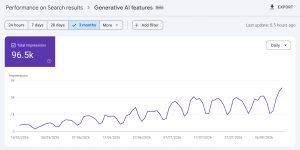
Ninety days later, the situation had transformed. Every number below is taken directly from Google Search Console or Google Analytics 4, with no estimates or modeling involved.
• 2,000+ organic clicks each month
• 100K GenAI impressions recorded in Search Console
• 200+ referral visits coming from ChatGPT and other AI assistants
• 50+ product signups per month
• Unpaid editorial links obtained from European government domains
For a site that started at absolute zero, that represents a robust first quarter. The more relevant question is what drove the results.
The starting point was about as challenging as it gets. The domain carried no authority, and the niche was already saturated. Grants, subsidies, and public programs are topics where government and public-sector websites dominate the top positions.
An additional, newer challenge existed as well. The product had strong market fit, yet the brand was completely absent from ChatGPT, Gemini, and AI Overviews. As AI answers absorb an increasing share of clicks, that absence translates into lost pipeline.
Raaquib’s analysis was straightforward. A new site cannot outmatch government domains on trust, so it must out-format them. Being the clearest, most quotable answer mattered more than raw authority.
That is where two newer disciplines came into play, built on top of sound technical SEO.
• Answer Engine Optimization (AEO): getting cited inside AI answers rather than merely ranking in blue links.
• Generative Engine Optimization (GEO): shaping how AI engines interpret and describe a brand.
One principle guided the entire plan: make the brand the easiest and most trustworthy source for an AI model to quote, then earn signals in all the places that model already checks.
Raaquib executed eight pillars across three fronts simultaneously. A new site rarely has the luxury to test one tactic per quarter.
The first front focused on the site itself, where everything was built to be quotable.
• Country-specific pages structured around clear questions with self-contained answers.
• An LLM info page and an llms.txt file that give AI assistants a single plain-language description of the product.
• A dedicated FAQ page with one question per block, so each answer stands independently.
• Regular blog publishing, with every post reviewed by a human before going live.
The common thread is quotability. If a sentence only makes sense alongside the surrounding page, an AI model is far less likely to extract it.
The second front borrowed reach from platforms that already possessed trust.
• Placements in “best tools” roundups on high-authority sites, because AI answers tend to rely on listicles when recommending software.
• Useful replies in country-specific Reddit and Quora threads where buyers were already seeking help.
• Supporting LinkedIn posts that reinforced the same positioning.
Consistency did the heavy lifting. When the same product description appears across multiple platforms, the model has less room to guess.
The third front—digital PR—was the slowest yet most durable. Outreach efforts earned editorial links from mid-tier European news sites, and the site also picked up unpaid editorial links from European government domains.
On measurement, Raaquib is more candid than most case studies.
No tool today can reveal how often a brand is cited inside AI answers, or on which prompt. That data is not yet exposed, so he relies on two verifiable proxies.
• GenAI impressions from the Generative AI features report in Search Console.
• LLM referral traffic in GA4, meaning sessions that arrive from AI assistants.
Reporting in this area continues to evolve, which is why he maintains a public SEO updates tracker that logs algorithm changes, AI search features, and tooling releases each month.
He is equally direct about attribution. Eight tactics ran concurrently, so it is clear what moved together, but not always which single action caused which individual win.
For SaaS founders, a few lessons extend well beyond one client.
• A new domain is not a disqualifier. AI answers pull from clearly formatted, trustworthy sources.
• Quality over volume. Short, standalone answers and human-reviewed posts are what models can reuse with confidence.
• Describe yourself before a model does. A consistent entity description leaves less room for invented details.
• Go where models already look. Listicles, community threads, and news coverage all feed AI answers.
• Report honestly. Use Search Console and GA4, and call proxies what they are.
The platform targets buyers in more than one European market, so a single generic page was never sufficient. Each market needed its own questions answered directly.
That thinking shapes Raaquib’s work as an SEO consultant in Germany: country-specific pages written to be cited, supported by local community threads and European news coverage.
For founders entering Germany or the wider EU, the takeaway is practical. Build for each market on its own terms, and keep the brand description identical everywhere.
“AEO and GEO are still young,” Raaquib Pathan notes, and much of this project was tested in parallel, not assumed to work.
The outcome still stands on verified data. A brand-new SaaS site reached 100K GenAI impressions, 2,000+ monthly organic clicks, and steady signups in a single quarter, without an aged domain behind it.
For teams watching AI answers absorb more clicks, that is a useful benchmark. The work is unglamorous, measurable, and open to any company willing to be the clearest answer in its category.
Raaquib Pathan
Raaquib: Dubai SEO Consultant
email us here
Visit us on social media:
LinkedIn