
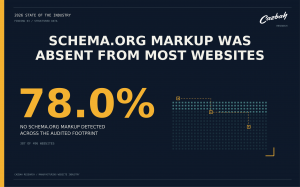
According to the findings, 78% of manufacturing websites did not have Schema markup present.
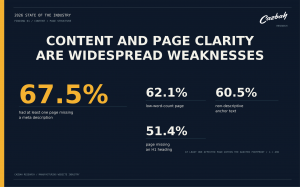
Cazbah’s 2026 Manufacturing Website Industry Report identifies widespread issues with content and clarity.
Cazbah’s 2026 analysis of manufacturing websites uncovers serious gaps in SEO, content, schema, crawlability, and search visibility across 528 U.S. industrial websites.
The data is truly remarkable. Our research showed that nearly three out of four manufacturing websites were underperforming, and roughly 30% were severely underperforming.”— Charles BroersmaFARMINGTON, NY, UNITED STATES, August 26, 2026 /EINPresswire.com/ — Cazbah, a veteran-owned digital marketing agency that works with small and mid-sized B2B manufacturers, has published its 2026 State of the Manufacturing Website Industry report. The report, based on an evaluation of 528 eligible U.S. manufacturing and industrial websites, provides practical benchmark data for industrial owners, leadership teams, engineers, operations leaders, procurement teams, and marketers to assess website clarity, crawlability, search visibility, and buyer pathways.
The sample sizes varied per dataset: 496 websites had complete technical audit records, 507 had organic visibility records, and 525 had backlink records. Technical audits were set to examine up to 50 pages per site, and each percentage is calculated using the eligible sample for that specific metric.
Since the study merges technical, organic, and backlink datasets, the findings should be treated as benchmarks rather than performance grades. A technical issue on one audited page qualifies a website for that metric, but it does not imply the same problem affects every page. Organic traffic numbers are third-party estimates, not analytics sessions, and Authority Score is a proprietary SEMrush metric. Cazbah recommends comparing the benchmark data with first-party analytics, Search Console performance, RFQ activity, lead quality, and sales outcomes before setting priorities.
The report’s 11 key findings are:
67.5% of audited websites had at least one page lacking a meta description, 62.1% had at least one page with low word count, 60.5% used non-descriptive anchor text, and 51.4% had at least one page missing an H1 heading.
29.4% returned at least one 4xx status code, 25.6% contained at least one broken internal link, and 25.0% included at least one page blocked from the audit crawler.
78.0% had no Schema.org markup detected across the audited pages.
28.8% ranked for fewer than 100 organic keywords, and 18.9% received fewer than 100 estimated monthly organic visits.
30.1% had a third-party Authority Score below 10, indicating limited external recognition or other authority constraints within that scoring model.
For manufacturers, these website conditions can impact different stages of supplier evaluation. Engineers need clear information about materials, tolerances, equipment, applications, and capabilities. Procurement teams look for certifications, quality controls, service areas, resources, and contact paths. Operations leaders need evidence of capacity, delivery support, and process fit. When essential information is hard to find, poorly organized, or unavailable due to broken links, qualified buyers may lack the confidence to proceed. Strong manufacturing website design and SEO help connect these details so visitors and search systems can identify what the company offers.
No single finding proves that a manufacturer has lost rankings, traffic, leads, RFQs, or revenue. However, taken together, the findings show where a website creates friction for technical buyers or makes important capabilities harder for search systems to understand. These issues are common across the studied manufacturing websites and should be addressed with each new website build or update.
“The data is really astounding,” says Charles Broersma, Founder and CEO of Cazbah. “Our study found that nearly 3 out of 4 manufacturing websites were underperforming, with around 30% dramatically underperforming. It takes a great partner to pull these companies out of the slump they’re in.”
The report recommends treating each manufacturing website as an ongoing business system. Manufacturers should first fix access problems and broken buyer paths, then strengthen high-value capability, product, industry, application, and RFQ pages. Accurate structured data, credible external recognition, and separate tracking for visibility, inquiries, qualified leads, RFQs, pipeline, and sales can support better decisions over time.
The recommended order helps manufacturers and industrial companies avoid spending resources on cosmetic improvements while higher-impact problems remain. Repairing broken navigation, inaccessible resources, and failed RFQ pathways protects demand. Strengthening capability pages then gives buyers the details needed to evaluate fit. Structured data, internal linking, external authority, and ongoing measurement support broader search visibility after those foundations are working.
Cazbah applies this same buyer-focused approach to SEO for industrial companies, connecting technical information, search visibility, usability, and conversion paths. Manufacturers that want to compare their current site against the report’s findings can request Cazbah’s Website & Lead Analysis for a practical review of buyer clarity, visibility, and lead pathways.
FAQ
What does Cazbah’s manufacturing website report measure?
The report measures common conditions involving content, page structure, crawlability, structured data, organic visibility, and external authority across eligible U.S. manufacturing and industrial websites.
What should manufacturers fix first?
Start with problems that interrupt active buyer journeys, including broken RFQ paths, unavailable pages, broken internal links, and unintentionally blocked capability or product pages. Then improve the content and structure of high-value pages.
Does missing Schema.org markup automatically hurt rankings?
No. Structured data is not required to rank on Google or in AI models, and adding it does not guarantee better search placement. Accurate markup can help search systems interpret a page’s content and business entities more clearly.
How can a manufacturer improve SEO on its website?
Make important pages crawlable and easily accessible through internal linking, answer technical buyer questions completely, use clear page titles and headings, repair broken links, and track organic visibility alongside qualified inquiries and RFQs.
Why does website content matter for manufacturing buyers?
Manufacturing buyers often research suppliers before making contact. Detailed content about processes, materials, tolerances, equipment, certifications, applications, and RFQ requirements helps engineering and procurement teams evaluate whether a supplier can meet the project’s technical and commercial needs. Visibility to B2B buyers at all stages of discovery will improve the odds that a procurement team will send an RFQ.
About Charles
Charles Broersma is the Founder and CEO of Cazbah. He has over 25 years experience helping small and mid-sized B2B manufacturers improve digital visibility, website performance, and lead generation through practical strategies aligned with industrial buying behavior.
About Cazbah
Cazbah is a veteran-owned digital marketing agency serving small and mid-sized B2B manufacturers, industrial companies, distributors, OEMs, fabricators, machine shops, and technical suppliers. Its Total Internet Marketing Solution includes website design and development, SEO, content marketing, Google Ads/PPC, analytics, email marketing, social media, and dedicated Internet Marketing Consultant support focused on qualified visibility, stronger buyer experiences, RFQs, and long-term sales opportunities.
Charles Broersma
Cazbah
+1 (866) 422-9224
marketing@cazbah.net
Visit us on social media:
LinkedIn
Instagram
Facebook
YouTube