
The numbers coming out of the catheter shaft manufacturing sector are hard to ignore: a market worth nearly $2 billion today is on track to double within the next five years. The driving force? A global shift away from traditional open surgery toward techniques that leave smaller scars and shorten recovery times.
The Business Research Company’s Catheter Shaft Manufacturing Global Market Report 2026 – Market Size, Trends, And Forecast 2026-2035
The catheter shaft manufacturing industry is undergoing a notable expansion, propelled by breakthroughs in medical technology and evolving healthcare approaches. A growing preference for minimally invasive treatments, combined with rising rates of cardiovascular and neurological disorders, is pushing this market forward. Below, we break down the market’s current size, the forces driving it, regional trends, and the innovations shaping its future.
Also worth a look: CASAMONTE’s new calculator hub tackles the messy math of interior surface projects and Intellibright targets wasted HubSpot spend with new revenue-focused implementation services.
Catheter Shaft Manufacturing Market Size and Projected Growth
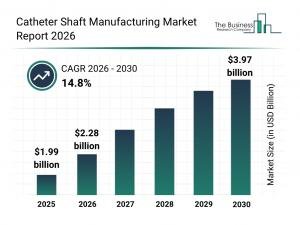
The catheter shaft manufacturing market has been growing at a rapid clip. Its value climbed from $1.99 billion in 2025 to an estimated $2.28 billion in 2026, a compound annual growth rate (CAGR) of 14.6%. That upward trajectory is tied directly to the rising demand for minimally invasive procedures, a higher incidence of cardiovascular diseases, the broader application of endovascular treatments, and a growing preference for neurological catheter interventions. Looking further ahead, analysts expect the market to hit $3.97 billion by 2030, with a CAGR of 14.8%. What’s fueling that future growth? The adoption of more sophisticated catheter designs, an increase in complex interventional procedures, and a demand for shafts that offer better flexibility and pushability.
Download a free sample of the catheter shaft manufacturing market report:
https://www.thebusinessresearchcompany.com/sample_request?id=51054967&type=smp&name=Catheter%20Shaft%20Manufacturing%20Market%20Report%202026&utm_source=EINPresswire&utm_medium=Paid&utm_campaign=Oct_PR
Key Drivers Behind the Growth of Catheter Shaft Manufacturing
At the heart of this market’s expansion is the dramatic rise in minimally invasive procedures. These techniques use small incisions or natural body openings to diagnose and treat conditions, which means less tissue damage and quicker recoveries than conventional surgery. Thanks to advances in technology, these interventions are now safer and more precise than ever—and that’s driving wider adoption. The result is a growing need for catheter shafts that are flexible, responsive to torque, resistant to kinking, and able to navigate tight anatomical pathways during both diagnostic and therapeutic work.
To illustrate this trend, data from June 2024 shows that minimally invasive hyaluronic acid filler procedures in the United States hit 5.29 million in 2023—an 8% increase from the year before, according to the American Society of Plastic Surgeons. While that example comes from aesthetics, it reflects a broader movement toward less invasive techniques across medicine, which in turn is boosting demand for advanced catheter shaft manufacturing.
View the full catheter shaft manufacturing market report:
https://www.thebusinessresearchcompany.com/report/catheter-shaft-manufacturing-market-report?utm_source=EINPresswire&utm_medium=Paid&utm_campaign=Oct_PR
Defining Catheter Shaft Manufacturing and Its Importance
Catheter shaft manufacturing is a highly regulated, intricate process that produces the tubular core of medical catheters. It typically involves co-extruding multiple polymer layers, adding internal wire braiding or coiling to boost mechanical strength, and applying specialized coatings. The quality of this manufacturing process directly determines a catheter’s flexibility, pushability, and kink resistance—critical traits that affect performance in delicate neurological and endovascular procedures.
Emerging Trends Reshaping Catheter Shaft Designs
Looking ahead, the market is increasingly turning to innovative shaft structures. Multilayer designs are being adopted to improve strength and durability. Braided shafts are gaining traction for their mechanical stability, while coiled shafts offer better flexibility and resistance to kinking. There’s also growing interest in specialized coatings that boost catheter performance, leading to better patient safety and higher procedural success rates.
Regional Overview of the Catheter Shaft Manufacturing Market
North America held the largest share of the catheter shaft manufacturing market in 2025, thanks to its advanced healthcare infrastructure and strong demand for minimally invasive procedures. But Asia-Pacific is expected to be the fastest-growing region over the forecast period. The report covers key regions including Asia-Pacific, South East Asia, Western Europe, Eastern Europe, North America, South America, the Middle East, and Africa, offering a comprehensive view of global market dynamics.
What’s new in our 2026 market reports:
• Market attractiveness scoring and analysis
• Total addressable market (TAM) analysis
• Company scoring matrix graphics and tables
• Excel dashboards
• Market hotspots infographics
• Key technologies and future trends
• Updated graphics and tables
Speak With Our Expert:
Saumya Sahay
Americas +1 310-496-7795
Asia +44 7882 955267 & +91 8897263534
Europe +44 7882 955267
Email: marketing@tbrc.info
The Business Research Company – www.thebusinessresearchcompany.com
Follow Us On:
• LinkedIn: https://in.linkedin.com/company/the-business-research-company
Oliver Guirdham
The Business Research Company
+44 7882 955267
info@tbrc.info
Visit us on social media:
LinkedIn
Facebook
X
Why it matters: This market’s sustained double-digit growth signals that the medical device industry is betting heavily on minimally invasive techniques for the long haul. For patients and healthcare systems alike, that means more procedures that reduce trauma, shorten hospital stays, and lower overall costs—but it also puts pressure on manufacturers to keep innovating on flexibility, durability, and safety.