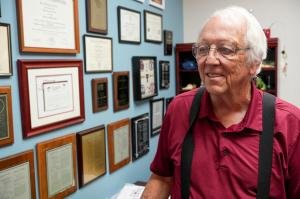
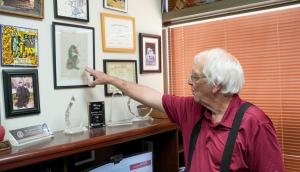
Samuel Prien, Ph.D., from Texas Tech University Health Sciences Center, showcases artwork created by students.
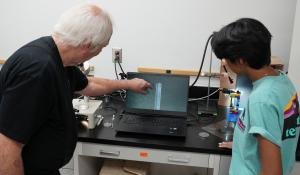
Graduate student Sanjana Akula collaborates with Samuel Prien, Ph.D., at Texas Tech University Health Sciences Center.
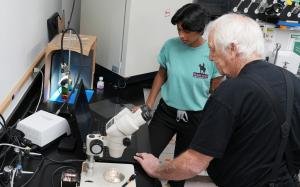
Samuel Prien, Ph.D., alongside graduate student Sanjana Akula, demonstrates a technique for choosing viable embryos.
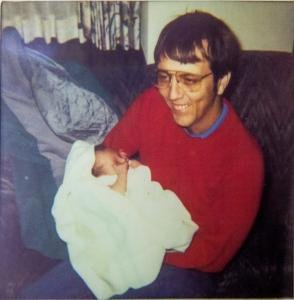
The first baby conceived through in-vitro fertilization in Lubbock, Texas, was delivered in 1989 under the guidance of Samuel D. Prien, Ph.D.
I have watched this institution develop, and I hope I have developed alongside it. I have had the privilege of mentoring more than 50 students. I have conducted research that I believe has made a difference and brought all of these achievements to life.”— Samuel Prien, Ph.D., Texas Tech University Health Sciences CenterLUBBOCK, TX, UNITED STATES, July 28, 2026 /EINPresswire.com/ — A third-floor office at the Texas Tech University Health Sciences Center (TTUHSC) will soon sit vacant. After nearly five decades with the university, Samuel Prien, Ph.D., is clearing out his workspace ahead of his August retirement. Though he is moving on, his legacy endures.
Prien occupies a distinctive position within the Texas Tech University System. He holds a joint appointment as a professor in the TTUHSC School of Medicine’s Department of Obstetrics and Gynecology and in the Texas Tech University (TTU) Department of Animal and Food Sciences.
“I instruct medical students, residents, undergraduates, and graduates,” Prien said. “In short, I teach everyone. I calculate that roughly 10,000 individuals have been touched by my work.”
Anyone entering Prien’s office first notices a wall covered with his achievements. The arrangement of diplomas, awards, fellowships, and patents provides a small visual summary of his numerous accomplishments. Yet he quickly directs attention to the opposite wall.
“That side carries far more significance for me,” Prien said. “Those are items from my students.”
Above his desk, Prien keeps a grouping of drawings, paintings, and photographs.
“It’s remarkable how talented the people who have worked in my lab are,” Prien said. “I don’t see them as objects. Whenever I look at them, I recall the person who was there.”
Prien lights up when discussing teaching, but he minimizes his own role.
“People took chances on me,” he said. “My small way of repaying them is to take others in whom I recognize those same abilities and let them become what they can.”
Sanjana Akula, a graduate student in the TTU Department of Animal and Food Sciences, will count among Prien’s last students.
“Everyone I’ve learned from in reproductive physiology has either been Dr. Prien or has been taught by Dr. Prien,” Akula said.
“Think of this as a ripple in a pond,” Prien said. “I am the stone. The ripples keep spreading. Hopefully, they go on forever. The students create their own ripples, and everything improves.”
Prien’s ripples extend far beyond TTUHSC’s corridors. His breakthroughs in fertility treatments have enabled thousands of people to build families.
“During my time here, I estimate at least 3,800 babies have been born,” Prien said. “That is probably an undercount. I know we averaged about 100 babies a year for a while.”
Prien was part of the first successful birth using Assisted Reproductive Technology (ART) at TTUHSC in the late 1980s.
“The first one was called the GIFT [gamete intra-fallopian transfer] baby back then, because we were still learning how to culture embryos,” Prien said. “We would take her eggs and his sperm, place them back into her