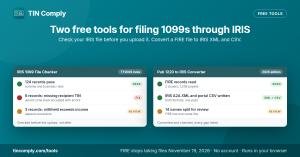
With the IRS retiring its FIRE filing system in just over a year, businesses that file 1099s are facing a hard deadline and a steep learning curve. TIN Comply is stepping in with two free utilities designed to take the guesswork out of the mandatory shift to the IRS Information Returns Intake System (IRIS).
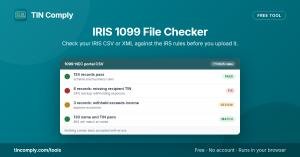
The IRIS 1099 File Checker runs an IRIS portal CSV or A2A XML file through the IRS business rules for its tax year before it is uploaded.
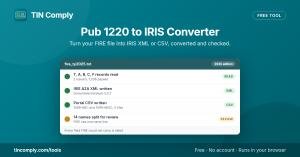
The Pub 1220 to IRIS Converter reads a FIRE file, detects its Pub 1220 edition, and writes IRIS A2A XML and portal CSV files that are converted and checked.
Also worth a look: Matilda Technologies wins second project from beverage giant after European yard go-live and Priority 1 Air Rescue taps Kolby Gaertner to unify simulation training line.
A free IRIS 1099 File Checker and a Pub 1220 to IRIS Converter run in the browser with no account, as FIRE stops taking files on November 19, 2026.
The stakes are clear: the IRS publishes the rules but not a place to try a real file against them, and the first time most filers meet those rules is the filing itself. These two tools put the check in front of the upload.
AUSTIN, TX, UNITED STATES, October 9, 2026 /EINPresswire.com/ — TIN Comply today released two free, browser-based tools for businesses moving their 1099 filing to the IRS Information Returns Intake System (IRIS): the IRIS 1099 File Checker, which checks an IRIS file against the IRS business rules before it is uploaded, and the Pub 1220 to IRIS Converter, which handles the FIRE to IRIS move by turning a legacy FIRE file into IRIS XML and portal CSV files. Both run entirely in the browser, need no account, and are available now at tincomply.com/tools.
Why now
The clock is ticking on the IRS FIRE system, which stops taking files on November 19, 2026. Starting with the January 2027 filing season, every electronic filer of Forms 1097, 1098, 1099, 3921, 3922, 5498 and W-2G must use IRIS. IRIS applies a published set of business rules to every file it receives, but it offers no place to test a real file: the Taxpayer Portal has no test mode and the A2A test system refuses live taxpayer data. A file that breaks a rule comes back rejected, or worse, “accepted with errors,” where the forms are filed and the problems are recorded against them. Filers whose software still writes the FIRE format face a second problem: FIRE’s fixed-width records and IRIS’s XML and CSV templates do not map one to one, and the IRS does not provide a conversion tool.
IRIS 1099 File Checker
The checker reads an IRIS Taxpayer Portal CSV or an A2A XML transmission and runs every record through the IRS IRIS business rules for its tax year (2022 through 2026), the A2A schema, and the portal’s own template formatting rules. It reports what IRIS would reject, what it would accept with errors, and what is worth a second look, record by record, with the IRS rule and a plain-language fix for each finding. It covers every portal template for every year, and it warns when a file is over the portal’s 250-row upload limit or the A2A 100 MB transmission limit. It counts the recipient name and TIN pairs IRIS will match on arrival; running that match needs an IRS connection, which a free TIN Comply account provides. Users download their own file with a status and reasons column added, plus a summary to keep with the filing.
Use it at: https://www.tincomply.com/tools/iris-1099-file-checker
Pub 1220 to IRIS Converter
The converter reads a FIRE file as written under IRS Publication 1220, covering the 2022 through 2025 editions and 32 form types, and produces both IRIS formats from one pass: an A2A XML transmission and the portal CSV files, one template per form, split at the portal’s row limit. It works out which edition of Pub 1220 the file follows from the T record and the issuer records, shows that evidence, and waits for the user to confirm before converting; when the evidence conflicts, it stops rather than guess. Every amount code and every form-specific field is mapped to its IRIS box where IRIS has one, and the output is run through the same IRIS check as the checker. The converter describes its result as converted and checked, never as ready to file: it lists every judgment it made (a single FIRE name line split into first and last name, a foreign address parsed into city, province and country), every IRIS field FIRE could not supply, and every FIRE field IRIS has no place for, by record.
Use it at: https://www.tincomply.com/tools/pub-1220-to-iris-converter
Availability
Both tools are free and need no account, login or card. Each one is JavaScript that runs in the user’s browser: the file is read on the user’s own computer and nothing is uploaded or stored. They join five existing free tools on the same page, which cover TIN format checks, IRS bulk TIN matching files and results, CP2100 B-Notice triage and Notice 972CG penalty response.
“The IRS publishes the rules but not a place to try a real file against them, and the first time most filers meet those rules is the filing itself,” said a TIN Comply spokesperson. “These two tools put the check in front of the upload, and give the people still on FIRE a way across that shows its work.”
About TIN Comply
TIN Comply is a vendor validation platform for accounts payable, tax and compliance teams. It runs IRS TIN Matching, sanctions screening, address validation, W-9 collection and related checks on one vendor record, through a web portal, a REST API and bulk file processing, with managed services for W-9 outreach, vendor master cleanup and IRS notice handling. The company is based in Austin, Texas.
TIN Comply Support
TIN Comply
866-360-9805
Visit us on social media:
LinkedIn
Why it matters: With the FIRE system’s retirement now less than 14 months away, every business that files information returns electronically must adapt to IRIS — and these free tools remove a major barrier by letting filers test and convert files before submission. The move could save countless businesses from costly rejections and “accepted with errors” penalties during the first mandatory IRIS filing season.