The Chain from The Frank Co. – 2
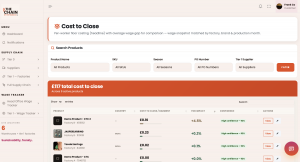
Overview of Cost to Close displayed on The Chain Dashboard
This new offering links factory payroll information with purchasing choices at the product level, providing fashion companies with insight into the expense involved in bridging living wage shortfalls
Cost to Close™ offers brands a more straightforward method to grasp how their purchasing decisions affect workers. It links the wage information already gathered in supply chains with commercial choices”— Frankie Hewitson, Founder of The Frank Co.
BRIGHTON, EAST SUSSEX, UNITED KINGDOM, August 24, 2026 /EINPresswire.com/ — The Frank Co., a sustainability consultancy and technology company serving fashion brands, has introduced Cost to Close, a solution that converts factory wage data into the expense required to eliminate living wage gaps at the garment and order level.
Integrated within The Frank Co.'s supply chain transparency platform, The Chain, Cost to Close connects payroll data from factories with product and order details to reveal what closing a living wage deficit would cost per garment and per order. The goal is to incorporate worker impact into the same commercial discussions around product cost, pricing, and procurement.
[Turning wage data into a commercial decision]
Fashion brands are increasingly gathering information on wages and living wage adherence across their supply networks. Yet wage data typically remains isolated from the buying process, where choices about product costs, factory pricing, and order volumes are made.
The Frank Co. created Cost to Close to bridge that divide.
The tool transforms a factory's monthly wage gap into a wage gap per minute, applies the labor minutes needed to produce a garment, and determines the resulting living wage increase per item. Buyers can then multiply that figure by the order quantity to see the total adjustment required.
This provides buyers with a concrete financial number rather than leaving worker impact as a standalone sustainability metric.
The need for such a figure became evident to The Frank Co. through its brand engagements. In one detailed analysis of a supplier in Bangladesh, payroll data revealed that roughly one in three workers earned below the statutory minimum wage over a six-month period, even after prior social compliance audits. This finding underscored the value of understanding the true scale of wage gaps and converting them into figures that can steer commercial choices.
[Making the cost of closing the gap visible]
A recent Cost to Close case study demonstrates this requirement, involving an anonymous global fashion brand with factories in several countries.
The assessment examined payroll-level wage data from 25 factories and discovered that 21 experienced negative real wage growth in 2025. This means workers' purchasing power declined even when nominal wages rose.
The analysis also revealed why headline wage increases can offer an incomplete picture.
In two European factories, workers received nominal wage hikes exceeding 40%. At one facility, real wages increased by 16.8%. At another, real wages dropped by 18.4%. Both operated under the same inflationary conditions, illustrating how nominal wage increases alone can hide declining purchasing power.
Cost to Close advances this type of wage analysis by linking it directly to the product a buyer orders.
In one instance, the calculation showed that closing the living wage gap for an oversized cotton tee would require a £0.50 uplift per garment. For an order valued at £2,500 FOB, the total cost to close the gap was £50, representing a 2% increase in the total FOB value.
Another pilot brand, monitoring payroll across three factories that produced the majority of its orders, used the tool over three years. All three factories eventually exceeded the local living wage benchmark, up from wages that had previously hovered near the statutory minimum. Real wage growth at the most closely tracked factory exceeded 25% year on year, with the largest gains going to the lowest-paid workers.
As one factory remarked after seeing its own wage position for the first time: "Seeing the gap, not just a pass or fail, was in itself valuable to us."
[Giving worker impact a place in the buying room]
The Frank Co. designed Cost to Close to make wage information actionable at the point where purchasing decisions occur.
The solution offers a per-product and per-order view of the living wage gap, along with worker impact data, living wage benchmarking, and confidence scoring. The Chain ties wage data to the relevant production date and factory, connecting the calculation to the conditions of a specific order.
For suppliers, this creates a channel for their wage data to reach the buying conversation. Wage information collected through The Chain can feed into the procurement process without requiring additional data submissions or audits from the factory.
In practice, this can mean the difference between an order that needs adjustment and one that does not. For one order of 400 units with a 14-minute standard minute value, Cost to Close revealed a £0.05 uplift per garment before the brand confirmed the order. On a second order from a factory already meeting the benchmark, the tool returned £0.00, confirming that pay was already adequate rather than leaving the question unanswered.
"The objective is not another sustainability score. It is a practical mechanism that helps brands understand the cost of closing wage gaps and gives worker impact greater visibility when commercial decisions are being made." – Harrison Atuokwu, Sustainability Compliance Coordinator at The Frank Co.
[Available to fashion brands]
Cost to Close is accessible through The Frank Co. as part of The Chain, its supply chain transparency platform. The Chain integrates supplier management, factory-level wage data, environmental metrics, and other supply chain transparency tools, with Cost to Close adding a buying decision layer centered on living wage impact.
Fashion brands can schedule an introductory call and submit a sample order for The Frank Co. to demonstrate how Cost to Close functions and to explore how the solution could support their procurement and sustainability processes.
For more information about Cost to Close, contact info@thefrankco.com or visit thefrankco.com.
[About the Frank Co.]
The Frank Co. is a sustainability consultancy and technology company for fashion brands. It combines deep industry expertise with proprietary software to make supply chain transparency genuinely useful, not merely a compliance exercise. Through The Chain, The Frank Co. assists brands in consolidating supplier, wage, environmental, and product-level supply chain data to support more informed decision-making.
Miranda Rose Preston
The Frank Impact Company
+44 7368 399220
email us here