Dr. Ghantel Perkins, Assistant Superintendent for Teaching and Learning at Crete-Monee School District 201-U, works with elementary students inside the SmartLab at Crete-Monee Elementary School.
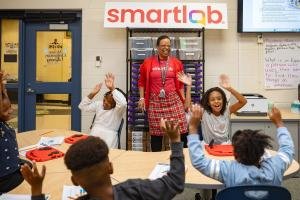
An ah-HA! moment comes alive when students transform curiosity and obstacles into discovery, building experiences that foster confidence and a solid STEM identity.
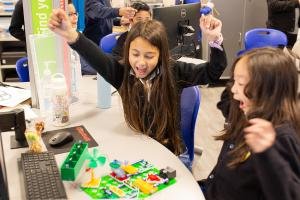
A nationwide effort helps students develop STEM identity, self-assurance, and lasting skills while linking education to real-world careers in an AI-driven future.
Also worth a look: BWT Logistics connects procurement and execution with material staging solutions and Imarc Wins Multiple 2026 Honors for Web Design and Development Excellence.
A strong STEM identity is a learner’s self-belief that ‘I belong, I can master rigorous challenges, and my ideas make an impact.’”— Dr. Jennifer Berry, CEO of SmartLab
LONGMONT, CO, UNITED STATES, October 7, 2026 /EINPresswire.com/ — SmartLab, a top STEM education provider offering career-focused K-12 STEM learning solutions, has revealed the comeback of SmartLab STEM Identity Day on Friday, Nov. 6, 2026. This national initiative aims to assist students in cultivating the confidence, resilience, and sense of belonging necessary to succeed in a rapidly evolving world.
Centered on the straightforward notion that STEM belongs to everyone, STEM Identity Day unites schools, educators, families, businesses, and community professionals to link what students learn today with the opportunities awaiting them tomorrow. SmartLab defines STEM identity as extending beyond preparation for conventional science, technology, engineering, and math careers. It represents a mindset grounded in belonging, persistence, and the conviction that one’s contributions can create change—attributes that hold value across various industries, professions, and communities.
"At SmartLab, we define a strong STEM identity as a learner’s self-belief that ‘I belong, I can master rigorous challenges, and my ideas make an impact.’ That’s not just for kids. It’s for all of us. This mindset is developed through active, student-centered learning cycles, where curiosity is met with challenge, where failure is part of the process, and where learners emerge more resilient and ready to solve meaningful problems” —Dr. Jennifer Berry, CEO of SmartLab.
The 2026 event arrives as artificial intelligence and new technologies keep reshaping how individuals learn, work, and address challenges. Cultivating STEM identity is growing in importance—not because every student must become a scientist, engineer, or programmer, but because young people require opportunities to think critically, manage uncertainty, tackle tough problems, and decide how technology can support their ideas.
During STEM Identity Day, participating schools can welcome community professionals into classrooms to recount their career paths, explain how STEM applies to their roles, and respond to student inquiries. Guest speakers do not need to hold traditional STEM positions. Rather, the aim is to expand students’ awareness of where STEM appears in everyday life and introduce them to opportunities they might otherwise miss.
Those real-world connections also provide students with something textbooks cannot always deliver: representation. When professionals share their journeys, struggles, and career trajectories, students can see individuals from their own neighborhoods applying STEM skills in significant ways and start envisioning new paths for themselves.
“The right project finds the identity for the kid. The kid finds their identity in the project. They come in as kids. They leave seeing themselves as engineers, creators, and collaborators.” —Marcus Diamond, Weld Central SmartLab Facilitator
Schools can organize a single session, several class periods, or an entire day. SmartLab supplies host schools and guest speakers with materials and instructions to ensure participation is manageable and customizable to local requirements. The event builds on the first SmartLab STEM Identity Day in 2025 and SmartLab’s dedication to hands-on, career-connected learning experiences where students investigate ideas, cooperate, work through obstacles, and uncover what they can achieve.
Those transformations frequently arise from ah-HA! moments—instances when students make a connection, resolve a complex problem, bounce back from failure, or see an idea succeed. Repeated over time, such experiences can reshape how students view themselves as learners and problem-solvers.
Students start gathering evidence about themselves: I figured that out. I solved that problem. My idea worked. I recovered when something didn’t work. Those experiences help build confidence through the process of persevering, creating and solving.
Rather than concentrating solely on a specific technology, SmartLab highlights durable skills—including critical thinking, communication, collaboration, creativity, questioning, discernment, and problem-solving—that stay valuable as technologies and careers shift. Community involvement is a vital part of strengthening those links. Business leaders, professionals, parents, and community groups can take part as guest speakers, mentors, and volunteers, demonstrating to students how STEM skills and mindsets show up across fields like healthcare, manufacturing, transportation, finance, agriculture, media, the arts, education, and technology.
“Every product decision, every curriculum update, and every piece of support we build for facilitators and schools is ultimately about one thing: making sure more students get to feel what it means to have a STEM identity. I see their eyes light up when they figure something out. It’s those ah-HA! moments that make this experience so rewarding for our students.” —Kristin Whalen, Vice President of Product and Experience at SmartLab.
SmartLab’s method focuses on active, student-driven project-based learning rather than technology for its own sake. Students might code a game, design an app, build a robot or drone, produce digital media, or engineer a solution, but the technology itself is not the final objective. As Dr. Berry describes it, “Technology is the paintbrush, not the painting.” The true worth emerges when students use technology to create, explore ideas, and address meaningful problems.
That distinction has become increasingly significant with generative AI. As technology grows more capable of producing answers, writing code, and completing complex tasks, students need the judgment to question outputs, evaluate accuracy, and decide what should happen next. For SmartLab, future readiness means more than knowing how to operate technology. It means developing the confidence and agency to use it purposefully.
STEM Identity Day is also designed to forge connections that can last beyond a single event. By bringing schools and communities together, the initiative can open the door to ongoing career conversations, mentoring, classroom engagement, and partnerships that link K-12 learning with the world students will eventually enter.
Schools, educators, businesses, community organizations, and professionals are invited to take part in SmartLab STEM Identity Day on Nov. 6, 2026. Schools can host a STEM Identity Day experience, while companies, organizations, and community professionals can volunteer to share their careers and experiences with students.
Register to host or volunteer at https://www.smartLabLearning.com/smartlab-stem-identity-day.
Hannah Brennan
Creative Learning Systems
+1 303-772-6400
Visit us on social media:
LinkedIn
Instagram
Facebook
YouTube
X
SmartLab STEM Identity Day