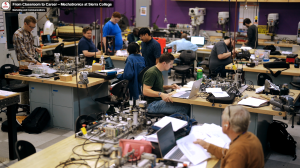
With a looming shortage of 67,000 semiconductor workers by 2030, a California community college is proving that the fix may start in high school. Sierra College, already running a dual-enrollment mechatronics program at two local high schools, has secured $200,000 from the California Education Learning Lab to spread that model statewide.
Sierra College and Regional Partners Awarded $200,000 to Take High School Mechatronics Pathway Statewide
High school students now walk into labs that look like the ones employers run, and they earn college credit before they graduate. This grant lets us help other colleges build the same on-ramp.”— Roy Ingram, Sierra College Mechatronics Department Chair
Also worth a look: Hatfield.ai unveils HatfieldIQ, an AI platform that connects the dots across global risks and CVBBA names top dealmakers at 2026 conference, honoring brokers who closed millions in sales.
ROCKLIN, CA, UNITED STATES, November 17, 2026 /EINPresswire.com/ — The $200,000 grant from California Education Learning Lab will allow Sierra College to turn its existing high school Mechatronics pathway into a replicable blueprint for community colleges across California. That pathway, launched in 2025 at Oakmont and Antelope high schools through a partnership with the Roseville Joint Union High School District, is already yielding results.
The urgency is clear: the Semiconductor Industry Association and Oxford Economics project the U.S. semiconductor industry could face a workforce gap of 67,000 by 2030. Sierra College’s project, titled “From Practice to Blueprint: Advancing Mechatronics and Semiconductor Pathways,” aims to train more instructors to meet that demand. Over the two-year grant period, the initiative expects to reach 20 faculty members and roughly 1,000 students.
Key partners include Robert Bosch Semiconductor, the UC Davis Center for Nano-Manufacturing, Roseville Joint Union High School District, Western Placer Unified School District, the Greater Sacramento Economic Council, and the Sacramento Valley Manufacturing Alliance.
“We are grateful to the California Education Learning Lab for this investment, and to the high school, university and industry partners who built this pathway with us,” said Willy Duncan, Sierra College Superintendent/President. “Students are moving from the classroom into high-demand technical careers, and employers are finding the skilled people they need. Our region is ready to share what works with the rest of California.”
A Model Built With Local High Schools
The groundwork was laid by $2.2 million in combined grants from K12 Strong Workforce and the Sacramento K16 Collaborative. Those funds trained high school faculty and built labs at Oakmont and Antelope High Schools that mirror the Mechatronics lab on Sierra’s Rocklin campus. The first phase of the newly modernized Applied Technology Center on that campus opened for instruction this fall.
In the first year of the program, nearly 100 students completed college-level Mechatronics courses and earned free college credit. This fall, enrollment at the two high schools jumped to nearly 150, and Antelope launched its first advanced manufacturing sections with 40 students. Both schools plan to add new advanced courses in spring 2027.
“For years, Sierra College Mechatronics was one of the best-kept secrets around. We’ve been too busy building careers to tell everyone about it. Well, the secret is out,” said Roy Ingram, Professor and Department Chair of Mechatronics at Sierra College and co-principal investigator on the grant. “High school students now walk into labs that look like the ones employers run, and they earn college credit before they graduate. This grant lets us help other colleges build the same on-ramp.”
“When Mechatronics is on campus, word spreads. Students hear about the cool things their friends are doing in class, and we get that grapevine effect, with more of them asking their counselors about it,” said Shane Waggoner, Director of Career Technical Education for Roseville Joint Union High School District. “They do the same labs they would at Sierra College, earn college credit in high school and get into the workforce sooner.”
Training More Instructors, Sharing the Blueprint
The grant funds two main strategies. The first aims to expand the teaching pipeline through industry externships, teaching institutes for dual enrollment instructors, cleanroom training at UC Davis, and a pathway for industry professionals to transition into teaching. This builds on Sierra’s existing weeklong summer institute, where college faculty train high school teachers to lead introductory Mechatronics courses.
The second strategy involves producing the blueprint itself: program design guidance, an employer toolkit, and facilities planning resources that any California college can adopt. Dr. Amy Schulz, Executive Dean of Workforce and Strategic Initiatives at Sierra College, leads the project as principal investigator. Ingram and Jonathan Schwartz, a retired Colfax High School teacher hired for the project, serve as co-principal investigators.
Connected to National Semiconductor Workforce Efforts
Sierra College Mechatronics is already plugged into national workforce development through the Micro Nano Technology Education Center (MNT-EC) and the National Network for Microelectronics Education (NNME). Ingram participates in the MNT-EC Community of Practice and serves on the MNT-EC/NNME Community College Advisory Board, helping shape curriculum guidance and educational pathways for colleges launching microelectronics programs. This involvement allows Sierra College to share its experience building industry-connected technical education programs while influencing the future of semiconductor technician training nationwide.
MNT-EC is a National Science Foundation Advanced Technological Education national center based at Pasadena City College, focused on building America’s micro and nanotechnology technician workforce. NNME’s Pacific Intermountain regional node, led by Boise State University with UC Davis as a core member, connects schools, colleges, and employers across nine Western states.
The pathway leads directly to jobs. More than 100 employers have hired Sierra College Mechatronics graduates. Sierra College also operates California’s third-largest dual enrollment program; in 2025-26, 6,460 high school students took 410 Sierra College courses.
Learn more about the Mechatronics pathway at sierracollege.edu/mechatronics.
About Sierra College
Sierra College is rising to the needs of our community. Sierra College serves 3,200 square miles of Northern California with campuses in Rocklin, Grass Valley and Truckee. With approximately 125 degree and certificate programs, Sierra College is ranked first in Northern California (Sacramento north) for transfers to four-year universities, offers career/technical training, and classes for upgrading job skills. Sierra graduates can be found in businesses and industries throughout the region. More information at www.sierracollege.edu.
###
Kayla Scott
Sierra College
Visit us on social media:
LinkedIn
Instagram
Facebook
YouTube
X
Other
Why it matters: This grant turns a successful local experiment into a potential statewide solution for a critical workforce shortage. By equipping high school students with college credit and industry-ready skills, Sierra College is creating a direct pipeline into high-demand semiconductor and advanced manufacturing careers—a model that could help close the projected 67,000-worker gap before it becomes a crisis.