Newly published research brings renewed hope for improved pregnancy outcomes among women with adenomyosis who undergo assisted reproduction
BEIJING, BEIJING, CHINA, September 7, 2026 /EINPresswire.com/ — More than one in five women worldwide are affected by adenomyosis, a disorder in which the uterine lining infiltrates the muscular wall of the uterus. In addition to causing pain and discomfort, the condition creates substantial obstacles for women seeking to conceive. Assisted reproductive technologies (ART), including in vitro fertilization (IVF) and embryo transfer (ET), are known to produce lower odds of successful pregnancy and live birth in these patients. Therefore, improving those outcomes has become a critical aim in reproductive medicine.
A potential strategy involves administering a gonadotropin‑releasing hormone analogue (GnRHa) prior to ET to temporarily curb estrogen production. The rationale is that lowering specific hormone levels may enhance the uterine environment and raise the likelihood of implantation and pregnancy. However, evidence for this method has been mixed: some studies indicate benefits, others show no effect, and guidelines from various medical bodies contradict one another. Part of the inconsistency arises because research often fails to differentiate between fresh embryo transfers (ETs) and frozen embryo transfers (FETs)—two procedures with distinct biological characteristics.
To clarify this issue, a team led by Professors Tao Wu and Qing Xue from Peking University, China, carried out a study that examined GnRHa pre‑treatment separately for each type of ET, combining their own patient data with a systematic review of the literature. The paper was published online on December 17, 2024, and appears in Volume 132, Issue S2 of BJOG: An International Journal of Obstetrics & Gynaecology (April 15, 2025).
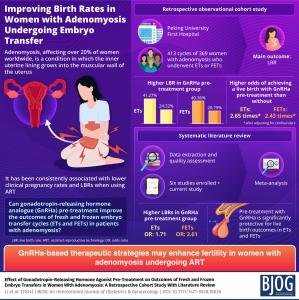
First, the researchers performed a retrospective cohort study, analyzing outcomes from 413 treatment cycles involving 369 women with adenomyosis treated at Peking University First Hospital between 2015 and 2023. They compared live birth rates, clinical pregnancy rates, and miscarriage rates among women who received GnRHa pre‑treatment versus those who did not, using statistical models to adjust for confounders such as age, body mass index, uterine size, and embryo quality. Second, they conducted a meta‑analysis, integrating their findings with those from six other studies on the same topic.
The results were notably consistent and clear across both components of the investigation. “After adjusting for confounders in our cohort study, the odds of achieving a live birth after ET or FET were 2.65 times and 2.43 times higher, respectively, for women with GnRHa pre‑treatment than for those without,” explains Prof. Wu. The meta‑analysis reinforced this pattern, showing that women given GnRHa pre‑treatment had significantly higher live birth rates after both ET and FET cycles. Notably, miscarriage rates did not differ significantly between the two groups.
Overall, the evidence supports GnRHa pre‑treatment as a viable option for women with adenomyosis undergoing either type of ET, and the authors recommend that clinicians actively consider it in practice. However, the researchers acknowledged that all studies included in the meta‑analysis were conducted in China, which may limit how broadly the conclusions can be applied. “More worldwide studies on this topic and randomized controlled trials are warranted to strengthen this newfound evidence,” concludes Prof. Xue.
This investigation therefore lays the groundwork for further research involving diverse international populations, paving the way for universally applicable clinical guidelines for treating adenomyosis in women pursuing assisted reproduction.
Reference
Title of original paper: Effect of Gonadotropin‑Releasing Hormone Agonist Pre‑Treatment on Outcomes of Fresh and Frozen Embryo Transfers in Women With Adenomyosis: A Retrospective Cohort Study With Literature Review
Journal: BJOG: An International Journal of Obstetrics & Gynaecology
DOI: 10.1111/1471-0528.18026
About Peking University, China
Peking University (PKU) is a public university located in Beijing, China. Founded in 1898 as the Imperial University of Peking, it was the nation’s first comprehensive university. After merging with Beijing Medical University in 2000, PKU expanded into science, engineering, medicine, humanities, and social sciences. Today, the university comprises six faculties, 55 schools and departments, and ten affiliated hospitals, with over 48,600 students supported by more than 12,600 faculty and staff. PKU collaborates with nearly 400 universities and institutions across more than 60 countries, nurturing world‑class talent and contributing to a shared future for humanity.
Website: https://english.pku.edu.cn/
About Professor Tao Wu from Peking University, China
Dr. Tao Wu serves as Professor and Deputy Chair of the Department of Epidemiology and Biostatistics at the School of Public Health, Peking University, China. She earned her bachelor’s degree in Preventive Medicine from Beijing Medical University, a Master’s in Epidemiology from Peking University, and a Ph.D. in Genetic Epidemiology from Johns Hopkins University. Her research interests encompass genetic epidemiology, chronic diseases, and public health education. She has led numerous national and municipal research grants and authored multiple publications in international peer‑reviewed journals, including Genetic Epidemiology, Diabetes Care, and BMC Med Educ.
About Professor Qing Xue from Peking University First Hospital, China
Dr. Qing Xue is Professor and Director of the Reproductive Center at the First Hospital of Peking University, China. She completed postdoctoral training at Northwestern University, USA, and holds both MD and PhD degrees. Dr. Xue is a member of the American Society for Reproductive Investigation, Standing Committee Member and Secretary‑General of the Fertility Protection Branch of the Chinese Preventive Medicine Association, Committee Member of the Reproductive Professional Committee of the Chinese Medical Doctor Association, Standing Committee Member of the Reproductive Medicine Branch and Obstetrics and Gynecology Microecology Medicine Branch of the China International Exchange and Promotive Association for Medical and Health Care, and Vice Chairman of the Reproductive Medicine Committee of the Beijing Chronic Disease Prevention and Health Education Research Association. Her research focuses on gene regulation in endometriosis and infertility, as well as the fetal‑maternal interface in endometriosis. She has published over 100 SCI papers, including in Nature Communications and Biomaterials. She has led 12 national and provincial research grants, including two sub‑projects under the National Key R&D Program of China (13th and 14th Five‑Year Plans) and six General Programs of the National Natural Science Foundation of China. Her honors include four provincial/ministerial awards, among them the Second Prize for National Maternal and Child Health Science and Technology.
Funding information
The study was supported by the National Key Research and Development Program of China (No. 2022YFC2704000) and the National High Level Hospital Clinical Research Funding (Interdisciplinary Clinical Research Project of Peking University First Hospital, No. 2022CR47).
Jing Ma
Wiley
+86 1085419367
jima@wiley.com
Visit us on social media:
Other