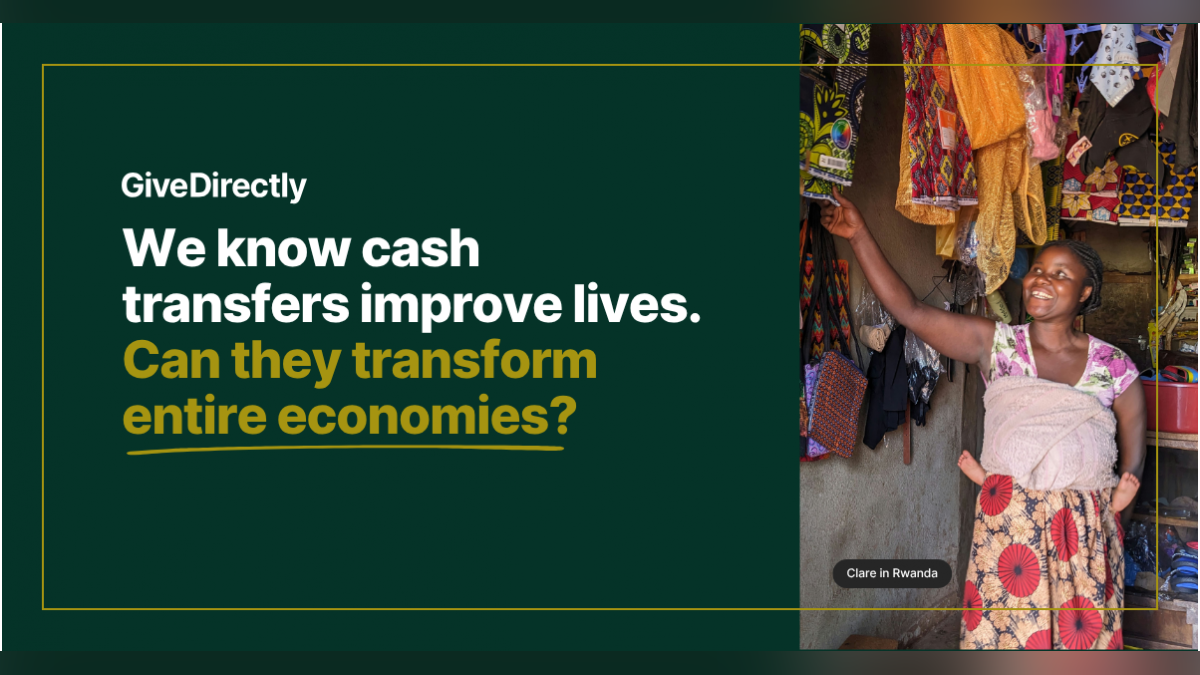
GiveDirectly is about to find out whether handing cash directly to people living in poverty can do more than lift individual households — it’s testing if the payments can spark growth across a whole local economy. The U.S. nonprofit’s largest program ever, set to reach roughly 120,000 rural households in Malawi by the end of 2026, is designed to answer a question that has split development economics for decades: can cash transfers work at the scale of a nation’s GDP, not just a family’s budget?
In its largest program yet, GiveDirectly will enroll about 120,000 rural Malawi households by the end of 2026 for one-time cash worth about 85% of local GDP.
Working on GiveDirectly’s learning agenda has convinced me that these questions were never really separate — they only look that way because we’ve rarely had programs big enough to study both at once.”— Caitlin Tulloch, Senior Director of Research, Learning, and Product
Also worth a look: Xiora Technologies launches browser-based AI video companions with memory and GiveDirectly and Coinbase pilot lifts NYC savings, but dims future outlook.
NEW YORK CITY, NY, UNITED STATES, November 4, 2026 /EINPresswire.com/ — GiveDirectly, a U.S. nonprofit that sends cash directly to people living in poverty, is using its largest cash program to date to test whether cash transfers can drive economic growth across a whole local economy, beyond the gains seen in single households. By the end of 2026, roughly 120,000 households in two of Malawi’s poorest rural districts, including Chiradzulu, will be enrolled to receive a one-time, unconditional cash payment. GiveDirectly set out the research plan in a July 7, 2026 post by Caitlin Tulloch, its Senior Director of Research, Learning, and Product.
For context, here’s what’s at stake: the total amount of cash flowing into the areas receiving payments equals about 85% of local GDP. GiveDirectly compares that to giving every adult in the United States a one-time payment of $114,000. The program is anchored by a $100 million commitment from the Canva Foundation, announced in October 2025.
Earlier evidence from a GiveDirectly program in Kenya found that each $1 transferred generated about $2.50 in local economic activity, as recipients’ spending reached neighbors and local businesses. The Malawi research is testing whether that multiplier effect holds when cash reaches much more of an economy, in a different country.
Key facts
- Scale: in the areas receiving cash, the total equals about 85% of local GDP. GiveDirectly compares it to giving every adult in the United States a one-time payment of $114,000.
- Funding: the Malawi program is anchored by a $100 million commitment from the Canva Foundation, announced in October 2025.
- Earlier evidence: research on a GiveDirectly program in Kenya found each $1 transferred generated about $2.50 in local economic activity, as recipients’ spending reached neighbors and local businesses.
- What is measured: jobs, businesses, prices and inflation risk, using surveys, satellite imagery, mobile-money records and economic modeling.
- Business test: grants to about 1,650 local businesses so they can stock up, plus a test of whether telling businesses when cash will land helps them prepare for the jump in demand.
- Status: the research is under way and has not produced results.
Hundreds of studies show that households who receive cash earn more and own more assets. Yet most of the 1.5 billion people who have escaped extreme poverty since the 1990s did so because their economies grew. Development economics has usually studied those “micro” and “macro” questions separately. GiveDirectly’s programs are now large enough to study both at once.
The five questions in GiveDirectly’s learning agenda
- Can cash, at large enough scale, change how a whole economy works?
- What relationship should large-scale cash programs have with governments?
- What is the most cost-effective way to design a large-scale cash program?
- Which families can escape poverty on cash alone, and which need extra support to get there?
- What does leaving poverty actually look like for a household, across shelter, food, savings, schooling, and resilience to shocks?
“For most of my career, I have been a dyed-in-the-wool applied microeconomist,” Tulloch wrote. “Working on GiveDirectly’s learning agenda has convinced me that these questions were never really separate — they only look that way because we’ve rarely had programs big enough to study both at once.” If cash at this scale does not lead to lasting growth, she added, “that is just as important to know.”
Questions and answers
Can cash transfers grow a local economy? Evidence from Kenya points that way: each $1 transferred generated about $2.50 in local economic activity. The Malawi research tests whether that holds when cash reaches much more of an economy, in a different country.
Do large cash transfers cause inflation? Studies of GiveDirectly’s smaller programs in Kenya and Malawi found very little inflation. GiveDirectly is tracking prices in Malawi because that may not hold at this scale.
Is there more on the Malawi program? Tulloch discusses the agenda with economist Dean Karlan in a companion video podcast, and Bloomberg featured the Malawi program in August 2026. The full post is at givedirectly.org/economic-growth.
ABOUT GIVEDIRECTLY
GiveDirectly is a nonprofit that lets donors send money directly to people living in poverty, with no strings attached. Since 2009, it has delivered more than $1 billion in cash to more than 2 million people. GiveDirectly currently works in the Democratic Republic of the Congo, Kenya, Malawi, Mozambique, Rwanda, Uganda and the United States. Learn more at givedirectly.org.
Yonah Lieberman
GiveDirectly
press@givedirectly.org
Visit us on social media:
LinkedIn
Bluesky
Instagram
Facebook
YouTube
X
Why it matters: If GiveDirectly’s Malawi experiment succeeds, it could shift how governments and philanthropists approach poverty — from targeted micro-interventions to economy-wide cash injections. If it fails, it would be just as valuable, proving that cash alone cannot replace the broader structural conditions needed for growth.