Customer feedback is often treated as a list of isolated complaints, but a new analysis from Yellow Tokens suggests those complaints may be symptoms of a deeper, more predictable pattern. The company’s latest findings, drawn from 4,000 customer comments, reveal a recurring link between what customers expected, how service was delivered, and whether they felt they got their money’s worth.
Across 17 market segments, 125 comments showed recurring associations among unmet expectations, service execution gaps and negative value perception.
What matters is not only whether something went wrong, but what the customer believed should have happened instead.”— Bruno Pomeranz, Yellow Tokens
Yellow Tokens has released new findings from its analysis of 4,000 customer comments showing a recurring relationship between unmet customer expectations, service execution failures and perceived value gaps.
Also worth a look: Valley National Realty’s child care investment model wins WINGS honor and PROLIM lands on Inc.’s 2026 Power Partner list for AI-driven client growth.
The analysis relied on a balanced dataset spanning 17 market segments, with customer feedback published between January 1 and December 31, 2025.
Using the Yellow Tokens Marketing Engine, the company identified a behavioral pattern internally labeled “Rising Expectations Lower Tolerance for Operational and Value Gaps.”
The pattern connected 125 comments to a mix of expectation tension, operational problems and negative value perception.
Among the supporting signals flagged by the Marketing Engine, Expectation Escalation and Service Execution Gap each appeared 82 times. Value Perception Imbalance appeared 43 times.
These counts describe analytical signal occurrences, not percentages of customers or population prevalence estimates.
The finding suggests that customer dissatisfaction can become more pronounced when what is delivered visibly diverges from what the customer expected.
“What matters is not only whether something went wrong, but what the customer believed should have happened instead,” said Bruno Pomeranz of Yellow Tokens. “When the actual experience falls below an expected standard, an operational problem can quickly become a broader judgment about quality, reliability and whether the experience was worth the price.”
Grounded customer feedback associated with the pattern included situations in which customers described differences between advertised and actual conditions, repeated service failures, unmet expectations based on previous experiences and situations where the delivered experience did not match the standard customers believed they had purchased.
In one type of feedback, customers compared real conditions with images or descriptions presented before purchase. In others, disappointment was tied to recurring operational issues, such as unavailable items, incorrect orders or service conditions that did not meet expected standards.
Other customer narratives connected the gap directly to value, questioning whether the amount charged was justified by the experience ultimately delivered.
Yellow Tokens cautions that the analysis does not establish that customer expectations increased over time.
The dataset covers feedback from 2025 and identifies recurring expectation-related structures within those customer narratives. It does not compare expectation levels across multiple years or measure a historical increase in consumer expectations.
Similarly, the findings do not establish that expectation gaps directly cause customer switching or negative value perception.
Instead, the analysis identifies repeated relationships among the signals customers express when describing disappointing experiences.
This distinction is important for organizations interpreting customer feedback.
A complaint about cleanliness, an unavailable service, an incorrect charge or inconsistent execution may appear operational on the surface. But the customer narrative can also reveal an expectation gap: the experience did not match what was promised, what was previously delivered or what the customer believed was reasonable for the price.
For customer experience and operations teams, that means analyzing the failure alone may provide an incomplete picture.
The relevant question may also be what expectation existed before the failure occurred and how the gap between expectation and delivery influenced the customer’s interpretation of the experience.
The findings were generated through the Yellow Tokens Marketing Engine, an evidence-grounded intelligence system designed to identify recurring behavioral relationships within public customer feedback.
The system classifies customer comments into structured signals, analyzes how those signals appear together and connects higher-level patterns with supporting customer evidence.
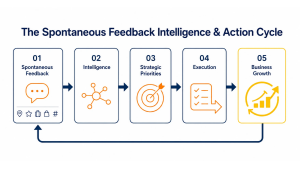
The analysis is part of Yellow Tokens’ broader Spontaneous Feedback Intelligence & Action (SFIA) approach, which connects voluntarily published customer feedback with intelligence, prioritization and continuous improvement.
Yellow Tokens is continuing to analyze the dataset for additional patterns involving operational consistency, trust, perceived value, empathy and human support.
Additional information about Yellow Tokens AI-powered customer feedback analysis and Spontaneous Feedback Intelligence & Action is available on the company’s website.
ABOUT YELLOW TOKENS
Yellow Tokens is a software company focused on transforming spontaneous public customer feedback into structured intelligence, priorities and action. Its platform combines structured analysis and artificial intelligence to identify recurring patterns, support competitive analysis and help organizations connect customer signals with continuous improvement initiatives.
BRUNO POMERANZ
Yellow Tokens
support@yellowtokens.com
Visit us on social media:
LinkedIn
Instagram
Facebook
YouTube
TikTok
Why it matters: For businesses trying to improve customer experience, this analysis underscores that fixing a single operational error may not be enough. The data suggests that how a failure aligns with a customer’s prior expectations can shape their overall judgment of the brand, making expectation management as critical as service recovery.