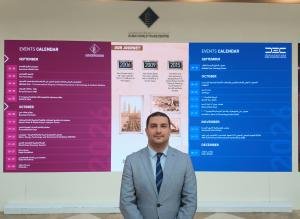
When a country makes it easier to start and run a company, the whole world takes notice — and according to one top business leader, the United Arab Emirates has become the standard to follow. Mohamed Rabie Moawad, Chairman of Letsia Holding, argues that the UAE’s combination of simplified company formation rules, flexible regulations, efficient government services, and openness to global markets has turned it into a premier destination for investment and entrepreneurship.
Moawad stressed that the UAE’s pull for companies, entrepreneurs, and international investors is no accident — it stems from a comprehensive economic strategy that makes business facilitation and investment competitiveness central priorities. He pointed to streamlined registration procedures, the growth of digital government services, and the creation of specialized free zones as key factors that have opened up diverse opportunities for investors and businesses across many industries.
“The UAE has established an important model for building an investment-friendly economy through simplified procedures, modern regulatory frameworks, and efficient government services,” Moawad said. “When establishing and operating a business becomes clearer and more efficient, an economy becomes better positioned to attract new ventures, encourage investment, and support sustainable growth.”
Also worth a look: PrintSheetLab launches free math calculators that show every step, plus printable base ten blocks and YALONG brings 40 years of TVET expertise to GESS Dubai with hands-on mechatronics lab.
According to the Letsia chairman, one of the UAE’s standout achievements is its focus on supporting businesses at every stage — from initial registration and licensing all the way through operations, expansion, and tapping into international markets. He explained that ease of company formation has become a strategic factor in global economic competitiveness. Investors today weigh not just market opportunities but also regulatory clarity, administrative efficiency, infrastructure, and access to essential services when picking where to put their money.
Moawad also highlighted the UAE’s digital transformation efforts as a crucial part of its economic development. Accessible digital government services, he noted, can cut through administrative red tape, letting businesses channel more resources into innovation, daily operations, and growth. He added that the UAE’s experience offers valuable lessons for emerging economies looking to upgrade their own investment climates — especially in administrative simplification, government digitalization, and modernizing regulatory frameworks.
“What distinguishes the UAE’s approach is the recognition that supporting entrepreneurship begins with creating an environment where businesses can establish themselves, operate efficiently, and grow,” Moawad said. “This experience provides a valuable reference for emerging economies working to strengthen their investment policies and improve the ease of doing business.”
Beyond regulations and digital services, Moawad pointed to the UAE’s strategic geographic location, advanced infrastructure, international connectivity, and well-developed financial and professional services as factors cementing its status as a regional and international business hub. He also acknowledged the role of the country’s free zones and economic initiatives in offering diverse environments that accommodate technology, financial services, manufacturing, trade, and investment activities.
Moawad emphasized that supporting businesses should go beyond just company formation — it must include access to financial and technological services, workforce development, investment opportunities, and an ecosystem that can adapt to global economic shifts. The Letsia Holding Chairman concluded that the UAE’s mix of regulatory flexibility, digital progress, infrastructure development, and economic openness shows how coordinated policies can boost a country’s appeal to entrepreneurs and international firms. He added that continued improvement in these areas can further strengthen the UAE’s long-term competitiveness while providing useful insights for other economies aiming to encourage private-sector growth and international investment.
Why it matters: The UAE’s model, as described by a top business figure, demonstrates that deliberate policy coordination — not just market size — can make a nation a magnet for global capital and talent. For other countries wrestling with bureaucratic hurdles, the UAE’s emphasis on digital services and regulatory clarity offers a concrete blueprint worth studying. If adopted more widely, such approaches could reshape how emerging economies compete for international business.
Reena Malhota
Letsia
Visit us on social media:
LinkedIn