Speed is everything when a stroke strikes, and artificial intelligence is becoming the tool that buys back those precious minutes. A new market forecast from The Business Research Company shows hospitals and emergency networks are rapidly adopting AI-powered triage systems that read brain scans in real time — and the financial numbers reflect that urgency.
The Business Research Company’s AI-Powered Acute Stroke Triage Global Market Report 2026 – Market Size, Trends, And Forecast 2026-2035
Artificial intelligence is no longer a futuristic concept in emergency medicine — it is actively reshaping how stroke patients are assessed and treated. AI-powered acute stroke triage platforms are becoming indispensable for fast diagnosis and better recovery odds. Here is a breakdown of the current market valuation, what is driving expansion, which regions lead the charge, and where the industry is headed in the coming years.
Also worth a look: WSI’s Brandie Kelly to show Toronto businesses how to win AI recommendations and Goldcote launches four free travel finders that answer one border-crossing question each.
Market Size and Growth Outlook
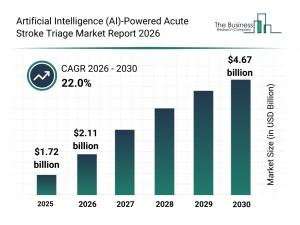
The global market for AI-powered acute stroke triage has seen explosive momentum in recent months. Valued at $1.72 billion in 2025, it is expected to climb to $2.11 billion in 2026 — a compound annual growth rate of 22.3%. That surge is tied to a rising number of stroke cases worldwide, wider deployment of advanced imaging tools, growing reliance on clinical decision support systems, increased funding for emergency care infrastructure, and steady improvements in machine learning accuracy.
Access a complimentary sample of the artificial intelligence (ai)-powered acute stroke triage market report here:
https://thebusinessresearchcompany.com/sample_request?id=86018007&type=smp&name=Artificial%20Intelligence%20%28AI%29-Powered%20Acute%20Stroke%20Triage%20Market%20Report%202026&utm_source=EINPresswire&utm_medium=Paid&utm_campaign=Oct_PR
Looking further ahead, projections place the market at $4.67 billion by 2030, maintaining a CAGR of 22.0%. The anticipated growth is fueled by an urgent need for faster stroke diagnosis, rising investment in AI-enabled emergency response, the spread of telestroke networks, a shift toward outcome-based care models, and breakthroughs in real-time medical data processing. Emerging trends include broader use of AI-driven imaging interpretation, real-time stroke alert systems, predictive clinical decision tools, cloud-based imaging platforms, and a sharper focus on time-critical care protocols.
How AI-Powered Acute Stroke Triage Works
At its core, AI-powered acute stroke triage relies on machine learning algorithms that rapidly process brain imaging and patient data when a stroke is suspected. The system instantly determines stroke type, severity, and whether large vessel occlusions are present. That real-time analysis accelerates clinical decision-making, allowing medical teams to act quickly — a factor that can dramatically influence patient outcomes.
View the complete artificial intelligence (ai)-powered acute stroke triage market report:
https://thebusinessresearchcompany.com/report/artificial-intelligence-ai-powered-acute-stroke-triage-global-market-report?utm_source=EINPresswire&utm_medium=Paid&utm_campaign=Oct_PR
What’s Driving Demand
The escalating incidence of strokes is the primary catalyst behind this market’s growth. A stroke happens when blood flow to the brain is interrupted, causing cell damage that can lead to permanent disability or death without immediate treatment. High blood pressure is a major contributor, increasing the likelihood of blocked or ruptured brain vessels. AI-driven triage tools improve stroke diagnosis by rapidly analyzing brain scans, helping clinicians identify stroke type and urgency early. That reduces diagnostic delays, flags critical cases for immediate attention, accelerates treatment, and boosts the chances of recovery.
Consider the numbers from Australia: the Stroke Foundation reported that in 2023, roughly 45,785 Australians experienced a stroke — one every 11 minutes. Of those, 34,793 were first-time strokes, highlighting the pressing need for fast and accurate triage systems. These statistics demonstrate how rising stroke rates directly translate into demand for AI-powered diagnostic technology.
Regional Leadership
North America currently dominates the AI-powered acute stroke triage market, holding the largest share in 2025. The full market report covers Asia-Pacific, South East Asia, Western Europe, Eastern Europe, South America, the Middle East, and Africa, providing a comprehensive view of regional dynamics and growth potential across the globe.
What the 2026 Market Reports Include
• Market attractiveness scoring and analysis
• Total addressable market (TAM) analysis
• Company scoring matrix graphics and tables
• Excel-based forecasting dashboards
• Market hotspots infographics
• Key technologies and future trend analysis
• Updated graphics and tables
Expert Contact Information:
Saumya Sahay
Americas +1 310-496-7795
Asia +44 7882 955267 & +91 8897263534
Europe +44 7882 955267
Email: marketing@tbrc.info
The Business Research Company – www.thebusinessresearchcompany.com
Follow Us On:
• LinkedIn: https://in.linkedin.com/company/the-business-research-company
Oliver Guirdham
The Business Research Company
+44 7882 955267
info@tbrc.info
Visit us on social media:
LinkedIn
Facebook
X
Why it matters: As stroke incidence climbs globally, the speed of diagnosis becomes a life-or-death variable. The rapid expansion of this market signals that healthcare systems are betting heavily on AI to close the gap between symptom onset and treatment — a shift that could redefine emergency neurology in the coming decade.