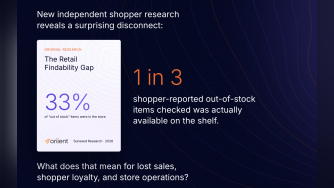
It’s a frustrating grocery-store ritual: you scan the aisle, check every shelf, and finally give up, convinced the item isn’t there. New independent research commissioned by location-technology company Oriient suggests that in one out of every three such cases, you’re wrong—the product is actually sitting on the shelf, hidden in plain sight.
NEW YORK, NY, UNITED STATES, November 11, 2026 /EINPresswire.com/ — According to The Retail Findability Gap, a study conducted independently by Sunseed Research and funded by Oriient, one in three items that grocery shoppers reported as out of stock was, in fact, on the shelf when researchers physically checked. The finding reframes what retailers have long treated as a pure inventory problem: at least part of the “out-of-stock” experience is actually a findability issue, meaning the product is physically present in the store but the shopper simply cannot locate it.
Sunseed Research interviewed 1,006 shoppers immediately after their trips at two grocery stores in the greater Tulsa, Oklahoma area between July 7 and July 14, 2026. Of those shoppers, roughly one in ten (10.6%) reported encountering an out-of-stock item. Researchers then went to the expected shelf locations for each reported product, asking store associates for assistance when necessary. Their follow-up checks revealed that 64% of the perceived out-of-stocks were genuinely missing from the shelf, while 33% were actually there—available for purchase, just not found by the shopper.
Also worth a look: Tysabri market nears $3M as autoimmune cases fuel double-digit growth and Advanced aerospace materials market poised to hit $32.28B by 2030 as plane orders soar 537%.
“Retail has treated out-of-stocks as an inventory problem for decades,” said Mickey Balter, co-founder and CEO of Oriient. “This research shows some of them are something else: the product is on the shelf, and the shopper can’t find it. Stores know what they carry and what it costs. Very few know precisely where it sits, and that blind spot sits under the shopper experience, the associate’s workload and every AI tool that assumes the store can be read.”
When shoppers reported an out-of-stock, their resulting behavior carried significant consequences for retailers:
– Half (50%) simply skipped the item altogether.
– A third (33%) planned to go buy it at another store that same day.
– Some kept their purchase within the same store by switching brands (15%) or picking a substitute product (12%).
– Those who reported an out-of-stock gave the store a Net Promoter Score of just 40, compared with 71 among shoppers who didn’t encounter a missing item—a 31-point gap in customer loyalty.
The findability problem also translated directly into extra demands on store staff. Shoppers who reported an out-of-stock were more than three times as likely to ask an associate for help locating an item during their trip (20% vs. 6%).
“Every out-of-stock that isn’t really out of stock turns into a search, and when the shopper asks for help, it becomes two people searching,” said Chris Smith, VP of Global Sales at Oriient. “Going into the holidays, with stores already stretched, that’s labor nobody budgeted for.”
The categories that shoppers most frequently reported as out of stock were dry goods, pasta, seasonings and cereal (11% of all item mentions); soda, water and juice (11%); salty snacks (10%); frozen foods (9%); and condiments (7%). Together, these five categories accounted for nearly half (48%) of the 151 items that shoppers reported as missing.
The full report, The Retail Findability Gap, is available to view and download here.
Methodology: Sunseed Research independently developed the survey, collected the data, and analyzed the results. Researchers conducted 1,006 in-person interviews immediately after shopping trips at two grocery stores under a single retail banner in greater Tulsa, Oklahoma, from July 7 to July 14, 2026. Each interview lasted an average of three minutes, with no participation incentive offered. Of those shoppers, 107 reported an out-of-stock experience, covering 151 individual item mentions. The margin of error is ±3.1 percentage points for the full sample and ±9.5 points for the out-of-stock subgroup. Findings reflect one market and one retail banner and are not nationally representative. Source: Sunseed Research, Out-of-Stock Shopper Intercept Study, July 2026.
About Oriient: Oriient makes the inside of the store knowable in real time, using the smartphones people already carry. Its software-only platform gives retail apps, systems and workflows real-time indoor context, using the earth’s magnetic field and sensors already built into the phone, with no dedicated in-store hardware to install or maintain. It’s accurate to about one meter, and retailers integrate one SDK and replicate it across locations. Oriient is deployed across more than 6,700 locations covering more than 960 million square feet and is a Google Cloud Partner. Learn more at oriient.me.
Hope Alcocer
Oriient
hopea@wonderwomanmedia.com
Visit us on social media:
LinkedIn
Why it matters: This study suggests that retailers pouring resources into inventory management alone may be missing a significant part of the problem. If one-third of perceived out-of-stocks are actually findability failures, then digital shelf-mapping and real-time location tools—like Oriient’s smartphone-based platform—could help bridge the gap between what’s in the store and what shoppers can actually find, potentially recovering lost sales and reducing strain on store associates.