As generative AI seeps deeper into everyday writing workflows, the old binary question — was this written by a person or a machine? — no longer captures the messy reality of modern content creation. Documents now routinely blend human drafting with AI-generated passages, or pass through “humanizer” tools that scrub machine tells. That shift is forcing the AI detection industry to rethink its tools, and Canadian firm Originality.ai is stepping up with a new generation of models designed specifically for this murky middle ground.
The most advanced and accurate AI detector for mixed and humanized AI writing.
As AI becomes more integrated into the writing process, the way people want to understand AI involvement is changing. These models aim to meet that industry need.— Jon Gillham
Also worth a look: GEIOS partner Rybach brings nano-scale fix for hot rock to IAH 2026 congress and MedScout’s Scout AI and MCP bring MedTech intelligence into ChatGPT and Claude.
COLLINGWOOD, ONTARIO, CANADA, October 20, 2026 /EINPresswire.com/ — The challenge of spotting AI-written content is no longer just about catching fully synthetic text. Today, AI-generated passages can be heavily edited, rewritten, or run through humanizer tools that make them look convincingly human. At the same time, human and machine contributions are increasingly layered within the same document, creating fresh questions about authorship, originality, and transparency across education, publishing, and professional content fields.
In response, Originality.ai, a Canadian company specializing in AI detection, has rolled out 5.0 and 5.0 Max, its most accurate AI detection models to date. These new tools zero in on a growing pain point: identifying AI involvement in documents that mix human writing, AI generation, and humanized text.
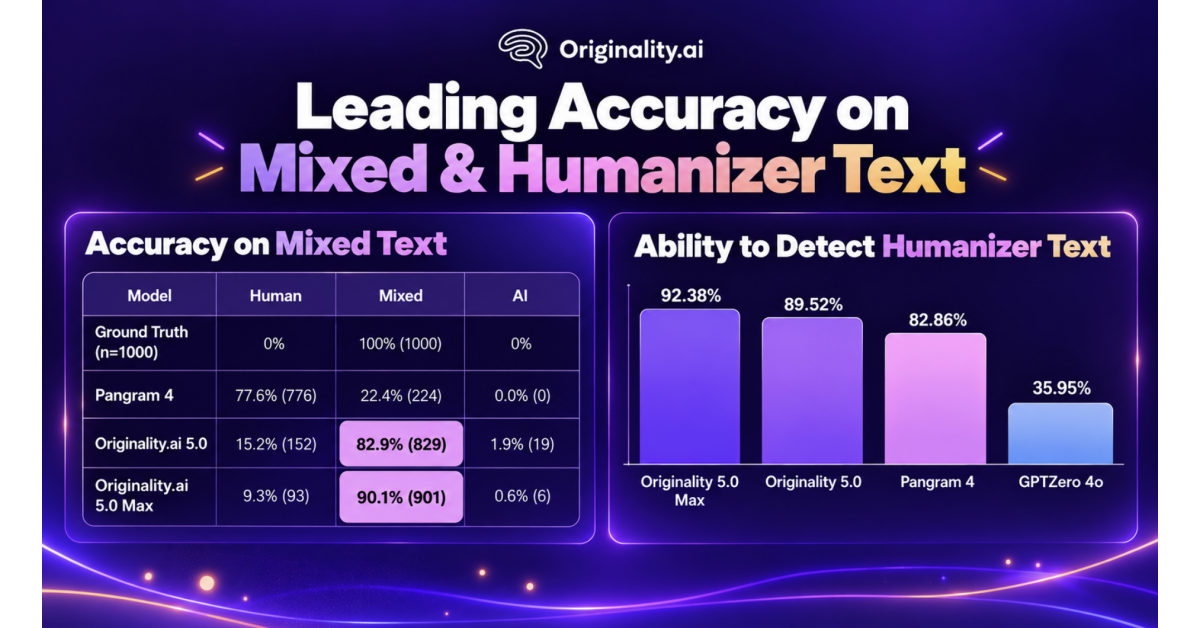
In internal testing using 1,000 mixed-writing documents from OpAI-Bench, Originality.ai reports that 5.0 Max correctly flagged 90.1% of documents as mixed writing, compared to 82.9% for the standard 5.0 model.
Why Mixed Human-AI Writing Is Changing AI Detection:
Earlier detection methods were built around a simpler task: telling fully human-written text apart from AI-generated copy. But real-world writing workflows rarely fit those neat categories anymore.
Consider a student who uses AI to sketch an essay outline, then writes and edits the final version themselves. Or a marketing team that takes an AI-generated draft and substantially rewrites it. Or a publisher who runs across content processed through AI humanizer software designed to hide its machine origins.
These situations create real headaches for organizations tasked with judging the authenticity and originality of written work. For educators, the concern reaches beyond catching AI use to gauging independent thought and student learning. For publishers and businesses, it raises stakes around editorial integrity, transparency, and whether expert commentary is genuinely human.
The rise of mixed and humanized writing has also made it more important for AI detectors to offer nuanced assessments rather than simple yes-or-no verdicts.
A New Approach to Identifying AI Involvement:
Originality.ai’s 5.0 and 5.0 Max models bring a revised scoring system aimed at helping reviewers better interpret what they see.
Moving away from the confidence-based scoring of earlier models, the new AI checker sorts content into three buckets:
Likely Original: Content assessed as predominantly human-written.
Mixed Writing: Content showing indicators of both human and AI-generated writing.
Likely AI: Content assessed as predominantly AI-generated.
The models also feature improved sentence-level highlighting, letting reviewers zoom in on specific passages that might need extra scrutiny. An optional Deep Scan function offers further explanations for why text may have been flagged, plus editing suggestions.
Together, these updates signal a shift toward AI detection tools that provide more context around potential AI involvement, rather than leaning entirely on an overall document score.
Balancing Detection Accuracy, Speed, and Scale:
The launch includes two models tailored to different review needs. Originality.ai 5.0 focuses on faster processing and lower scanning costs, making it a fit for routine checks and organizations handling large volumes of content. Originality.ai 5.0 Max, meanwhile, prioritizes the company’s highest detection accuracy, with longer processing times and higher credit costs for scenarios where precision is paramount.
Both models automatically detect the language of submitted content and support AI detection across more than 30 languages, in addition to code detection.
Even with these advances, the company acknowledges that identifying AI-generated content is not a perfect science. Accuracy can shift depending on language, writing style, content type, and the degree of human editing or AI humanization. Originality.ai stresses that AI detection results should guide further human review, not serve as final proof of authorship or academic misconduct.
Availability
Originality.ai 5.0 and 5.0 Max are now accessible through the company’s web application, Bulk Scan, Chrome and Firefox browser extensions, API, MCP integration, and Moodle.
More information is available at https://originality.ai.
Jonathan Gillham
Originality.ai
Visit us on social media:
LinkedIn
Facebook
YouTube
TikTok
Originality.ai 5.0 and 5.0 MAX are Here! Our Most Accurate AI Detector & AI Checker Yet
Why it matters: As AI tools become embedded in everyday writing, the line between human and machine authorship is blurring fast. Originality.ai’s new models aim to give educators, publishers, and businesses a more realistic read on how much AI is actually in a document — not just a binary flag. That shift could shape how institutions set policies on AI use, originality, and accountability in the years ahead.