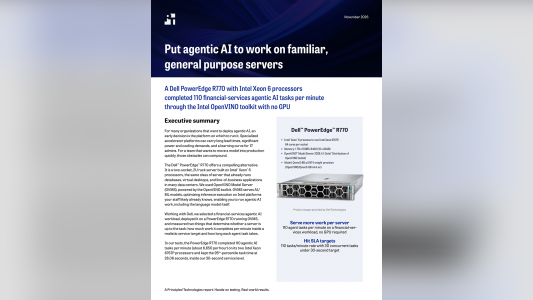
For companies weighing where to deploy agentic AI in production, the assumption has often been that specialized accelerators are a prerequisite. But a new benchmark from Principled Technologies suggests a familiar, general-purpose server may be sufficient for many workloads — potentially sidestepping GPU shortages, power constraints, and steep learning curves.
Principled Technologies testing (PT) shows a general-purpose server completing 110 financial-services AI agent tasks per minute within a 30-second target.
ROUND ROCK, TX, UNITED STATES, November 3, 2026 /EINPresswire.com/ — For many organizations ready to put agentic AI into production, one early decision is where to run it. Specialized accelerator platforms can bring long lead times, significant power and cooling demands, and a learning curve for IT staff. A new PT report, commissioned by Dell Technologies, examined a familiar alternative: a two-socket Dell PowerEdge R770 rack server with Intel Xeon 6 processors and no GPU.
PT ran a financial-services agentic AI workload on the server using the open-weight Qwen3-8B model at INT4 weight precision, served through Intel OpenVINO Model Server 2026.4.1. Each AI agent gathered data from a database, documents, or a library of public SEC filings, ran analysis code, and called the model to write a narrative, a list of findings, or a decision. The workload mixed eight task types, from regulatory ratio checks and portfolio valuation to fraud alert triage and board-report writing.
Key findings
• At 30 concurrent tasks, the Dell PowerEdge R770 completed 110 agent tasks per minute, about 6,650 an hour.
• The 95th-percentile task time at that load was 28.06 seconds, inside the 30-second service level PT set for work in which a person is likely waiting on the result.
• At 110 tasks per minute, an 8-hour working day would yield roughly 53,000 agent tasks for this task mix.
• The server ran the model on one processor and the agents, analysis code, document search, and PostgreSQL database on the other, with OpenVINO putting the Intel Advanced Matrix Extensions (Intel AMX) built into each Xeon 6 core to work.
The report also stresses measuring throughput and latency together. “A server that posts a large aggregate number by queuing work deeply will feel slow to everyone waiting in that queue,” the report states. Past 30 concurrent tasks, task time rose while throughput did not, so added load led to queuing rather than more output.
According to the report, “That makes the R770 a reasonable place to start your agentic AI journey on Intel Xeon 6 processors with Intel AMX and a reasonable place to stay for workloads of this shape.” When demand outgrows the processors, the chassis can take up to two 450W double-width GPUs or six 75W single-width cards.
To learn more, read the full report, Put agentic AI to work on familiar, general purpose servers.
About Principled Technologies, Inc.
Principled Technologies, Inc. is the leading provider of fact-based marketing and competitive analysis backed by transparent methodologies.
Principled Technologies, Inc. is located in Durham, North Carolina, USA. For more information, please visit www.principledtechnologies.com.
Sharon Horton
Principled Technologies, Inc.
press@principledtechnologies.com
Visit us on social media:
LinkedIn
Facebook
YouTube
X
Also worth a look: WSI’s Brandie Kelly to show Toronto businesses how to win AI recommendations and Goldcote launches four free travel finders that answer one border-crossing question each.
Why it matters: This benchmark challenges the assumption that agentic AI deployments require expensive, hard-to-source accelerators. For organizations with existing Intel Xeon infrastructure, the findings point to a potentially faster, lower-cost path to production — while still leaving room to add GPUs later if workloads grow.