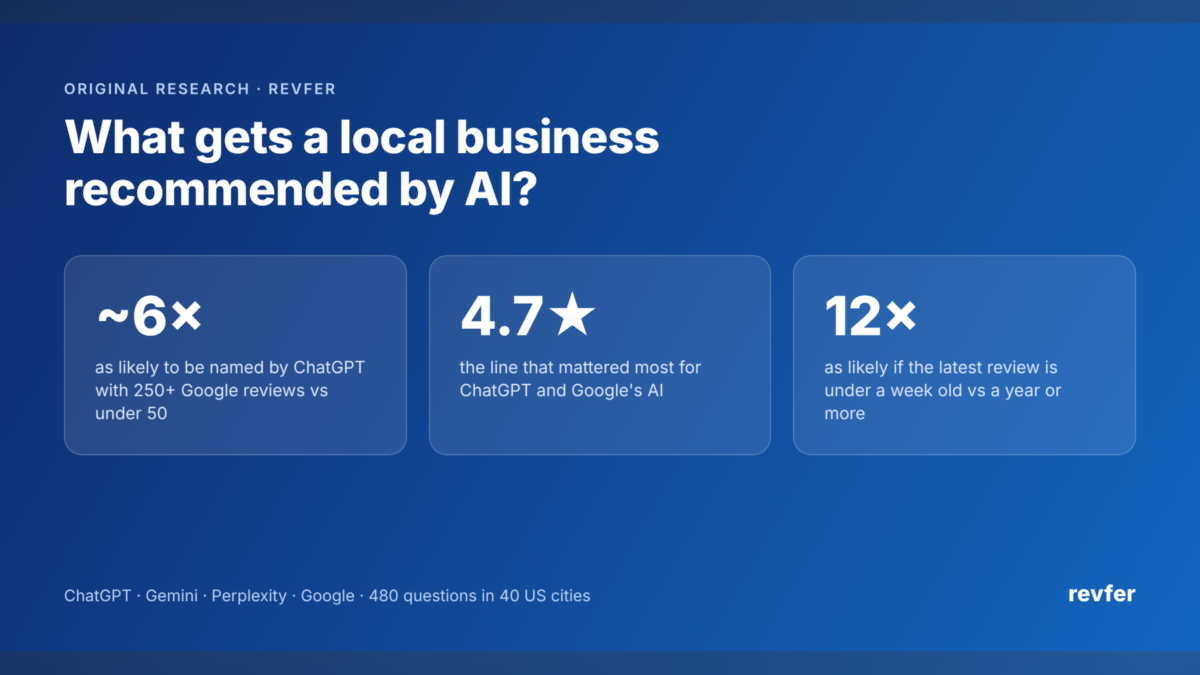
When you ask an AI assistant for a local business recommendation, the results may feel like magic — but a new study suggests they’re actually rooted in something quite familiar: Google reviews. The findings, from Revfer, an AI software company based in Ashland, Massachusetts, show that the businesses AI tools name are largely the ones that already have high review volume, stellar ratings, and recent customer feedback.
Share of Google Maps top-20 businesses named in each AI tool's top 5, by number of Google reviews. Source: Revfer.
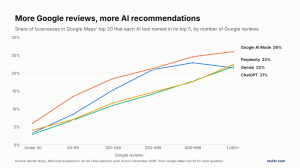
Businesses rated 4.7 stars or higher were named far more often by ChatGPT; for Gemini the gap was much smaller. Source: Revfer.
Also worth a look: Student First Technologies tailors tech to states’ unique education choice programs and ImageSEO finds one in three top sites missing alt text on images as DOJ deadline nears.
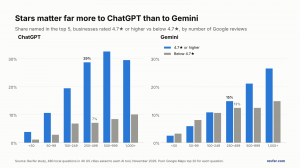
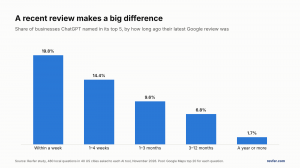
ChatGPT named about 20% of businesses whose latest Google review was under a week old, and under 2% of those whose latest review was a year or more old. Source: Revfer.
A Revfer study asked ChatGPT, Gemini, Perplexity and Google 480 local questions in 40 US cities. Review volume, rating and freshness predicted who was named.
AI didn't discover anyone new. It named the businesses customers had already been reviewing, a lot and recently. The way to show up in AI is still to earn real reviews.”— Pankaj Aggarwal, Founder, Revfer
ASHLAND, MA, UNITED STATES, November 9, 2026 /EINPresswire.com/ — What happens when you ask an AI chatbot to point you toward a good chiropractor in Boise, or a top-rated plumber in Austin? According to a comprehensive new study from Revfer, the AI tools tend to converge on a predictable set of winners: local businesses that already have a strong, recent stream of Google reviews.
Revfer put five AI systems — ChatGPT, Google Gemini, Perplexity, Google AI Mode, and Google Search — through their paces by asking the same plain question, such as “Can you recommend a good chiropractor in Boise, ID?”, across 40 US cities and 12 local industries. The industries spanned hair salons, restaurants, plumbers, dentists, and more. In total, the study covered 480 questions, roughly 2,900 answers, and more than 16,000 business recommendations, all collected between November 5 and 7, 2026. For each query, the researchers used the businesses appearing in Google Maps’ top 20 for the same search as their baseline comparison group.
The results paint a clear picture about what drives AI recommendations:
The number of Google reviews emerged as the single strongest predictor of being recommended, and this held true for every AI tool tested. Businesses with 250 or more reviews were about six times more likely to be named by ChatGPT than those with fewer than 50.
Rating played a particularly significant role for ChatGPT and Google’s own AI tools. Among businesses with 250 to 499 reviews, ChatGPT named 29% of those rated 4.7 stars or higher, compared to just 7% of those with lower ratings. For Gemini and Perplexity, review volume was the dominant factor, with rating having less of an impact.
Freshness of reviews mattered for every tool, but especially for ChatGPT. It named about 20% of businesses whose most recent Google review was less than a week old, but fewer than 2% of those whose latest review was a year or more old.
Perhaps most striking: more than half of the businesses that appeared in Google Maps’ top 20 for a given search were never named by any AI tool at all. When looking at businesses that were named by three or more different tools, they had a median of 488 reviews and a most recent review just 5.5 days old. Those never named had a median of 101 reviews and a latest review 22 days old. Notably, both groups shared the same median rating of 4.8 stars.
Other factors, such as whether a business replied to reviews, posted photos, or had booking links, mattered little once review volume and freshness were factored in. Having a website was linked to higher odds of being named by Gemini. ChatGPT and Google AI Mode also showed a tendency to favor independent businesses over chains.
The study is observational in nature — it shows which businesses were named, not why. As Pankaj Aggarwal, founder of Revfer, put it: “AI didn’t discover anyone new. It named the businesses customers had already been reviewing, a lot and recently. The way to show up in AI is still to earn real reviews.”
The full analysis is on the Revfer blog, and the aggregate results are available at doi.org/10.5281/zenodo.24089202. No individual business is named in the published results.
About Revfer
Revfer is AI software that runs social media and Google review replies for small businesses and startups, without needing prompts. It learns the business once, drafts posts and replies in the owner’s voice, and publishes them on approval. Revfer is based in Ashland, Massachusetts. Learn more about Revfer at revfer.com.
Pankaj Aggarwal
Revfer
+1 407-416-9408
Visit us on social media:
LinkedIn
Instagram
Facebook
Why it matters: For local business owners, this study underscores that the path to being recommended by AI is not a secret algorithm hack — it’s the same fundamentals that have always mattered: earning genuine, frequent, and positive reviews from real customers. As AI assistants become a primary way consumers discover services, the businesses that invest in consistent review generation may have a significant edge, while those that neglect this could find themselves invisible to a growing share of potential clients.