The adult day care industry is quietly becoming a cornerstone of eldercare infrastructure, yet it remains so fragmented that the top 10 providers combined control just 1% of global revenue. That paradox — massive projected growth with no dominant players — makes this a market worth watching closely.
Adult Day Care Market Industry
The Business Research Company’s Adult Day Care Global Market Report 2026 – Market Size, Trends, And Forecast 2026-2035
Also worth a look: Data catalog as a service market to hit $6 billion by 2030 as AI and cloud drive demand and Shamrok’s Tersavia gives spas a full booking and AI platform for free.
LONDON, GREATER LONDON, UNITED KINGDOM, October 27, 2026 /EINPresswire.com/ — The adult day care sector is carving out a critical niche within modern healthcare, particularly as aging populations worldwide require more specialized daily support. The competitive landscape includes a broad mix of providers vying for position through personalized care plans, skilled nursing, therapeutic programming, and a growing emphasis on regulatory compliance and digital health integration. Here’s a closer look at how this market is shifting, what forces are propelling it forward, and which organizations are leading the charge.
Adult Day Care Market Size and Forecast Through 2030
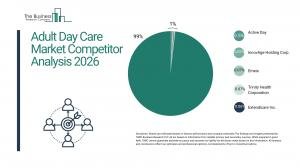
As of 2025, Active Day commanded a modest 0.5% share of the adult day care market, a figure that underscores just how dispersed the industry is — even the top 10 companies together pull in only about 1% of total revenue. Globally, the provider base spans large healthcare conglomerates and specialized elder-care firms alike, with service offerings centered on skilled nursing, therapeutic activities, personalized care plans, and integrated health monitoring. Their competitive playbooks emphasize person-centered care, regulatory compliance, seamless coordination, and the adoption of digital tools for care management.
Request A Free Sample Of The Adult Day Care Market Report
https://thebusinessresearchcompany.com/sample_request?id=22321160&type=smp&name=Adult%20Day%20Care%20Market%20Report%202026&utm_source=EINPresswire&utm_medium=Paid&utm_campaign=Oct_PR
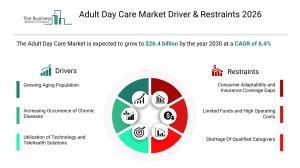
Looking forward, the adult day care market is on track to surpass $26 billion by 2030. That figure represents a small but notable slice — roughly 2% — of the broader Home Health Care and Residential Nursing Care Services market, which is projected to reach nearly $1,678 billion by 2030. Within the wider Healthcare Services industry, expected to hit $11,915 billion by 2030, adult day care will account for just under 0.2% of the total. The segment is forecast to expand steadily at a compound annual growth rate of 6% over the coming years.
Key Drivers Behind Adult Day Care Market Expansion
At the heart of the market’s momentum is the global demographic shift toward an older population. With rising life expectancy and declining birth rates, more people aged 65 and above now require daily supervision, social engagement, and healthcare support. Adult day care offers a cost-effective middle ground between full institutionalization and living alone, helping many seniors preserve their independence. This demographic tailwind is expected to add approximately 2.0% growth annually to the market.
Access The Detailed Adult Day Care Market Report Here
https://thebusinessresearchcompany.com/report/adult-day-care-global-market-report?utm_source=EINPresswire&utm_medium=Paid&utm_campaign=Oct_PR
Another significant growth accelerator is the rising prevalence of chronic conditions such as diabetes, cardiovascular disease, arthritis, Parkinson’s disease, and dementia. These illnesses require ongoing medical monitoring, rehabilitation, medication management, and help with daily activities — services adult day care centers are uniquely equipped to deliver. By reducing hospital admissions and easing the burden on family caregivers, these facilities have become an integral part of the long-term care continuum. The chronic disease burden is predicted to contribute roughly 1.6% in annual growth.
Technology and Telehealth Advancements Accelerate Market Growth
The integration of telehealth, remote patient monitoring, wearable devices, electronic health records, and artificial intelligence is reshaping elder care delivery. These tools enable continuous health tracking, virtual consultations, improved medication adherence, and highly individualized care plans. They also strengthen communication among caregivers, healthcare providers, and families, while expanding access for seniors with complex needs. The adoption of digital health solutions is forecast to add about 1.1% annual growth to the adult day care market.
How PACE Centers Are Changing Adult Day Care Models
Programs of All-Inclusive Care for the Elderly (PACE) are redefining the market by bundling healthcare coordination, social activities, and personalized support under a single roof. For instance, in October 2025, ArchCare launched the Senior Life Harlem PACE center, which provides medical services, meals, and social engagement opportunities for seniors. This integrated model promotes independence, enhances well-being through consistent supervision, and offers community-based support that weaves together various care components effectively.
Dominant Service Types Within the Adult Day Care Market
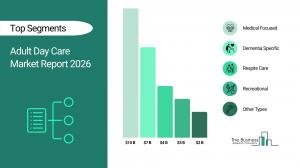
Adult day care services are categorized by type into medical focused, dementia specific, respite care, recreational, and other segments. Medical focused care is set to be the largest category in 2030, projected to represent 38% of the market, or $7 billion in value. Its dominance is driven by demand for skilled nursing, clinical supervision, rehabilitation, post-hospital recovery, and management of multiple chronic conditions. Coordinated outpatient care teams and preventive health initiatives further bolster this segment by curbing hospital readmissions.
Additional Market Segmentation by Service, Funding, and End Users
The market is further broken down by service type, including adult social day services, adult day healthcare, and specialized day care programs. Funding sources are split between private and public sectors. End users consist primarily of elderly individuals, disabled persons, and other groups needing daytime care and support.
Regional Leadership and Growth Trends in Adult Day Care
By 2030, the Asia-Pacific region is expected to become the largest adult day care market globally, reaching $8.3 billion, up from $5.4 billion in 2025. That represents a robust CAGR of 9%, fueled by rapid population aging, increasing chronic and age-related illnesses, a growing number of working women needing daytime elder care, government backing for community-based services, improved healthcare infrastructure, and rising awareness of person-centered care and healthy aging practices in countries including China, Japan, South Korea, and India.
In terms of individual countries, the USA leads with a projected market size of $6.7 billion in 2030, growing from $5.3 billion in 2025 at an annual rate of 5%. This steady expansion is supported by preferences for aging in place, caregiver demand for respite care, government-funded community programs like Medicare Advantage and Medicaid, rising dementia cases requiring supervised care, growth in specialized adult day health centers, and investments in integrated senior care services.
Growth Opportunities Across Adult Day Care Segments
From 2025 to 2030, the combined increase in market value across medical focused, dementia specific, respite care, recreational, and other service types is expected to exceed $7.3 billion. Medical focused care alone will grow by approximately $3 billion, dementia specific by $2 billion, respite care and recreational services by $1 billion each, and other types by around $0.3 billion. This expansion is fueled by rising demand for person-centered care, specialized cognitive and memory care, therapeutic and social activities, collaborations between healthcare and community organizations, the use of adult day care as a more affordable alternative to institutional care, and investments in facilities and workforce training — all aimed at improving quality of life for seniors through sustainable community-based support.
Market Fragmentation Reflects Low Barriers to Entry
The adult day care market’s fragmented nature is underscored by the fact that the top 10 providers controlled just 1% of revenues in 2025. This dispersion stems from low entry barriers and a decentralized service environment shaped by diverse care demands, regional policies, workforce availability, and the need for personalized health and social support for older adults and disabled individuals. Leading firms have gained market shares through diversified offerings, healthcare partnerships, expansive service networks, and ongoing innovations in adult day and community support services. As demand grows for customized programs, health monitoring, therapeutic offerings, and integrated care, these companies are expected to solidify their positions through collaboration, innovation, and geographic expansion.
Key Market Players and Their Presence in 2025
The companies leading the market in 2025 include Active Day and InnovAge Holding Corp., each holding about 0.5% share, followed by Emeis, Trinity Health Corporation, Extendicare Inc., On Lok, Inc., WelbeHealth, Age UK, SH Town Square Franchising Inc., and United Medicare Pte Ltd., all with smaller shares. These organizations deliver a range of adult day health services featuring nursing, personal care, therapeutic activities, and social engagement tailored to seniors and adults with chronic illnesses or disabilities.
Strategic Approaches Shaping Market Competition
Current competitive strategies focus on enhancing adult day care programs to promote individualized care and improve client well-being. Providers are also leveraging digital health technologies to advance care coordination and monitoring. Expanding facility footprints to accommodate growing aging populations and community care demands, while integrating person-centered care to elevate the quality and social aspects of service, are key priorities for market players.
Who Is the Adult Day Care Market Leader?
The Business Research Company reported that Active Day was the top global seller in 2025, capturing a 0.5% market share. Its adult day services division offers a comprehensive mix of adult day health programs, including personal care, nursing support, therapeutic activities, and social engagement for older adults, people managing chronic conditions, and disabled adults.
Participants Across the Adult Day Care Supply Chain
Suppliers of raw materials and medical products include major firms such as Medtronic plc, Baxter International Inc., Becton Dickinson and Company, Cardinal Health Inc., Owens and Minor Inc., Medline Industries LP, Stryker Corporation, Hillrom Holdings Inc., Invacare Corporation, and others providing essential healthcare equipment and consumables.
Wholesalers and distributors facilitating market reach comprise companies like Henry Schein Inc., Concordance Healthcare Solutions LLC, Cencora Inc., Morris and Dickson Company LLC, Anda Inc., and several other specialized medical supply distributors.
The end users of adult day care services include senior living providers and home health agencies such as Brookdale Senior Living Inc., Amedisys Inc., Enhabit Inc., The Ensign Group Inc., Genesis HealthCare Inc., Extendicare Inc., Revera Inc., Five Star Senior Living Inc., and many others offering comprehensive elder care services across the globe.
Our 2026 market reports now feature expanded strategic intelligence through market attractiveness scoring and analysis, total addressable market (TAM) analysis, company scoring matrix graphics and tables, Excel-based dashboards, market hotspots infographics, key technology and future trend analysis, along with updated graphics and tables.
Learn More About The Business Research Company
The Business Research Company (www.thebusinessresearchcompany.com) is a leading market intelligence firm renowned for its expertise in company, market, and consumer research. We have published over 30,000+ reports across 27 industries and 60+ geographies. Our research is powered by 1,500,000 datasets, extensive secondary research, and exclusive insights from interviews with industry leaders.
We provide continuous and custom research services, offering a range of specialized packages tailored to your needs, including Market Entry Research Package, Competitor Tracking Package, Supplier & Distributor Package and much more.
Disclaimer: Please note that the findings, conclusions and recommendations that TBRC Business Research Pvt Ltd delivers are based on information gathered in good faith from both primary and secondary sources, whose accuracy we are not always in a position to guarantee. As such TBRC Business Research Pvt Ltd can accept no liability whatever for actions taken based on any information that may subsequently prove to be incorrect. Analysis and findings included in TBRC reports and presentations are our estimates, opinions and are not intended as statements of fact or investment guidance.
Contact Us:
The Business Research Company
Americas +1 310-496-7795
Europe +44 7882 955267
Asia & Others +44 7882 955267 & +91 8897263534
Email: marketing@tbrc.info
Follow Us On:
LinkedIn: https://in.linkedin.com/company/the-business-research-company
Oliver Guirdham
The Business Research Company
+44 7882 955267
Visit us on social media:
LinkedIn
Facebook
X
Why it matters: With the global population aging rapidly and chronic disease rates climbing, adult day care is emerging as a cost-effective alternative to institutional care — yet the market’s extreme fragmentation signals room for consolidation and innovation. Providers that successfully integrate digital health tools and specialized services stand to capture outsized share in a field projected to grow by more than $7 billion over the next five years.