
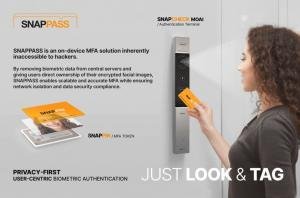
Promotional image of ANDOPEN’s SnapPass | Image provided by ANDOPEN
Jayden Lee from ANDOPEN (right) answering questions at the interview

“Our On-Device AI Architecture Eliminates Hacking Vulnerabilities by Keeping Personal Biometric Information Securely in the Hands of the Individual.”
PANGYO, GYEONGGI-DO, SOUTH KOREA, July 17, 2026 /EINPresswire.com/ — As unease mounts about recent cloud server intrusions and widespread personal data exposures, a security technology startup that is revolutionizing biometric authentication is capturing significant attention. That company is ANDOPEN Co., Ltd. (CEO Jayden Lee), based in Pangyo Techno Valley, Seongnam-si, Gyeonggi-do. Rejecting the traditional approach of keeping biometric data on centralized servers, ANDOPEN unveiled ‘SnapPass,’ a privacy-first multi-factor biometric authentication solution built on the idea that personal data ought to be owned and managed directly by the individual rather than by a server.
Given that older biometric systems store enormous volumes of personal information on central servers linked through cloud networks, they inherently invite the danger of large-scale data breaches during a cyberattack. Moreover, once biometric data is exposed, the fallout is severe and irreversible, because it cannot be reset the way a typical password can.
To address these systemic weaknesses, ANDOPEN created SnapPass. The full solution comprises three main components: ‘SNAPPIN’ (also referred to in context as the card-type token ‘Snap’), a physical token carried by the user; ‘SNAPCHECK MOAI’ (also called SnapCheck on-site), an on-device facial authentication terminal; and an integrated management platform, SPMS. Users encounter no cumbersome registration or operational steps; they simply glance at the terminal and tap their token on-site, captured by the concept “JUST LOOK & TAG.” Once the token is tapped, the terminal instantly performs a 1:1 comparison and analysis between the compressed, encrypted facial data held in the token and the live facial images taken by the terminal’s camera.
The key strength of SnapPass lies in its complete independence from networks during the authentication process, guaranteeing that no biometric traces remain on the terminal. The facial images recorded solely for verification are wiped from the device right after the authentication step concludes, thoroughly removing the threat of personal data leaks. Additionally, in contrast to conventional 1:N (one-to-many) biometric approaches, where the likelihood of false identification grows as the user base expands, SnapPass carries out a strict 1:1 match against the presented token, driving false recognition rates close to 0%. ANDOPEN calls its proprietary technology an ‘On-Device AI Physical Access Control Solution.’
The company’s technological know-how has already earned global recognition. It achieved the milestone of taking home CES Innovation Awards for two years in a row, received an Outstanding Information Security Technology designation from the Ministry of Science and ICT, and was selected as a finalist for the GLOMO Awards at MWC.
Pangyo Techno Valley sat down with ANDOPEN CEO Jayden Lee at the Startup Campus to talk about their decentralized security ecosystem, strategic enterprise partnerships, and forthcoming international plans.
Q1. Could you introduce your company and the vision driving it?
A. Our firm, ANDOPEN, takes a fundamentally distinct approach to biometric recognition compared with standard methods. When people picture biometrics, they typically imagine a user’s personal data being stored in or reliant on a cloud network or a device. In truth, every security weakness in biometrics originates from that very storage model. Because traditional systems keep data in the cloud, your personal information sits beyond your direct oversight, opening the door to inherent risks. Users have no way to tell whether their data is being handled appropriately or abused. Moreover, if biometric data is ever leaked, it is not something you can simply swap like a password. Since it carries such high stakes, we decided to construct a physically independent system called ‘SnapPass’ where the user directly retains control over all of their own personal information.
Q2. So the solution is to place the information back in the user’s hands instead of storing it elsewhere under someone else’s control. How does that actually function?
A. Our integrated offering is named SnapPass. This system includes a device called ‘SnapCheck’ and a dedicated card-type token called ‘Snap’ that uses AI to compress, encrypt, and hold the user’s personal data. To facilitate mobile token scenarios, we also deliver it as a QR code. Additionally, the framework incorporates a management platform, SPMS, to govern the entire workflow. All personal data exists exclusively on this physical token. When a user takes this token and taps it onto the device, the system first runs the primary token authentication layer to verify whether it is a legitimate token with proper access privileges. After it is confirmed as an authorized token, the device initiates the secondary authentication layer by capturing the user’s face with its camera and matching the live camera image against the compressed, encrypted data stored inside the token to confirm that the person holding the card is indeed its authorized owner.
Q3. A crucial point is that anyone can pick up a conventional physical key and use it, but this token makes sure only the legitimate owner can do so. What advantage does that bring?
A. Because users always carry their biometric data in a physically separate format, the SnapCheck hardware device retains no personal information. Although it captures a facial image through the camera for face recognition, that process deletes all collected personal data immediately after verification finishes. Traditional biometric systems inevitably see false recognition rates climb as the user population grows. With our approach, the chance of false recognition is wiped out because it constantly performs a strict 1:1 local match. As a result, it avoids false acceptance errors, places no cap on the number of enrolled users, and requires no network link. Never transmitting personal data over a network creates a powerful differentiator. That is why we call our SnapPass solution an “On-Device AI Access Control Solution.”
Q4. Which industries or commercial settings do you see as the first targets for deploying this solution?
A. Our main focus market is physical access control—the physical security sector. We are channeling our early efforts into this space. After building solid trust and a proven track record there, our aim is to branch into other fields. A clear example is membership management at Costco, which neatly solves the problem of membership card sharing and unauthorized use with minimal overhead. With support from the Seattle Economic Development Office, we are continuing discussions with Costco about possible deployment. In addition, we are already advancing on multiple fronts. Through our sales pipeline in the United States, we are currently progressing projects for casino memberships and patient registration cards for large-scale US hospitals. At the same time, we finalized a supply agreement to provide our workforce management solution to a food manufacturing facility in the US, with deployment scheduled for this September.
Q5. That sounds like a significant achievement. Are there any notable deployments or validation initiatives happening locally in South Korea?
A. Yes, we are currently finalizing a major agreement. We were chosen for a demonstration project managed by the National IT Industry Promotion Agency (NIPA) in Korea to apply sustainable development solutions to data centers. Data center security is obviously incredibly important. We are running a pilot project to upgrade their security infrastructure with our multi-factor authentication system, which will continue until the end of this year. We are also planning a validation effort with an international organization to verify employment credentials for vocational trainees across South America, speeding up our global expansion.
Q6. You noted earlier that personal data is not managed in the cloud or on a server. How does the system handle overall management and administrative monitoring if the data is fully decentralized?
A. Since we do not store personal data on a cloud or server, people frequently ask how administration works. We manage the system solely through the token’s hardware serial numbers. A separate layer is built entirely within our SPMS management platform to handle audit trails and configuration tasks without touching personal identities.
Q7. Can you tell us more about your upcoming international roadmap and where your solutions are rolling out next?
A. Right now, we are fielding partnership requests from a broad range of companies in the United States and in European countries such as Spain, Italy, Switzerland, and Portugal. Most security tech firms in Korea tend to start locally, move into Japan, and then gradually pursue global expansion. We took a somewhat different route. By participating multiple times in major international platforms like CES and MWC, we proactively identified global partners. For instance, a partner company headquartered in Spain with parallel branches in Switzerland signed an MOU with us directly on-site at the MWC exhibition floor last March. They are actively promoting our solution across Europe, and we have been invited to present at their upcoming Partners’ Day in Switzerland this September.
Q8. What is your perspective on Pangyo Techno Valley as an innovation hub for tech companies like ANDOPEN?
A. A few years ago, a Japanese buyer told me that Pangyo feels like a place where only geniuses gather. He was stunned by how many companies here are successfully commercializing advanced ideas. I strongly agree with that view. The infrastructure, support agencies, and technology enterprises are densely clustered here to accelerate technology development. It provides a meaningful competitive edge over other regions. Furthermore, because the headquarters of South Korea’s leading IT giants are concentrated in the Pangyo and Bundang areas, it is geographically advantageous for attracting top-tier technical talent.
Q9. What is the ultimate goal for ANDOPEN going forward?
A. Our ultimate aim is to make SnapPass the global benchmark for secure identity and biometric access control. We are working to reach the world stage, and soon you will see our serverless authentication solutions deployed internationally, returning data sovereignty to individual users.
Kim Seung Yeon
Gyeonggi Business & Science Accelerator
+82 31-776-4834
email us here
Visit us on social media:
LinkedIn
Instagram
Facebook
YouTube
Other