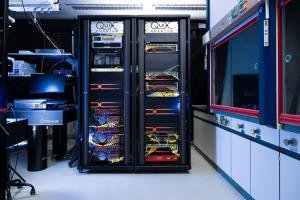
Built for the German Aerospace Center’s Quantum Computing Initiative, Carina provides a compact, room-temperature basis for achieving fault-tolerant computing within data centers
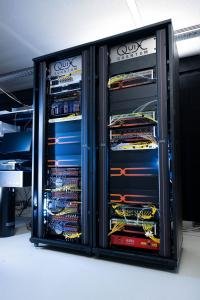
What QuiX Quantum is demonstrating with Carina and its measurement-based methodology is that this route is not only achievable but also feasible using integrated photonics.”— Prof. Gerard J. Milburn, University of Queensland.ENSCHEDE, NETHERLANDS, July 14, 2026 /EINPresswire.com/ — QuiX Quantum has unveiled Carina, the first universal photonic quantum computing architecture of its kind, engineered for placement within client data center environments as a critical building block for tomorrow’s fault-tolerant systems.
Created under the Universal Photonic Quantum Computer (UPQC) project of the DLR Quantum Computing Initiative (DLR QCI), with funding from the German Federal Minister of Research, Technology and Space, Carina integrates essential components for universal quantum computation by employing individual photons as physical qubits. It combines the vital technologies needed for measurement-based photonic quantum computing within a unified stack. This compact system, which operates at room temperature, is crafted to function smoothly alongside classical high-performance computing, artificial intelligence, and data center infrastructure, preparing both workflows and personnel for next-generation utility-scale machines.
In contrast to earlier special-purpose photonic systems that relied on narrow computational models like boson samplers, Carina is built to realize a universal gate-set capable of running any gate-based quantum algorithm. Through the integration of photon generation, multiplexing, state preparation, measurement, photonic assembly control, and rapid feed-forward control, Carina lays the physical qubit groundwork for the company’s forthcoming Dedalo architecture and its progression toward logical qubits.
“When Manny Knill, Raymond Laflamme and I released our linear optics quantum computing scheme in 2001, the core question was whether the probabilistic character of photon-to-photon interactions could be managed to achieve computational universality. The answer was yes in theory — but the engineering challenge appeared daunting,” remarked Prof. Gerard J. Milburn, University of Queensland. “What QuiX Quantum is showing with Carina and its measurement-based approach is that this path is not only tractable but navigable with integrated photonics. The combination of on-chip single-photon generation, feed-forward control and cluster-state generation in a system designed for deployment outside the laboratory is precisely the kind of milestone the field awaits. It moves the conversation from whether photonic quantum computing can be universal to how quickly it can be scaled.”
“Quantum photonics aims to bring quantum technologies to a wider audience by capitalizing on the extraordinary capabilities of the semiconductor manufacturing industry. The release of Carina from QuiX represents an exciting achievement in this endeavor: the first system created both to produce on-chip cluster states—the essential resource for measurement-based quantum computing—and for commercial deployment,” stated Prof. Andrew G. White, University of Queensland. “To guarantee strong and dependable performance, QuiX has brought together photon generation and detection, real-time feedforward, and control electronics in a platform intended for end users rather than solely for laboratory experimentation. Congratulations to the entire QuiX team: I cannot wait to see what the next few years bring for photonic quantum computing.”
“Carina signifies a major achievement for QuiX and the photonic quantum computing sector in bringing utility-scale quantum systems to customer facilities,” said Dr.-Ing. Stefan Hengesbach, CEO of QuiX Quantum. “The industry has been divided between systems that could be commercialized rapidly but were not intended for universal, fault-tolerant computing, and architectures with long-term scalability potential that proved difficult to implement. Carina merges these two needs into a universal architecture designed for installation in actual customer settings.”
The following recent announcements from QuiX outline the company’s strategy for operating single photons at speed and scale to unlock universal fault-tolerant quantum computing:
– Feed Forward Control Unit (FFCU), which translates signals from single-photon detectors into control actions on photonic integrated circuits.
– Photonic Assembly Control Unit (PACU), which offers a standardized control layer for photonic chips and assemblies. Collectively, these two components support the real-time operation, rack-based integration, monitoring, and serviceability needed to move photonic quantum systems beyond laboratory settings.
– For the first time for a European quantum firm, QuiX showcased a production-ready method of “below threshold” error mitigation on a photonic quantum computer, reducing physical qubit errors to a level suitable for scalable, fault-tolerant quantum computing.
– The company released its next-generation Dedalo architecture white paper, designed to progress from physical qubits to logical qubits and fault-tolerant photonic quantum computing, emphasizing photon-loss protection, modular photonic hardware, and data-center deployability.
– The delivery of the Carina core hardware platform to DLR QCI, advancing Europe’s universal photonic quantum computing roadmap.
“QuiX has always been a company that delivers physical hardware to its clients, and we understand that photonic quantum computing must extend far beyond chip design to provide on-premise fault-tolerant systems,” said Robin Wittland, CCO of QuiX Quantum. “The complete machine needs to be built, controlled, maintained, and scaled. Carina has been engineered as a full system, with photonic hardware, control electronics, and deployment requirements developed together from the outset.”
Many quantum computing platforms still rely on highly specialized operating conditions, including extensive cryogenic infrastructure, which can complicate deployment, upkeep, and integration. Carina tackles the practical needs of quantum systems operating where real-world workloads currently exist.
The complete white paper, Carina – Universal Photonic Quantum Computing Built for Customer Deployment, is now accessible from QuiX Quantum. Readers can download the document here to examine the Carina architecture in depth, including its components for photon generation, multiplexing, cluster state generation, fast feed-forward, and more. By utilizing components compatible with optical networking, rack-based infrastructure, and room-temperature operation across much of the system, Carina will enable customers to start constructing the operational layer around photonic quantum computing prior to the availability of utility-scale systems.
For inquiries, please contact c.taballione(at)quixquantum.com or r.wittland(at)quixquantum.com
About QuiX Quantum
QuiX Quantum is a European photonic quantum computing company established in Enschede, the Netherlands, in 2019. The firm develops integrated photonic quantum computing hardware and characterizes its methodology as full-stack and fabless, with systems built for modularity, scalability, and compatibility with data center and HPC environments. QuiX Quantum maintains offices in the Netherlands and Germany and is developing universal photonic quantum computing systems based on its silicon nitride photonic technology.
David Parmet
HKA Marketing Communications
+1 714-426-0444
email us here