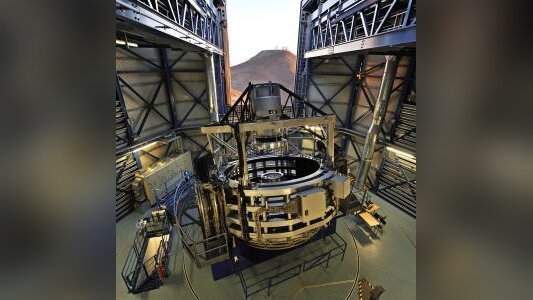
Astronomers are about to get the most detailed family portrait of the local Universe ever assembled, thanks to a new telescope in Chile that relies heavily on Australian engineering, software and scientific leadership. The effort, described as a “census of galaxies,” promises to reshape our understanding of dark matter, cosmic structure and the evolution of galaxies over billions of years.
PERTH, AUSTRALIA — A new telescope in Chile is embarking on the most complete galaxy census of the local Universe, powered by Australian technology. The 4-metre Multi-Object Spectroscopic Telescope (4MOST) has begun science operations. It will collect chemical fingerprints of millions of stars and galaxies to build a 3D map of the Universe.
“4MOST is a giant leap forward for astronomy. It will help answer decades-long questions about how the Universe works, and we’re so proud that Australia is playing a leading role,” says Professor Simon Driver, from The University of Western Australia node of the International Centre for Radio Astronomy Research (UWA-ICRAR).
Also worth a look: 5L Food Services expands to San Antonio, seeking restaurant partners for office meals and online ordering and Jeff Kagan opens his analyst columns to news publishers covering AI, wireless and tech.
The new facility is run by an international consortium led by the Leibniz Institute for Astrophysics Potsdam (AIP), but it relies on Australian hardware, software, and expertise.
Australian work on 4MOST began more than a decade ago, when Europe approached Australian engineers to build its key instrument: the Australian-European Southern Observatory Positioner (AESOP).
“We’re one of the few groups in the world that has the skills and capability to build these sorts of instruments from concept to commissioning. The core technology that we develop in Australia is unique,” says Distinguished Professor Jon Lawrence, Head of Instrumentation at Australian Astronomical Optics (AAO) at Macquarie University.
AESOP precisely controls 2400 optical fibres. Each is about as thin as a human hair and points to a different astronomical object to collect its light “spectrum”. Patterns in those spectra can reveal what an object is made of, how far away it is, and how it’s moving through space.
The technology is a successor to the 2-degree Field (2dF) instrument on the Anglo-Australian Telescope (AAT), with higher accuracy, faster operations, and six times the number of fibres. First commissioned in 1997, 2dF and its Australian-run surveys helped reveal the large-scale cosmic web structure of galaxies.
Initially, Australia’s contribution to 4MOST was limited to hardware. But that effort helped Professor Driver pitch one of the telescope’s key projects, the Wide Area VISTA Extragalactic Survey (WAVES).
WAVES is the largest extragalactic survey undertaken by 4MOST, using almost one fifth of its observing time over the next five years. UWA-ICRAR leads the effort, with Professor Driver as Principal Investigator.
The survey will study the growth of structure, mass and energy over seven billion years of cosmic history, capturing data at 10 times the speed of previous efforts on the AAT.
“By going a little deeper and covering a much larger area of sky, that changes the kinds of questions we can ask and the precision with which we can answer them,” says Dr Sabine Bellstedt, Programme Scientist for WAVES from UWA-ICRAR.
WAVES data will integrate with other ground- and space-based observatories to study the origin of galaxies and dark matter—the mysterious substance that holds those galaxies together.
“Dark matter remains one of astronomy’s biggest unsolved problems. One of our ambitions is to build datasets powerful enough to distinguish between competing models and provide new observational evidence about its true nature,” says Dr Bellstedt.
4MOST will also undertake community-led surveys. One of these is the 4MOST Hemisphere Survey (4HS), led by researchers at Swinburne University of Technology. It will measure distances for about 4.5 million galaxies across the entire sky, mapping mass and motion on the largest scales.
“A lot of astronomy surveys ask a handful of questions of a small sample. What we’re trying to do is much closer to a census. We want the richest, most complete picture possible of millions of galaxies so we can understand what makes them tick,” says Professor Edward Taylor, co-Principal Investigator on 4HS based at Swinburne.
Knowing those distances unlocks the full power of observatories elsewhere. The Legacy Survey of Space and Time is undertaking a decade-long timelapse of the southern sky, while the under-construction SKA-Low telescope in Western Australia will probe the Universe in radio.
“These facilities will generate extraordinary new views of the sky, but you need galaxy distances to understand what you’re looking at. 4HS provides that missing dimension and helps unlock their full scientific value. We see this as something people are going to be using in 20 years’ time as the go-to dataset,” says Associate Professor Michelle Cluver, co-Principal Investigator on 4HS.
Along with hardware and research, Australia is contributing to 4MOST software. UWA-ICRAR researcher, Associate Professor Luke Davies, co-designed a pipeline to extract all distance measurements in real time. Professor Taylor reprocessed many terabytes of archival imaging to find 4HS galaxy targets.
Both teams are now building software architecture to store and deliver new 4MOST data to astronomers around the globe.
“We’ve always punched above our weight. With around 100 engineers and a small community of researchers, we’ve developed an international reputation for ambitious survey science and instrumentation. This is a distinct competitive advantage,” Associate Professor Cluver says.
With operations now underway, data is heading to researchers across the globe. Dr Bellstedt says that community finds strength in its diversity.
“Being involved in 4MOST has given me an international family. We work so closely with colleagues across Australia and Europe that eventually you stop thinking about which country people come from and simply see yourselves as one team,” she says.
For Associate Professor Cluver, the most exciting part is laying the groundwork for future astronomers: “The sheer amount of science that will be possible with this data set is mind-blowing. It’s going to take many generations of astronomers to fully benefit from the information we’re going to provide.”
Why it matters: This census of millions of galaxies is not just a catalog — it’s a fundamental tool for solving some of astronomy’s biggest mysteries, from the nature of dark matter to how cosmic structure formed. By combining Australian-built hardware, software, and survey leadership, 4MOST positions researchers to produce reference datasets that will drive discoveries for decades to come.
Rockwell McGellin
International Centre for Radio Astronomy Research
+61 8 6488 7768
rockwell.mcgellin@uwa.edu.au
Visit us on social media:
LinkedIn
Instagram
Facebook
X
Other