With the Department of Justice’s web accessibility deadline for larger governments now just five months away, a new analysis of the internet’s most popular homepages reveals that more than half still fail on one of the most basic accessibility requirements: describing images for people who can’t see them.
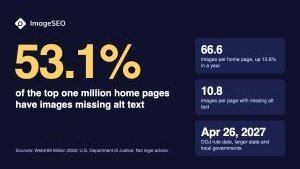
DALLAS, TX, UNITED STATES, November 9, 2026 /EINPresswire.com/ — ImageSEO, a WordPress plugin that writes image alt text and filenames, has reviewed the 2026 WebAIM Million report alongside its own audit of top-ranked homepages. WebAIM found images with missing alternative text on 53.1% of the top one million home pages, making it the second most common accessibility failure after low-contrast text.
The trend is moving in the wrong direction. Pages are carrying more images than before. WebAIM counted an average of 66.6 images per home page, up 13.6% in one year, and 16.2% of those images, or 10.8 per page, had missing alternative text. Across all error types, 95.9% of home pages had detected WCAG 2 failures, up from 94.8% in 2025, and the average rose to 56.1 errors per page from 51.
Also worth a look: Student First Technologies tailors tech to states’ unique education choice programs and Moores Lab AI’s new benchmark lets chip engineers compete, compare, and improve.
ImageSEO’s July 2026 audit used a narrower sample and a stricter test. It analyzed 306,634 images on 5,306 reachable homepages from the 10,000 highest-ranked domains on the Tranco list. Of those images, 67.7% had non-empty alt text, 21.0% used alt=”” and 11.3% had no alt attribute at all. At least one image with no alt attribute appeared on 37.1% of the sites, while 24.3% of sites described every homepage image. The two studies measure different things and are not directly comparable.
An empty alt attribute is not automatically an error. The W3C’s Web Accessibility Initiative says decorative images should use a null alt value so that screen readers can ignore them. Images that carry information need a text description.
The issue also has a public-sector deadline in the United States. The Department of Justice’s web accessibility rule under Title II of the Americans with Disabilities Act covers state and local governments. An interim final rule published April 20, 2026 moved the compliance date to April 26, 2027 for entities with a population of 50,000 or more, and to April 26, 2028 for smaller entities and special district governments. The department’s own explanation of the rule uses an image without alt text as an example of content that a screen reader cannot convey.
“Automation can close a gap this size, but it cannot decide what an image means on a particular page,” said the ImageSEO team. “A person still has to check that the description is right.”
ImageSEO generates alt text and filenames for images in WordPress media libraries. A free plan covers 10 images per month with no credit card. The full audit data is at https://imageseo.io/alt-text-study/.
This release is general information and is not legal advice. Figures were read from the sources named above on November 9, 2026. Automated alt text does not by itself make a website accessible or legally compliant, and generated descriptions should be reviewed. ImageSEO is not affiliated with or endorsed by WebAIM, the W3C, the Department of Justice or the WordPress Foundation. WordPress is a trademark of the WordPress Foundation.
Why it matters: With the DOJ compliance clock ticking for state and local governments, and the number of images on the average homepage still climbing, the gap between accessibility expectations and real-world practice is widening. Automated tools can help at scale, but the data makes clear that human review remains essential — a reality that organizations must bake into their workflows before the April 2027 deadline arrives.