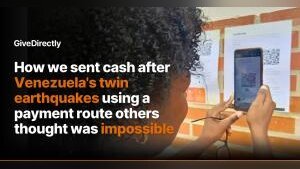
When twin earthquakes struck Venezuela on June 24, 2026, a U.S. nonprofit faced a daunting question: how do you get cash to survivors in a country under sanctions, with scarce physical currency and limited banking access? GiveDirectly’s answer — using USDC stablecoins routed through local payment networks — delivered $340 to each of 3,765 people in one of the hardest-hit areas, with first payments arriving just 21 days after the disaster.
In La Guaira, 3,765 people got $340 each via Pago Móvil, starting 21 days after the June 24 quakes. Of each donated dollar, 86 cents reached them as cash.
The nonprofit, which specializes in sending no-strings-attached cash to people living in poverty, published its results and lessons learned on October 14, 2026. The operation marks the organization’s first-ever response in Venezuela, where it had no office, no local team, and faced an array of logistical hurdles that would have stalled a conventional aid delivery.
Also worth a look: Lucentis market heads to $4.87M by 2030 as retinal disease cases climb and WSI’s Brandie Kelly to show Toronto businesses how to win AI recommendations.
My experience was amazing — it fell from the sky, because I used it to partly rebuild what the earthquake destroyed. And I still have further to go.”— Hector, 57, recipient in Catia La Mar
GiveDirectly moved the funds as USDC, a stablecoin pegged to the U.S. dollar, and recipients received bolívares through Pago Móvil, the mobile payment system already widely used across Venezuela. The operation centered on Catia La Mar in La Guaira state, one of the areas most devastated by the magnitude 7.2 and 7.5 earthquakes, with local organization Alimenta La Solidaridad serving as an on-the-ground partner.
Key facts from the operation paint a picture of both speed and scale. Each of the 3,765 verified recipients received $340. Once individuals were confirmed eligible, the median time to payment was four days, and payments landed a median of two minutes after each batch was transmitted. The cost efficiency exceeded expectations: 86 cents of every donated dollar reached recipients as cash, surpassing the 70 to 80 cents GiveDirectly had projected.
The payment infrastructure was a multi-step chain designed to navigate U.S. sanctions. GiveDirectly used Coinbase Business to convert dollars into USDC on the Stellar network. Decaf, a stablecoin payments platform, screened recipients’ details for compliance. Vetted local cashiers operating on Airtm’s marketplace then exchanged the USDC for bolívares and disbursed funds through Pago Móvil. This approach meant recipients needed neither a crypto wallet nor a U.S. bank account, and GiveDirectly never held bolívares or transacted directly with Venezuelan banks.
Early follow-up surveys show tangible impact: 95% of recipients reported improved stability and wellbeing, 60% said the cash helped them restart or sustain income-generating work, and 97% said the money arrived at the right time. Half of respondents used the funds to buy food and drinking water, while others purchased hygiene supplies, paid for medicine and clinic visits, and replaced damaged mattresses and cooking stoves.
To identify where to work, GiveDirectly combined an AI-powered alert system, satellite damage assessments from DISHA, and volunteer mapping through the Humanitarian OpenStreetMap Team and MapSwipe, then verified findings on the ground. Enrollment happened entirely on phones via QR code scanning. Automated ID and selfie checks streamlined the process dramatically — only 5% of applications needed manual review, compared with nearly 100% in GiveDirectly’s first-ever response in the Philippines.
The operation also surfaced challenges worth noting. The $340 payment was designed to cover basic needs for roughly three months, but recipients said it lasted about three weeks, as prices rose and more than 45% reported having no regular income. A registration glitch allowed approximately 1,500 more eligible people to enroll than planned, with donors and a contingency fund covering the additional cost. Daily banking limits on local cashiers capped payment batches at 100 to 300 people, slowing distribution somewhat.
GiveDirectly is now reviewing how it sets payment amounts based on these findings.
“My experience was amazing — it fell from the sky, because I used it to partly rebuild what the earthquake destroyed. And I still have further to go,” said Hector, 57, one of the recipients (translated from Spanish).
“Each lesson brings us closer to our five-day emergency cash goal — a world where families receive meaningful support within days of a crisis, wherever they are,” wrote Gianmarco Morassutti Vitale, GiveDirectly’s Delivery Manager for Emergency Cash.
Questions and answers
How did GiveDirectly send aid to Venezuela under sanctions? It worked through two providers, Decaf and Airtm, so it never held bolívares or dealt directly with Venezuelan banks. Decaf screened recipients’ payment details for compliance, and local cashiers completed the last step as ordinary domestic bank transfers.
Did recipients have to use cryptocurrency? No. The stablecoin only moved the money into the country. Recipients received bolívares in their existing accounts through Pago Móvil, and almost all said they would use it again.
What did people spend the cash on? Half of respondents bought food and drinking water. Families also bought hygiene supplies, paid for medicine and clinic visits, and replaced damaged mattresses and cooking stoves.
Is the program still enrolling? No. The Venezuela response is no longer enrolling recipients. GiveDirectly accepts cryptocurrency donations through Endaoment.
The full post, with a step-by-step account of the payment route, is at givedirectly.org/venezuela-earthquakes-blog. GiveDirectly’s goal is to get emergency cash to people within five days of any crisis.
ABOUT GIVEDIRECTLY
GiveDirectly is a nonprofit that lets donors send money directly to people living in poverty, with no strings attached. Since 2009, it has delivered more than $1 billion in cash to more than 2 million people. GiveDirectly currently works in the Democratic Republic of the Congo, Kenya, Malawi, Mozambique, Rwanda, Uganda and the United States. Learn more at givedirectly.org.
Why it matters: This operation demonstrates that stablecoin-based payment rails can bridge sanctions and infrastructure gaps to get humanitarian cash to crisis zones faster and more efficiently than traditional methods. As GiveDirectly pushes toward its five-day emergency response goal, the Venezuela experience offers a replicable template — and a cautionary tale about payment sizing — for future disaster responses in constrained environments.
Yonah Lieberman
GiveDirectly
press@givedirectly.org
Visit us on social media:
LinkedIn
Bluesky
Instagram
Facebook
YouTube
X