What if the real driver of customer trust isn’t just what a company does, but how it makes people feel while doing it? A new analysis suggests the two are far more intertwined than many organizations assume.
Two patterns across 17 market segments associate empathy and service execution with both trust erosion and positive customer experiences.
Customers do not necessarily separate what happened from how they were treated while it happened.”— Bruno Pomeranz, Yellow Tokens
New findings from Yellow Tokens, drawn from an examination of 4,000 customer comments, reveal that empathy shows up alongside service execution in patterns tied to both the weakening and the reinforcement of customer trust.
Also worth a look: Daiahn opens Agent Intelligence beta to Fortune 500 execs, tackles enterprise AI visibility and CEI launches ShopCalcs to digitize fabrication shops from quote to weld inspection.
The research relied on a balanced dataset spanning 17 market segments, with customer feedback collected from January 1 through December 31, 2025.
By applying the Yellow Tokens Marketing Engine, the company uncovered two distinct yet complementary behavioral patterns within the feedback.
The first pattern, which the team internally calls “Trust Fragility Amplified by Lack of Empathy and Service Gaps,” linked 195 comments to a negative trust dynamic. In those cases, service execution failures, perceived empathy shortfalls and trust fragility appeared together.
The second pattern, labeled “Empathy and Service Quality Create Durable Trust and Value Justification,” connected 530 comments to a positive trust dynamic. Here, empathy, service execution, experience quality and value perception formed a reinforcing cluster.
Read together, these findings indicate that empathy in customer narratives tends to surface alongside operational performance, rather than standing alone as an isolated aspect of the experience.
“Customers do not necessarily separate what happened from how they were treated while it happened,” said Bruno Pomeranz of Yellow Tokens. “The same operational issue can be described very differently depending on whether the customer felt ignored, supported, respected or understood. What stood out in this analysis is that empathy repeatedly appeared alongside execution in both negative and positive trust patterns.”
Delving into the negative pattern, the Marketing Engine flagged Trust Fragility and Service Execution Gap as supporting signals 145 times each. Empathy Deficit Perception appeared 50 times.
The feedback behind those signals included accounts of rude or indifferent interactions, unresolved service problems and customers describing feelings of abandonment or insufficient support.
The positive pattern pointed in the opposite direction.
Empathy and positive Service Execution each surfaced 294 times among its supporting signals. Experience Quality appeared 173 times, while positive Value Perception showed up 63 times.
That grounded feedback featured situations where employees offered personal assistance during unexpected problems, handled difficult circumstances with care, or delivered strong service even under operational pressure.
Yellow Tokens is careful to note that these occurrence counts represent analytical signals within the dataset. They are not percentages of customers, population estimates, or proof that empathy directly causes trust or loyalty.
Instead, the findings point to recurring structures found in spontaneous customer feedback.
The analysis suggests that operational performance and emotional treatment are frequently described in the same breath. Negative experiences can pair execution failures with perceptions of indifference, while positive experiences can combine effective service with recognition, care and responsiveness.
That distinction carries practical weight for anyone analyzing customer experience.
If an organization treats a complaint purely as an operational failure, it may overlook the emotional dimension that shaped how the customer interpreted the event. On the flip side, solid execution paired with helpful human interaction may feed a broader perception of reliability and value.
The findings emerged from the Yellow Tokens Marketing Engine, a system designed to analyze recurring behavioral relationships in public customer feedback.
That system sorts feedback into structured signals, examines how those signals relate to one another, and ties higher-level behavioral patterns back to supporting customer evidence. Yellow Tokens built this evidence-grounded architecture to keep strategic interpretations traceable to the feedback that generated them.
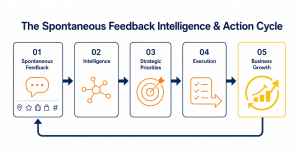
This analysis is part of Yellow Tokens’ broader Spontaneous Feedback Intelligence & Action (SFIA) approach, which links voluntarily published customer feedback with structured intelligence, prioritization and continuous improvement.
Yellow Tokens is now mining the same dataset for additional recurring patterns involving customer expectations, value perception, operational consistency and human support.
More details on Yellow Tokens AI-powered customer feedback analysis and Spontaneous Feedback Intelligence & Action can be found on the company’s website.
ABOUT YELLOW TOKENS
Yellow Tokens is a software company focused on transforming spontaneous public customer feedback into structured intelligence, priorities and action. Its platform combines structured analysis and artificial intelligence to identify recurring patterns, support competitive analysis and help organizations connect customer signals with continuous improvement initiatives.
BRUNO POMERANZ
Yellow Tokens
support@yellowtokens.com
Visit us on social media:
LinkedIn
Instagram
Facebook
YouTube
TikTok
Why it matters: For organizations sifting through customer feedback, this analysis is a reminder that emotional treatment and operational delivery are rarely separate concerns in the customer’s mind. Treating them as distinct could mean missing the very signals that drive trust — or erode it.