The Business Research Company

The Business Research Company’s Employer Fertility Stop-Loss Insurance Global Market Report 2026 – Market Size, Trends, And Forecast 2026-2035
The employer fertility stop-loss insurance space is experiencing notable traction as companies increasingly look for solutions to mitigate the financial uncertainties associated with employee fertility benefits. This market’s trajectory mirrors wider changes in workforce demographics, healthcare patterns, and technological progress that influence how reproductive health is incorporated into corporate benefit structures.
Anticipated Expansion and Market Valuation of Employer Fertility Stop-Loss Insurance
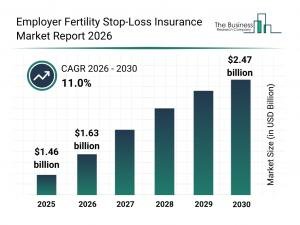
The employer fertility stop-loss insurance market has seen rapid expansion in the recent past, with projections indicating a climb from $1.46 billion in 2025 to $1.63 billion in 2026, reflecting a compound annual growth rate (CAGR) of 11.4%. This growth during the historical period can be attributed to several elements, including rising infertility rates among working-age individuals, a stronger corporate focus on wellness initiatives, broader uptake of assisted reproductive technologies, escalating healthcare expenses, and increased adoption of group health coverage. Going forward, the market is anticipated to sustain its upward momentum, hitting $2.47 billion by 2030, driven by an 11.0% CAGR. Key factors fueling this forecasted growth include the increasing use of fertility benefits for employee retention, growing awareness of reproductive health coverage, the emergence of tailored insurance offerings, the need for cost management in self-insured employer plans, and improvements in predictive health risk modeling.
Access a complimentary sample of the employer fertility stop-loss insurance market report:
https://www.thebusinessresearchcompany.com/sample_request?id=88678940&type=smp&name=Employer%20Fertility%20Stop-Loss%20Insurance%20Market%20Report%202026&utm_source=EINPresswire&utm_medium=paid&utm_campaign=Sep_PR
Defining Employer Fertility Stop-Loss Insurance and Its Role
This market focuses on insurance products designed to shield employers from significant financial burdens related to employee claims for fertility treatments. Such treatments encompass in-vitro fertilization (IVF), egg freezing, and other reproductive health services. By providing coverage that addresses the high costs of fertility benefits, employer fertility stop-loss insurance enables companies to broaden their healthcare offerings to staff while keeping expenditure in check.
Escalating Healthcare Costs as a Key Market Driver
A significant factor accelerating the employer fertility stop-loss insurance market is the persistent rise in healthcare costs. This refers to the gradual increase in expenses for medical procedures, hospital care, pharmaceuticals, and other health services. The growing reliance on assisted reproductive technologies, which frequently involve multiple and complex treatment cycles, is a major contributor to these rising costs. Employer fertility stop-loss insurance helps reduce financial exposure by capping employer obligations and transferring excess expenses to insurers via structured reimbursement models. For example, in May 2026, figures from the US Inflation Calculator showed that average healthcare costs in the United States rose by 2.5% for the year ending in April, following a 3.1% increase in March. This pattern clearly supports the market’s growth trajectory.
Explore the complete employer fertility stop-loss insurance market report:
https://www.thebusinessresearchcompany.com/report/employer-fertility-stop-loss-insurance-market-report?utm_source=EINPresswire&utm_medium=paid&utm_campaign=Sep_PR
Influence of Rising Female Labor Force Participation on Market Demand
The growing number of women in the workforce is another important factor boosting the employer fertility stop-loss insurance market. This increase is driven by enhanced educational access and greater workplace inclusion across various sectors. Employer fertility stop-loss insurance is vital in supporting this demographic by helping firms manage the financial risks of fertility benefits, which supports employee retention and improves access to reproductive care. As reported by the Organization for Economic Co-operation and Development (OECD), as of April 2024, the labor force participation rate for women aged 15 to 64 in OECD countries hit a record 66.6% in 2023, with female employment climbing by 1.0% from 2022 to 63.2%, outpacing the 0.3% growth rate for men. This upward trend in female workforce engagement is directly increasing demand in the fertility stop-loss insurance market.
Telehealth Growth as a Driver for Market Expansion
The swift expansion of telehealth services is also fueling the employer fertility stop-loss insurance market. Telehealth involves delivering healthcare via digital platforms, including video consultations, mobile health apps, and remote monitoring. The growing acceptance of these tools among patients and providers improves the convenience and accessibility of reproductive healthcare. Employer fertility stop-loss insurance facilitates this development by managing the financial risks tied to increased use of fertility treatments made possible through virtual care. For instance, data from the National Center for Biotechnology Information (NCBI) indicated that the share of the U.S. population using at least one telehealth visit rose from 12.05% in 2022 to 12.12% in 2023. This growth in telehealth adoption is contributing to higher demand for fertility-related insurance products.
Regional Insights into Employer Fertility Stop-Loss Insurance
Regarding regional leadership, North America accounted for the largest portion of the employer fertility stop-loss insurance market in 2025. In contrast, the Asia-Pacific region is projected to record the quickest growth rate over the forecast period. The market analysis covers a range of geographic regions, including Asia-Pacific, South East Asia, Western Europe, Eastern Europe, North America, South America, the Middle East, and Africa, offering a thorough perspective on worldwide market conditions.
Recent enhancements to our 2026 reports:
• Market attractiveness scoring and analysis
• Total addressable market (TAM) analysis
• Company scoring matrix graphics and tables
• Excel-based forecasting dashboards
• Market hotspots infographics
• Key technologies and future trend analysis
• Updated graphics and tables
Connect with Our Expert:
Saumya Sahay
Americas +1 310-496-7795
Asia +44 7882 955267 & +91 8897263534
Europe +44 7882 955267
Email: marketing@tbrc.info
The Business Research Company – www.thebusinessresearchcompany.com
Stay Connected With Us On:
• LinkedIn: https://in.linkedin.com/company/the-business-research-company
Oliver Guirdham
The Business Research Company
+44 7882 955267
email us here
Visit us on social media:
LinkedIn
Facebook
X