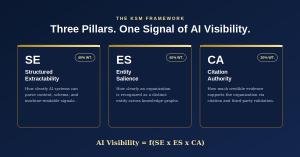
The Knowledge Structuring Model (KSM™) rests on three foundational components: Structured Extractability, Entity Salience, and Citation Authority, each contributing equally with a 40/40/20 weighting.
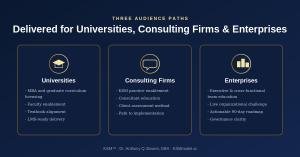
Three distinct delivery channels define the KSM™ Executive Education Program: Universities, Consulting Firms, and Enterprises.
An eight-week practical curriculum brings the Knowledge Structuring Model (KSM) to academic institutions, consultancies, and corporate environments
Businesses don’t require yet another set of AI Visibility, AEO, and GEO jargon. What they require are leaders who grasp how content, technology, identity, authority, governance, and measurement interconnect.— Dr Anthony Q. Bowen
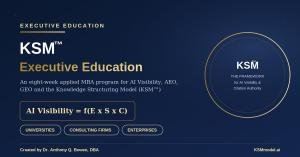
NEW YORK, NY, UNITED STATES, September 16, 2026 /EINPresswire.com/ — KSMmodel.ai, the organization behind the Knowledge Structuring Model (KSM), established by Dr. Anthony Q. Bowen, has unveiled the KSM Executive Education Program, an eight-week applied MBA and executive-level offering designed for executives, consultants, graduate students, and cross-functional leaders crafting actionable AI Visibility strategies and enterprise knowledge preparedness.
Titled “AI Visibility and Enterprise Knowledge Strategy – AEO, GEO and the Knowledge Structuring Model (KSM),” the program draws upon the published Knowledge Structuring Model developed by Dr. Bowen and corresponds with his publication, AI Visibility, AEO and GEO: Understanding the Knowledge Structuring Model.
With artificial intelligence increasingly influencing how organizations get discovered, understood, trusted, recommended, and referenced, leaders must navigate the shift of AI Visibility from an emerging marketing concept into coordinated, enterprise-wide execution.
"What organizations don’t need is another set of AI Visibility, AEO, and GEO catchphrases," remarked Dr. Anthony Q. Bowen, the model’s creator. "What they need are leaders who see how content, technology, identity, authority, governance, and measurement function together. This program equips executives and consultants with a methodical approach to identify the issue, assign accountability, and construct a pragmatic action plan."
The curriculum revolves around three core elements: Extractable Structured Content, which guarantees that organizational knowledge remains accessible and interpretable by AI systems; Entity Salience, which establishes clear and consistent connections across organizations, leaders, products, services, and locations; and Citation Authority, which reinforces the evidence, origin, and third-party endorsements that underpin organizational trust. KSM encapsulates these dynamics through the formula AI Visibility = f(E x S x C).
Participants advance through four phases: Understand, Diagnose, Design, and Execute. Spanning eight modules, they delve into the AI Visibility economy, apply the KSM framework, evaluate structured content, review entity and knowledge graph alignment, investigate citation authority, set up governance and delivery structures, create measurement systems, and craft a senior-level 90-day execution blueprint. The experience wraps up with an Executive Capstone, where participants present a comprehensive AI Visibility strategy to an executive or client panel. The focus is on producing an executive-ready strategy and a 90-day roadmap, rather than merely earning a certificate.
"The goal isn’t just to explain what AEO, GEO, or AI Visibility mean," Dr. Bowen noted. "It’s about enabling leaders to pinpoint what’s broken, what adjustments are required, who takes charge, how to govern the process, and what actions to prioritize in the first 90 days."
The program serves three distinct audiences. Universities can integrate it into MBA and graduate programs via curriculum licensing, faculty training, textbook alignment, applied capstone projects, and LMS-compatible delivery formats. Consulting firms can leverage it to train their teams and adopt a standardized KSM methodology for AI Visibility advisory services, encompassing client assessment frameworks and routes to implementation support. Enterprises can organize private cohorts for executives and cross-functional groups tackling real organizational issues, applying KSM across marketing, technology, content, communications, data, legal, AI, and governance functions to produce a prioritized 90-day plan with clear ownership and metrics.
After finishing the program, organizations can decide whether to handle subsequent implementation in-house, engage consulting partners, use a blended approach, or work with KSM-aligned implementation specialists. Education and implementation remain separate: the program builds the strategic, governance, and decision-making skills needed to steer the work, while implementation and remediation projects are handled independently.
The initiative is rooted in Dr. Bowen’s scholarly work on AI Visibility, Answer Engine Optimization, Generative Engine Optimization, the Knowledge Structuring Model, and Enterprise Knowledge Readiness for Agentic AI, all published on SSRN. KSM was created as a socio-technical framework that explains how organizations can boost their chances of being interpreted and cited by AI systems through improved knowledge architecture, entity clarity, and authority indicators.
Universities, consulting firms, and enterprises seeking curriculum licensing, practice enablement, private cohorts, or organizational delivery can request program details at https://ksmmodel.ai/executive-education. Further information on the Knowledge Structuring Model can be found at https://ksmmodel.ai.
Dr. Anthony Q. Bowen is the architect of the Knowledge Structuring Model, a corporate AI strategist, academic, researcher, and author specializing in the convergence of AI Visibility, enterprise knowledge strategy, marketing, technology, and organizational change. His efforts center on guiding organizations away from document-centric digital approaches and toward structured, entity-focused knowledge systems that support AI-driven discovery and the rise of agentic AI technologies.
Dr Elinor Garely
KSMModel.ai
+1 2126824499
email us here