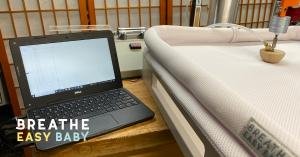
Breathe Easy Baby™’s breathable crib mattress is engineered to encourage air circulation and assist in lowering concerns about CO₂ rebreathing and airflow resistance, contributing to a more secure infant sleep setting.
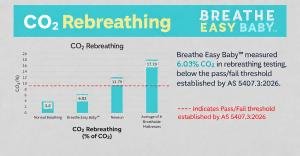
CO₂ rebreathing test outcomes comparing Breathe Easy Baby™ with alternative breathable surfaces and the pass/fail criteria of Australia’s AS 5407.3:2026 standard.
Infant sleep company challenges “breathable” mattress claims lacking measurable proof and encourages parents to ask: How was the mattress actually tested?
Parents should ask whether their baby’s mattress is safe if their face comes into contact with it. Parents deserve more than reassuring marketing language. They deserve measurable scientific evidence.”— Kelly Obriot, Founder, Breathe Easy Baby™DETROIT, MI, UNITED STATES, September 15, 2026 /EINPresswire.com/ — Each evening, countless parents lay their infants down in a crib, switch off the light, and step away, confident that the mattress beneath their child offers a secure and suitable rest surface.
Breathe Easy Baby™ holds that parents should feel empowered to pose a straightforward query about that trusted mattress: Is your baby’s mattress genuinely safe—and what scientific proof supports the safety and performance assertions made about my child’s crib mattress?
In 2024, roughly 3,400 infants died suddenly and unexpectedly across the United States, as reported by the Centers for Disease Control and Prevention. These fatalities encompassed SIDS, accidental suffocation, strangulation, and cases where the cause remained undetermined.
Those figures highlight the urgency of a wider dialogue on crib mattress safety. Rather than asking parents to trust terms like breathable, comfortable, or safe, Breathe Easy Baby™ directs its consumer outreach toward evidence-based research, quantifiable testing, and demonstrated results.
The Breathe Easy Baby™ crib mattress system was specifically designed to tackle two critical sleep-surface issues associated with infant suffocation risk: (1) carbon dioxide rebreathing and (2) airflow resistance.
The Breathe Easy Baby™ crib mattresses have undergone independent scientific evaluation for CO2 rebreathing, CO2 dissipation, airflow resistance, firmness, temperature regulation, and surface pressure.
Why CO₂ Rebreathing and Airflow Resistance Both Matter
When an infant's face lies in close proximity to a sleep surface, exhaled breath can linger near the nose and mouth and be drawn into the bedding. If that air is not effectively dispersed, some may be breathed back in — a condition termed CO2 rebreathing. Elevated airflow resistance can also impede how readily air moves against or through the sleep surface, increasing the difficulty for an infant to breathe.
Australia has recently introduced a new regulation, AS 5407.3, marking the world's first CO2 rebreathing standard for infant sleep products. Breathe Easy Baby’s breathe-safe mattresses meet this standard, offering parents and professionals a concrete method to assess airflow and rebreathing claims rather than depending solely on marketing terms.
Rather than asking, “Is this mattress breathable?” consider asking: “Has this mattress actually been tested for ease of breathing and CO2 rebreathing risk?”
A Safety Discussion That Has Barely Evolved in Decades
The track record of infant sleep product safety reveals why specific hazards warrant specific examination. Over the last 30 years, numerous infant items have been recalled or withdrawn following links to infant suffocation. An American Academy of Pediatrics report attributed 158 infant deaths to inclined sleepers from 2009 through 2023. Nearly 30% had been placed on their backs but were discovered unresponsive on their stomach or side. In another instance, the AAP advised parents to discontinue use of an infant lounger connected to the deaths of two babies. These examples demonstrate that product-specific evidence can trigger warnings, recalls, standards, and legislation.
In 2022, the United States enhanced crib-mattress regulations by adopting the Australian crib mattress firmness standard, AS/NZS 8811.1, yet there remains no equivalent U.S. CO2 rebreathing standard. Australia has pursued a more specific strategy with a test centered on CO2 rebreathing performance.
The American Academy of Pediatrics' Back to Sleep campaign significantly lowered SIDS rates during the 1990s, and Breathe Easy Baby™ endorses established safe-sleep practices, including placing babies on their backs on a firm, flat sleep surface. Safe-sleep guidance should also incorporate questions about how the sleep surface itself functions when a baby's face makes contact with it.
"Parents are repeatedly told how to put their baby to sleep, but very few are ever advised to ask whether their baby’s mattress is safe if their baby's face comes into contact with it. We believe parents deserve more than reassuring marketing language. They deserve measurable scientific evidence."
— Kelly Obriot, Founder, Breathe Easy Baby™
From Baby-Product Marketing to Scientific Proof
Breathe Easy Baby™ is intentionally shifting away from conventional baby-product advertising that relies on smiling infants and doting parents. In their place are graphs, charts, and scientific testing intended to present parents with measurable details about mattress performance and its possible safety and health advantages.
The Breathe Easy Baby™ crib mattresses have undergone extensive voluntary scientific testing. In collaboration with Mike Leshner, forensic engineer and internationally recognized safe-sleep expert, Breathe Easy Baby™ has evaluated its mattress system across various performance areas. Lesher’s Baby Breathing Lab, https://babybreathinglab.com, has performed numerous tests on our Breathe Easy Baby™ mattress products, confirming their enhanced safety and health benefits for infants. Our website states that our mattresses are the Gold Standard of safe sleep, and we have the scientific evidence to support that claim. The principle is clear: If manufacturers make infant-safety assertions, parents should be able to view the evidence behind them.
SIDS is multifaceted, and no mattress can ensure that SIDS will not happen, and Breathe Easy Baby™ is not asserting that all traditional crib mattresses are inherently unsafe; its purpose is to address specific sleep-environment hazards such as infant suffocation— especially CO2 rebreathing and airflow resistance — while fitting into a broader safe-sleep framework.
That distinction is essential. The objective is not to alarm parents. It is to provide them with a scientifically grounded option for establishing a safer sleep environment and greater peace of mind while their baby rests.
“Every parent knows what it feels like to quietly walk into the nursery and check whether their baby is breathing. We can’t remove every fear that comes with becoming a parent. But if better engineering can reduce a known sleep-environment risk, parents deserve to know that option exists.”
— Kelly Obriot, Founder, Breathe Easy Baby™
For Breathe Easy Baby™, the overarching message is straightforward: infant sleep safety should be measured and verified, not presumed.
About Breathe Easy Baby™
Breathe Easy Baby™ is a Southeast Michigan, Detroit-based infant sleep company dedicated to advancing crib mattress design safety through evidence-based science and testing. The Breathe Easy Baby’s mattress sleep system is designed to promote airflow and help reduce CO2 rebreathing and airflow-resistance concerns. Its breathe-safe mattresses comply with Australia's AS 5407.3 CO2 rebreathing standard.
For product details and infant safe-sleep education, visit https://breatheeasybaby.com.
Kelly Obriot
Breathe Easy Baby™
+1 313-405-2943
kelly@breatheeasybaby.com
Visit us on social media:
LinkedIn
Instagram
Facebook
YouTube