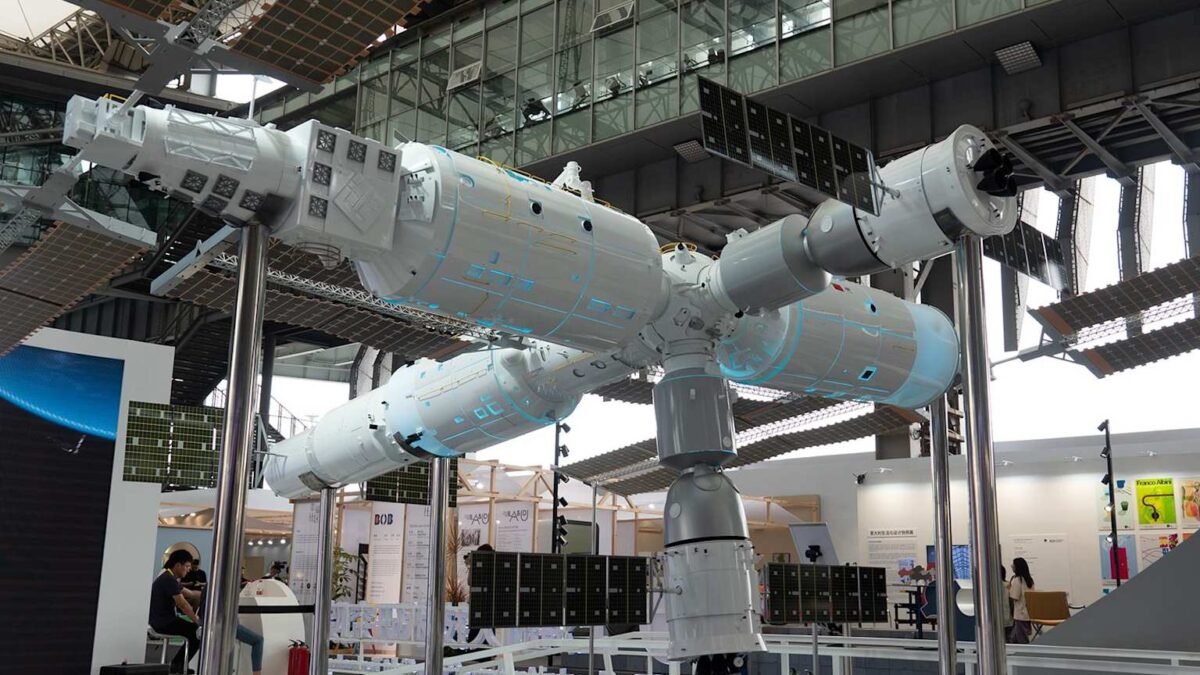
China has officially confirmed that it will more than double the size of its Tiangong space station, evolving the orbital outpost from a three-module T-shaped structure into a six-module cross-shaped complex with a total mass of roughly 180 metric tons, according to state broadcaster CCTV.
The announcement comes at a pivotal moment for low Earth orbit. NASA is preparing to retire the International Space Station in early 2031, a move that would leave Tiangong as the only continuously crewed facility orbiting the planet.
A New Multifunctional Hub in Orbit
The plan calls for adding a fourth module—a multifunctional extension to the existing Tianhe core—that will dock to the station’s forward port. This addition will reshape the station’s silhouette from a T into a cross. The new module will provide several docking ports, including connections for two future laboratory units, paving the way for the eventual six-module configuration.
Launch duties for the expansion module are expected to fall to the Long March 5B, China’s heaviest operational rocket, capable of delivering more than 22 metric tons to low Earth orbit. A recent patent filing pointed to upgrades being made to the rocket to handle the larger station hardware.
While Beijing has not published an official timeline, a 2023 roadmap suggested expansion work would begin around 2027. A rocket designer at the China Academy of Launch Vehicle Technology described an upcoming station mission as potentially “the most valuable space station project in the history of science,” and indicated it would be flown atop the Long March 5B in 2027.
Opening Up to International Partners
Alongside the physical buildout, China is opening Tiangong’s hatch to foreign astronauts. On April 22, the China Manned Space Agency announced that two Pakistani Air Force pilots—Muhammad Zeeshan Ali and Khurram Daud—had been picked as reserve astronauts and would soon travel to China for training. One of them is expected to fly to Tiangong as a payload specialist, becoming the first non-Chinese astronaut to live aboard the station.
Astronauts selected from Hong Kong and Macao as part of China’s fourth astronaut batch are also lined up for their first missions, possibly as soon as this year. The agency has signaled that it will continue expanding cooperation with the United Nations Office for Outer Space Affairs as well.
A Race Against the ISS Clock
The expansion takes on extra significance as the ISS approaches retirement. NASA plans to use a dedicated deorbit spacecraft—being built by SpaceX—to guide the 420-ton ISS into a controlled re-entry over the South Pacific. Even at 180 metric tons, an expanded Tiangong will still be less than half the ISS’s mass, but it should be able to host a permanent crew of six—just one shy of the ISS’s standard seven.
China’s 2026 spaceflight calendar is already packed, with two crewed Shenzhou missions, a cargo resupply run, the Chang’e-7 lunar probe, and flight tests of several reusable rockets on the manifest. Whenever the Tiangong expansion lifts off, it will mark the next chapter for a program that has moved from concept to continuous human presence in only about five years.