Researchers at the University of Pennsylvania’s School of Engineering have introduced a new artificial intelligence technique they call “Mollifier Layers,” aimed squarely at one of science’s most stubborn mathematical hurdles: inverse partial differential equations (PDEs). Published in Transactions on Machine Learning Research and scheduled for presentation at NeurIPS 2026, the approach delivers a faster and more stable way to work backward from observed patterns to uncover the hidden dynamics that produced them.
A Smarter Mathematical Strategy
Inverse PDEs show up everywhere from genetics to climate science, but they have long been bogged down by recursive automatic differentiation, the conventional computational tool that becomes unstable and memory-hungry when faced with higher-order equations and noisy data. Instead of throwing more compute at the problem, the Penn team turned to an idea from the 1940s—mollifiers, the smoothing functions originally described by the German-American mathematician Kurt Otto Friedrichs.
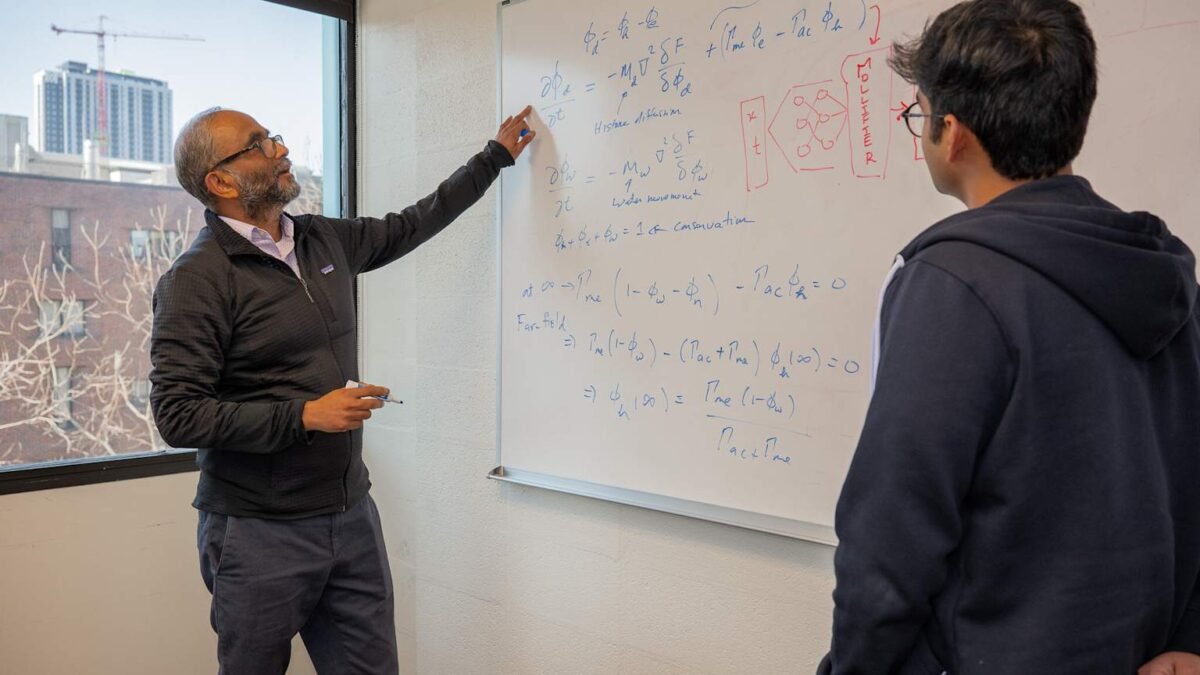
“Solving an inverse problem is like looking at ripples in a pond and working backward to figure out where the pebble fell,” explained Vivek Shenoy, the Eduardo D. Glandt President’s Distinguished Professor in Materials Science and Engineering and the senior author of the study. The challenge, he noted, is not seeing the effects but inferring the cause behind them.
The mollifier layer plugs into the output layer of a neural network, replacing recursive differentiation with a single convolutional operation. The result: training time and memory consumption drop by roughly six to ten times, while accuracy actually improves. Co-first author Ananyae Kumar Bhartari, a graduate of Penn Engineering’s Scientific Computing master’s program, recounted that the team initially blamed the neural network’s architecture before tracing the bottleneck back to differentiation itself. The new method, he said, lets them solve these equations more reliably without the heavy computational cost.
From Chromatin Biology to Climate Modeling
For the Shenoy Lab, the most immediate use case is chromatin biology, where understanding how tiny 100-nanometer folded-DNA domains regulate gene expression is critical. Mollifier Layers can help infer the epigenetic reaction rates that drive these processes, opening the door to dynamic modeling of how chromatin reorganizes during aging, cancer, and development—rather than relying on static microscopy snapshots.
Co-first author Vinayak Vinayak, a doctoral candidate in materials science and engineering, suggested that if reaction rates govern chromatin organization and cell fate, then changing those rates could in principle redirect cells toward desired states. The framework’s reach extends well beyond biology, with strong potential in materials science, fluid mechanics, and weather forecasting—essentially any field where higher-order equations and noisy data collide. As Shenoy summed it up, knowing the rules that run a system opens up the real possibility of changing it.