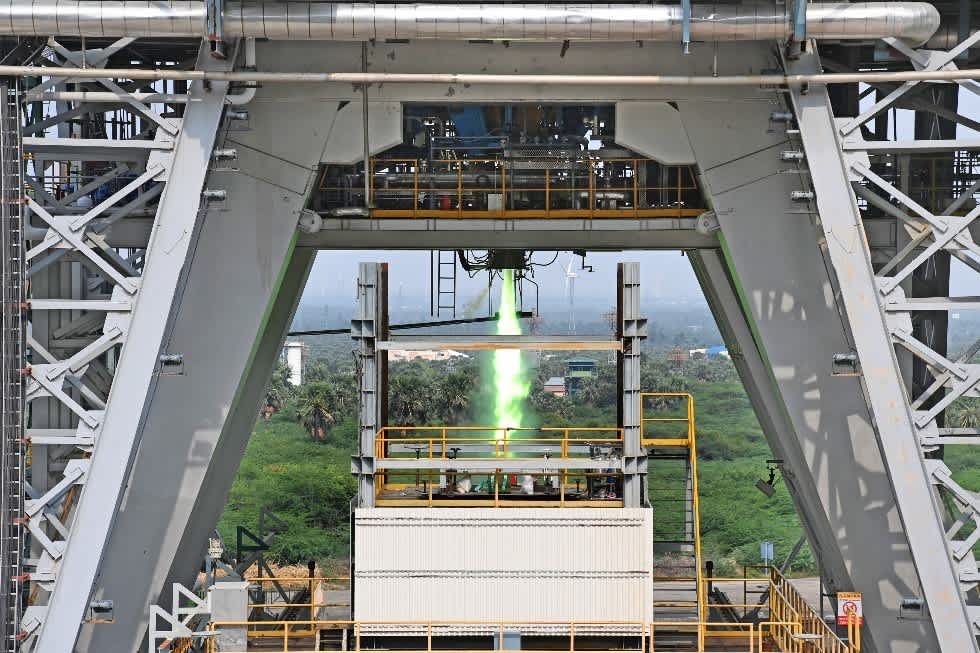
India’s space program may soon receive a significant technological boost. The Indian Space Research Organisation (ISRO) has been holding in-depth technical talks with Russia’s Roscosmos in Moscow regarding the procurement of advanced semi-cryogenic engines, with a draft contract reportedly nearing approval. The development was disclosed in ISRO’s Annual Report 2025-26, released earlier this week.
A Critical Step Toward Heavy-Lift Capability
Semi-cryogenic propulsion is at the heart of India’s vision for next-generation heavy-lift rockets. These engines, which burn refined kerosene with liquid oxygen, deliver substantially higher thrust and efficiency compared to ISRO’s current liquid propulsion systems. The new SC120 stage, powered by the 2,000-kilonewton SE2000 engine, is intended to replace the L110 core liquid stage on the LVM3 rocket. The upgrade would push the LVM3’s payload capability to geostationary transfer orbit from four tonnes up to five tonnes, a meaningful jump for India’s launch market.
ISRO has been candid about how demanding this development is. In a statement issued in March 2025—after the agency successfully completed the first hot test of its Engine Power Head Test Article at the Mahendragiri propulsion complex in Tamil Nadu—officials acknowledged that building an engine of this thrust class is extremely difficult and is a capability currently held by only a handful of countries.
Two Tracks Running in Parallel
While the Liquid Propulsion Systems Centre continues to advance India’s homegrown SE2000 program, the cooperation with Roscosmos is expected to speed up timelines and help close any remaining technology gaps. Although the annual report didn’t reveal a specific schedule for finalizing the contract or delivering the engines, the fact that talks have advanced to a draft contract suggests negotiations are well past the early stages.
The semi-cryogenic discussions are part of a broader strengthening of India-Russia space cooperation. The same report noted that approvals were granted in April 2025 to push forward joint work with Roscosmos on the Venus InfraRed Atmospheric gases Linker payload, which is being developed for India’s upcoming Venus Orbiter Mission.
Why This Matters for India’s Space Ambitions
If the agreement is signed, ISRO would gain access to mature Russian propulsion technology while continuing to develop its own engine in parallel. Combined with the indigenous SE2000 effort, this dual approach could place India among an elite group of nations capable of fielding high-thrust semi-cryogenic propulsion—an essential capability for launching heavier payloads, executing deep-space missions, and developing future reusable launch systems.