
AI Visibility
A fresh publication addresses AI visibility. The AI Visibility SEO & GEO Playbook outlines methods for maintaining visibility via Generative Engine Optimization (GEO) and SEO.
DUBAI, DUBAI, UNITED ARAB EMIRATES, August 4, 2026 /EINPresswire.com/ — For two decades, the arrangement in search was straightforward: a company secured a spot on Google, gathered clicks, and turned a portion of them into conversions. That arrangement is now unraveling. The AI Visibility SEO & GEO Playbook: Building AI Visibility with Search Engine Optimization (SEO) and Generative Engine Optimization (GEO), authored by Syntharis Group CEO PhDr. Oliver Scharfenberg, contends that the critical question in search is no longer whether a company ranks, but whether it shows up in the single answer an AI assistant now delivers to the reader — a challenge the book labels AI visibility.
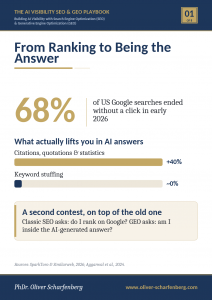
This transformation is measurable. By early 2026, roughly 68 percent of Google searches in the United States concluded without a click to any website, climbing from about 60 percent two years prior, based on data from SparkToro and Similarweb cited in the book. Google’s AI Overviews now frequently sit above the traditional list of results and often cite sources that never made it to the first page of standard search. Ranking well, Scharfenberg argues, is no longer synonymous with being seen.
“Securing the top ranking no longer guarantees your presence in the discussion,” Scharfenberg stated. “People stopped scrolling through links and began reading a single response that mentions only a few sources. If your brand is not among them, you become invisible at the precise moment a purchasing decision is being made.”
The book assigns a name to this second competition that is gaining traction in marketing: Generative Engine Optimization, or GEO — a practice the book points out was previously called answer engine optimization (AEO). Scharfenberg defines it as the systematic effort of shaping a company’s content, its entity, and the third-party references surrounding it so that AI systems correctly ingest, cite, and recommend the brand. He frames GEO as an extension of search engine optimization, not a substitute: where SEO renders content findable, GEO renders it usable — simple for a machine to extract, easy to verify, and linked to a brand the system already acknowledges.
The distinction is backed by research. In one controlled study, incorporating citations from trustworthy sources, credible quotes, and relevant statistics boosted a page’s visibility within generative answers by up to roughly 40 percent, while keyword stuffing had almost no effect (Aggarwal et al., 2024). In an AI response, Scharfenberg contends, the optimal approach is to be the clearest and most authoritative expression of an idea, not the one that repeats a term most frequently.
Much of the playbook translates this concept into routine practice. It introduces a pre-publication checklist the author calls the 5C Test — evaluating whether a page is clear, credible, citable, consistent, and connected. It explores entity optimization, helping search and AI systems recognize a company as a distinct, reliable entity rather than a mere string of words. A full chapter is devoted to E-E-A-T — the experience, expertise, authoritativeness, and trust signals that determine which sources a machine will reference. It also redefines visibility around three concepts: presence, trust, and influence, the last of which, the author notes, companies consistently fail to measure.
Spanning fourteen chapters, the book moves from the basics of search in 2026 through GEO strategy, entity optimization, and reputation management, culminating in a twelve-month roadmap that merges SEO and GEO into a single workflow. It includes applied case studies covering ten business types — from a local service provider and a B2B consultancy to a SaaS company, a healthcare provider, a hotel, a university, and a financial services firm — plus appendices: templates and worksheets, a working glossary, fifty prompts for monitoring how AI tools describe a brand, and one hundred AI visibility prompts for auditing a company’s presence.
Scharfenberg brings an unusual blend of experience to the topic. He serves as CEO of Syntharis Group and assists businesses in enhancing their digital visibility. The AI Visibility SEO & GEO Playbook is accessible on Amazon. Additional details can be found at https://www.amazon.com/author/phdr-oliver-scharfenberg As chief execut
Oliver Scharfenberg
Syntharis Group FZCO
+1 484-473-1088
email us here